
Despite being a significant economic resource, UK universities are the country's "equivalent of Gulf oil"
Investors can find opportunities here, according to Terry Tanaka.
For UK-listed companies, the past 20 years have been difficult. HSBC, Shell, and BP are no longer among the biggest listed corporations in the world. AstraZeneca, currently the biggest company in Britain, does not even rank in the top 40 worldwide. At the same time, British universities' reputations have taken a different turn. Robin Bagchi, the chairman of the London Technology Club, notes that "more universities are in the global top 10 now than we had 20 years ago." The head of Sarasin Bread Street, James Witter, claims that UK universities "continue to punch well above their weight in terms of producing world-leading research," which is a significant economic asset. Universities in the UK have produced more than 2,000 active start-ups. The statement that British academia is "our equivalent of Gulf oil" by a sovereign-wealth investor is not surprising...
Leading universities in the UK's "golden triangle."
The CEO of Oxford Science Enterprises, Ed Bussey, claims that "incredible institutions that are focused on applying science and technology to solve fundamental problems" are the cornerstone of such economic excellence. He ranks Oxford University as the most prestigious of these establishments, citing the university's reputation as a top research university and its history of winning over 70 Nobel prizes across a variety of fields. I'll be in line at lunch, and the person behind me will be a world leader in this field. When I'm walking back to the office, someone who won a Nobel Prize in another field will pass me.
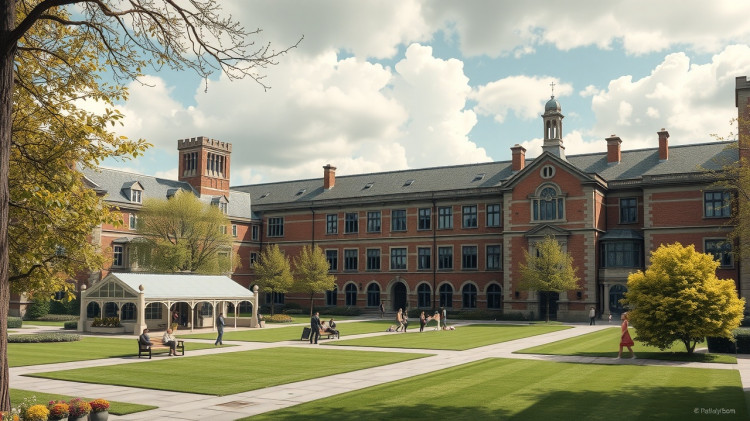
Located in Oxford, Oxfordshire, UK, Oxford University features a historic courtyard with a fountain.
An atmosphere that is valued more than the sum of the individual academics involved can be produced by such a concentration of eminent scholars. An environment that is "cosmopolitan and multinational" "attracts other great minds" and many investors who are willing to invest in early-stage businesses based on Oxford research. As a result, a "virtuous circle" is created in which the caliber of research draws funding, which in turn draws in more gifted scholars to Oxford.
Cambridge Innovation Capital's managing partner, Andrew Williamson, highlights the university's heritage and reputation as a key differentiator in luring top scientists. He claims, "We've been doing this for longer than almost anyone else in the entire world, as we've been around for almost 800 years." Utilizing its infrastructure and "cutting-edge science" culture, it has established connections between "the academic world, the start-up world, and the biggest global technology companies."
In British academia, there are other outstanding universities besides Oxford and Cambridge. More often than not, commentators refer to the "golden triangle" of Oxford, Cambridge, Imperial, and UCL instead of just "Oxbridge." In fact, Bagchi points out that "some recent rankings put Imperial College London near the very top of the global table, ahead of Oxford, Cambridge, and Harvard" in the field of science, technology, engineering, and mathematics (STEM). DeepMind is one of the many intriguing spin-outs that University College London has successfully developed.
Universities outside of the golden triangle in the UK.
According to Doug Quinn, partner at DSW Ventures, "some really great science coming out of the other UK universities" is also happening, even though the golden triangle is perhaps the most obvious symbol of British scientific excellence. There are important specialized labs at other UK universities that perform better than the general laboratories in the golden triangle institutions, as Quinn's colleague Mira Androniciuc points out. "It is evident that opportunities exist. But regrettably, there isn't yet a robust pipeline of new businesses being created by these. Only 250 early-stage investments were made in other universities in 2024, compared to about 600 in the golden triangle. According to Quinn, the regions only receive about 5% of the total investment made in the golden triangle. However, the disparity is mostly the result of inexperience and should close as more deals are made by teams outside of London and Oxbridge. Manchester University has already produced over 100 spin-outs and has a reputable technology transfer office.
According to Northern Gritstone CEO Duncan Johnson, a "Northern arc" is in fact beginning to take shape as a significant challenge, spearheaded by the four universities of Sheffield, Leeds, Manchester, and Liverpool. Compared to Oxford, Cambridge, and London, these four universities alone employ about 16,500 researchers and have the largest research budget in the UK, at about 770 million, according to Johnson. Northern Gritstone has successfully raised 362 million dollars from individuals and institutions, giving it first dibs on the commercial opportunities resulting from research by the Northern Arc.
The University of Southampton is a leader in quantum and high-performance computing, the University of Glasgow is a leader in chemistry, and Edinburgh is a leader in robotics, according to Henry Lane Fox, CEO of Founders Factory and chairman of the Creator Fund. Approximately one-third of the deals that Lane Fox and his team ultimately invest in and about half of the deals they assess originate from sources outside the golden triangle, "and both numbers are growing."
Lane Fox is so excited about the caliber of academic research in the UK that his Creator Fund is now focusing on doctoral students at UK universities in an effort to identify the most intriguing idea before his rivals do. In a similar vein, Chris Wiles, a partner at Foresight Group, has established a network of regional offices in Exeter, Cardiff, Manchester, Leeds, and Edinburgh. The UK government-funded research institutes that are not connected to any particular university, such as the Harwell Science and Innovation Campus in Oxfordshire and the UK Atomic Energy Authority's (UKAEA) nuclear research facility at Culham Campus, are another source of top-notch research.
Reevaluating commercialization in higher education in the UK.
In addition to generating some of the world's best research, British universities are generally far more adept than they were even a few decades ago at converting their findings into businesses and goods. Williamson asserts that "every university in the world is on a journey when it comes to commercialization." The UK government has specifically worked to encourage universities to make "knowledge transfer" and commercialization central to their missions over the past 20 years. Universities first established knowledge-transfer offices, primarily concentrating on technology licensing. This model has changed over the last ten to twenty years, and it currently generates spin-out businesses based on the technologies developed by academics. Due to their increased entrepreneurial spirit, academics and students "want to set up their own firms to commercialize their tech, rather than stay as academics and simply license it to third parties."
The CEO and founder of radiation-detection technology company Kromek, Arnab Basu, concurs that things have improved. Two decades ago, when he founded Kromek based on research he had pioneered at Durham University, "spin-outs were not the rage, and we had to do everything ourselves, from agreeing a licensing agreement with the university to finding investors and then raising additional funds." The network of resources available to entrepreneurs today, including capital and guidance, is far more advanced. Numerous smaller universities have also come to the realization that collaborating with other like-minded organizations is a smart way to rapidly acquire experience.
David Grimm, a partner at AlbionVC, claims that over the past 15 years, attitudes in academia have changed. Previously viewed as "a bit grubby and commercial," starting a start-up is now practically a requirement for becoming a professor. According to the most recent report on spin-outs, which was created in collaboration with analytics firm Beauhurst, investment in UK spin-outs hit a record £3.35 billion in 2024. As noted by Parkwalk Advisors' Moray Wright, this is comparable to £1.16 billion in 2019.
Cutting back on the "university tax".
However, just because UK universities have improved doesn't mean that there isn't still much space for growth. The desire of universities to hold onto as much of the spun-out company as possible was mentioned by almost all of the venture capitalists that BFIA spoke with as a major issue. According to James Paton-Philip, partner in the corporate team at the law firm Hill Dickinson, it is understandable for institutions to seek the best return for what is, after all, their intellectual property. However, too frequently, this "university tax" can make investing unappealing to investors and the people who founded the company in the first place, especially since the founders' stake will ultimately be further diluted as they raise more money.
Grimm acknowledges that universities often negotiate too aggressively and take too long to come to a consensus, which can be a big issue in the rapidly evolving technology sector where a number of companies are vying for market share. "In a number of significant instances, start-up concepts have failed on the launch pad because the negotiations became so complex that the opportunity had already passed by the time they were resolved.
The good news is that government pressure to standardize terms and lower the share institutions demand is making this a much less problematic issue. Grimm claims that the 2023 Independent Review of University Spin-outs has aided in accelerating the procedure. AlbionVC, for instance, has a deal with UCL whereby the university will invest a fixed 5% of any software start-up that emerges from it. It took a lot less time to establish the first business that AlbionVC spun out under the new circumstances. "This is not unique to UCL," Bagchi says. Oxford has cut its stake in its spin-outs by more than half, from 50% to 20%, while Imperial now receives a flat 10% share.
Microsoft from Britain is on its way.
According to Greg Smith, CEO of IP Group, the UK may be "world class at research, and very good at creating early stage companies, but there is still room for improvement when it comes to scaling up." Northern Gritstones Johnson concurs that our technology industry still "struggles" to raise significant funds for growth. From his own experience, he has discovered that while Silicon Valley tech companies can raise such amounts with a single phone call, British tech companies still find it difficult to raise amounts around £200 million.
According to Wright, UK start-ups are frequently forced to rely on foreign investors or sell themselves to larger US tech companies due to a lack of domestic capital willing to support tech firms. He makes it clear that while this kind of investment shows faith in the UK research base's abilities, larger tech companies and outside investors "have their own agendas, which don't necessarily align with the interests of the UK." As an example, he cites DeepMind, an AI spin-out from UCL that Google purchased for £400 million in 2014 and that "would now be worth more than 10 billion, maybe even more than 100 billion, if it had remained private."
It is possible that Britain lost its own OpenAI due to Google's acquisition of DeepMind. However, the fact that it and other companies, like Oxford Ionics and OrganOx, have made "significant sums" will "undoubtedly draw more interest into this area, and encourage more university researchers to launch commercial enterprises," according to Sarasins James Witter.
In the UK, these achievements are also contributing to the development of the required environment "of investors, lawyers, and financial services intermediaries." According to Paton-Philip, "there is no reason" why we cannot establish a British tech company comparable to Microsoft, given that pension funds and other institutions are prepared to make greater investments. Smith says "unequivocally" that a number of sizable British tech companies will appear in the upcoming ten years. Below, we examine some of the most promising assets to invest in.
Where can I invest in spin-outs from UK universities?
Investors with substantial financial resources can access venture-capital trusts through firms like Oxford Capital, Parkwalk Advisors, Foresight Group, and AlbionVC. Those with less money might want to look into IP Group (LSE: IPO), a FTSE 250 listed business that has spent the last 25 years investing in spin-outs from UK universities. An estimated 10,000 jobs have been created by the 500 businesses it has helped over this time. The group's portfolio currently consists of 62 companies in the fields of life sciences, "deep technology," and clean energy technology (cleantech). At a steep discount to the book value of its assets, the stock is trading at just seven times projected 2026 earnings.
Ceres Power (LSE: CWR), a company that develops fuel cell and hydrogen power technologies, was one of IP Group's most profitable clean technology investments. Initially originating from Imperial College London, IP Group intervened to save the business following a botched trial, actively participated in its administration, and ultimately sold its interest for a substantial profit in 2020. Although Ceres Power is currently losing money, it is still growing and is predicted to benefit greatly from the surge in demand for clean energy brought on by the data center boom. Sales are expected to triple between 2019 and 2024.
Among the numerous success stories of Cambridge Innovation Capital is Bicycle Therapeutics (Nasdaq: BCYC). In order to create medications that can target and treat solid tumors that traditional medications are unable to reach, it was established in 2009 by Cambridge Enterprises, Cambridge's commercialization body. Greg Winter, the 2018 Nobel Prize winner for chemistry, developed the technology. Although it is not yet profitable, it is developing a number of promising medications. Of these, zelenectide is the most advanced; it is undergoing advanced clinical trials to treat metastatic urothelial cancer, with the hope that it will also be successful in treating other cancers.
UCLB (UCL's commercialization arm) assisted Martin Pule, who heads the "CAR-T" research program at UCL's Cancer Institute, in founding Autolus (Nasdaq: AUTL). White blood cells are altered by its products to aid the body's immune system in combating cancer. Though the company is losing money, its treatment Aucatzyl was recently approved for use in the US, UK, and EU to treat acute lymphoblastic leukemia. It is hoped that this will open the door for similar treatments to be approved for a larger range of cancers in the near future.
As mentioned in the main story above, Arnab Basu was the one who initially spun out Durham University to form Kromek Group (Aim: KMK). For use in security and medical applications, the company specializes in producing radiation detectors that employ cadmium zinc telluride (CZT) semiconductors. In addition to developing biological pathogen detection devices with funding from the US and UK governments, the company has already signed contracts with GE, Siemens, Philips, and Canon. The stock is trading at eighteen times the projected earnings for 2026. Given that revenue more than doubled between 2020 and 2025, that appears to be a good deal.
Consider investing in micro-cap Quantum Base Holdings (Aim: QUBE) if you have a very high risk tolerance. Robert Young of Lancaster University founded it, and it creates product codes that are nearly impossible to fake using quantum technology. The commercial potential appears to be enormous, despite the fact that the company is currently losing money, given that counterfeiting is a major issue for global brands.






Leave a comment on: How to turn research into profits when investing in UK universities