
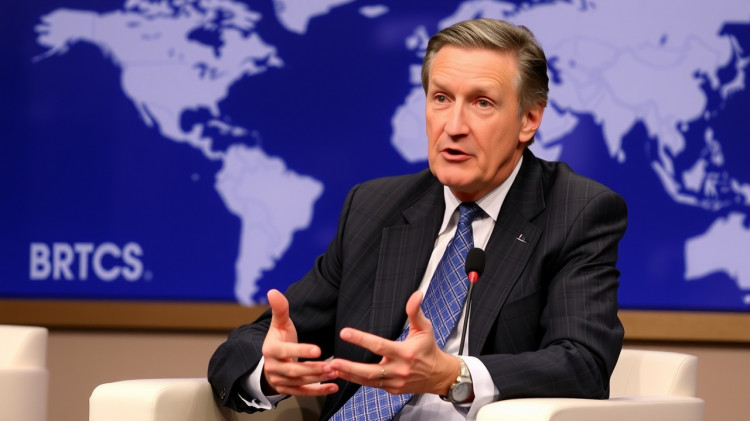
Jim O'Neill, who created the acronym BRICS in 2001, updates BFIA on the group's development
Terry Tanaka: Since you first used the term "BRICS" to refer to Brazil, Russia, India, and China almost 25 years ago, the four countries have followed quite different paths. Which has been the most successful, in your opinion, and why?
Jim ONeill: Certainly China. China has simply outperformed the other three nations, despite the difficulties they have faced since 2015. I recall that the original research note included a graph that showed when each of the BRICS could surpass their G7 counterparts using racing cars. In the beginning, China was expected to surpass Japan by 2030. In fact, by 2010, it had done so, and as of right now, China is twice the size of the other BRICS combined and four times larger than Japan.
Terry Tanaka: How did it do that?
Jim ONeill: The Chinese leadership has adopted a very long-term perspective on their goals by utilizing the stability afforded by their political system. Even their five-year plans include many longer-term objectives, as evidenced by their significant investment in the rail network and the shift to electric vehicles. For example, they set a goal for themselves in 2020 to double GDP per capita by 2035. They will undoubtedly succeed in doing so.
Terry Tanaka: Doesn't Russia's example demonstrate that stable political systems don't always result in prudent decision-making?
Jim ONeill: The so-called "commodities curse" affects both Russia and Brazil. I cautioned in 2001 that both nations would need to find a way to avoid becoming lazy like other commodity-rich nations that neglected to diversify their economies or consider innovation because they were so rich in natural resources.
And the post-Soviet era's widespread corruption and state capture, along with the startling misallocation of funds allocated to the bloody conflict in Ukraine, are examples of this. Our attempts to integrate Russia into the global communityincluding growing the G7 to become the G8proved to be incredibly foolish.
Terry Tanaka: Do you think the most recent agreement between the United States and China represents a real turning point in the trade war, or is it merely a stopgap?
Jim ONeill: I hope I'm mistaken, but I lean toward the latter. China's enormous population means that if it can double its GDP per capita by 2035, it will eventually surpass the United States in terms of GDP. As evidenced by its rage in the 1980s when it appeared that Japan would become a significant rival, the US will not like this because it is obsessed with being the biggest.
But over the past few years, I've noticed a growing awareness that the US cannot exert the same level of pressure on China as it has on every other nation. Unfortunately, since the US and China have contributed 80% of the global GDP growth since 2000, I am skeptical that this will result in a lasting improvement in relations.
Terry Tanaka: Does China have the potential to become trapped in the middle-income trap, where growth slows to a crawl before reaching the level of a fully developed nation?
Jim ONeill: China undoubtedly has issues and must keep up its reforms. The demographics of the real estate industry have peaked, which is concerning. Additionally, since the cities still have a two-tiered social structure, it must grant complete rights to those who have moved from rural to urban areas. The fact that those individuals lack land or property and are unable to purchase either is one reason the domestic savings rate is so high.
But it's possible that Chinese productivity is increasing. I recently read that exports to the global South are increasing significantly while exports to the US are decreasing by about 10% annually as a result of tariffs. Twenty percent of the world's manufacturing is currently produced in China. Most significantly, it is moving up the value chain and is no longer merely dependent on using cheap labor to produce low-quality goods.
Terry Tanaka: How about India?
Jim ONeill: India is such a complicated, fascinating country. It is rapidly urbanizing and in a demographic sweet spot. When I visited last year, I was pleasantly surprised by the significant advancements in urban transportation and infrastructure, including significantly better roads and airports. Additionally, low-income individuals and those living in rural areas now have easier access to financial products and public services thanks to digitization. You could even argue that 25 years ago, China was in India.
However, as China did at the same stage, India should be able to grow by 10% annually. The Indian leadership needs to make a few very clear, significant changes. For instance, there are still 300 million people who are illiterate, and agriculture is rife with waste and inefficiency. Additionally, China is fiercely protective of many of its industries, erecting various obstacles to foreign investment and competition.
Terry Tanaka: Changing the subject, do you have doubts about the AI revolution?
Jim ONeill: Since the owners of AI are making enormous sums of money, we must ensure that productivity begins to rise and that this process benefits the economy as a whole. If not, there will be a backlash against capitalism, as demonstrated by Zohran Mamdani's victory in New York. Healthcare is one fascinating area where AI could undoubtedly help the general public, particularly in challenging the notion that healthcare costs will only continue to rise indefinitely.
Terry Tanaka: Is there a chance that the government will invest enormous sums of money in constructing infrastructure for these data centers only to have the anticipated demand fall short?
Jim ONeill: In agreement. I find it troubling that there haven't been many incentives to develop many of the cutting-edge technologies we currently have, particularly in the North of England, like small modular reactors. Then Donald Trump shows up with some of his top tech friends, promising to do this, that, and the other. Suddenly, you're reading about the possibility of ten SMR versions being constructed in Teesside. Therefore, we are doing that to support them rather than to try and reduce our own energy costs.
Terry Tanaka: What do you hope Northern Gritstone can accomplish, and how did you get to be its chair?
Jim ONeill: I chaired the Cities Growth Commission, which developed the concept for the Northern Powerhouse, after completing my career as a global banker and economist. I later worked for David Cameron for a short time as a government minister to help get it through.
But while I was there, I discovered that many universities were among the top 100 in the world, and we were enrolling bright students with excellent research from all over the world, only to have them vanish once their studies were over.
I suggested that policymakers take action to promote more spin-outs that could create economic value in these areas, since many of these innovations involved low-productivity areas. Because of my experience working on the Northern Powerhouse, I was asked to serve as chair when the idea for Gritstone emerged from the three founding universities of Sheffield, Leeds, and Manchester. And because I found it so thrilling, I said "yes" without hesitation. The North's productivity may increase if Gritstone is successful. It has greatly stimulated me.
Terry Tanaka: How might more entrepreneurship be promoted in the UK, in your opinion?
Jim ONeill: Sadly, there isn't a secret to promoting entrepreneurship and taking risks. Given our slow productivity growth and the FTSE's dismal performance, British institutional investors' decision to allocate a larger portion of their capital to gilts rather than domestic shares has been reasonable. Therefore, similar to AI, there is no reason to encourage them to invest more in UK stocks unless doing so benefits the economy as a whole.
Having said that, I would like to see organizations like the British Business Bank given a little more latitude to conceptualize themselves in a manner similar to Singapores Temasek, which is a hybrid of an independent global investor and a sovereign wealth fund. As a major investor rather than a bank, it should see itself as promoting growth investment. Additionally, I would like to see more funding for organizations like Gritstone, and pension funds run by local governments could offer more real risk capital.
Lastly, a lot of the pre-budget pressure from some think tanks on the chancellor to raise the capital gains tax to the same level as income tax has alarmed me. Venture capital investing is very risky; you could lose a lot of money, even though some business taxes, particularly those pertaining to sole proprietors, might be treated more like income tax. Therefore, it's critical to maintain tax incentives for real risk-taking and rewards.
Jim ONeill was formerly the Treasury's commercial secretary and chairman of Goldman Sachs Asset Management. He currently serves as chair of the venture capital firm Northern Gritstone.






Leave a comment on: Jim O'Neill on the BRICS's nearly two decades