
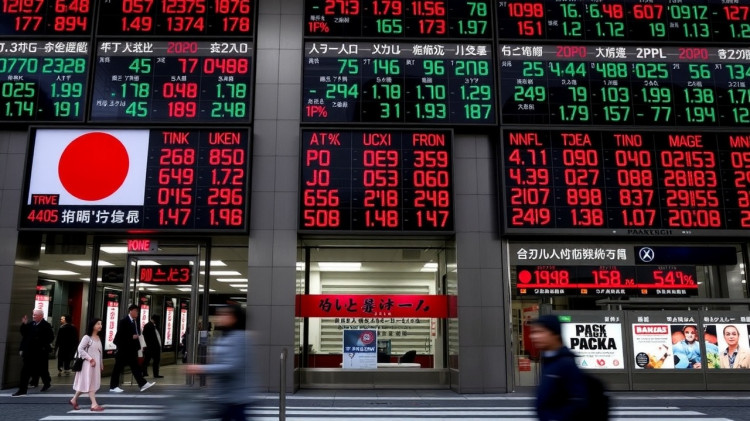
According to James Mackreides, the return of inflation may even help stocks, and political upheavals in Japan are not a barrier to gains
What does Japan do well?
Long-term government bond yields have skyrocketed, Japan's politics are unstable, the yen is trading at multi-decade lows against most major currencies, and inflation is resuming. Japan's corporate sector, however, is prospering. Stocks are consistently hitting new highs and are probably going to keep rising.
According to Masaki Taketsume, manager of the 370 million Schroder Japan Trust (LSE: SJG), the market's valuation is at the top of its ten-year range on a price/earnings ratio of roughly 16, but earnings growth is coming through strongly. An average gain of 10% is anticipated for 2026.
Financials should benefit from rising interest rates, which are predicted to reach almost 2 percent over the course of the upcoming year, he says. However, the majority of the earnings growth is anticipated to go to exporters due to the weakening yen. SJG's portfolio of 6070 stocks reflects this, with the largest holdings being the multinational insurer Tokio Marine, the bank Sumitomo Mitsui, and the conglomerate Hitachi, Toyota Motor, and electrical equipment group Fujikura. Mid and small caps, which make up 47% of the portfolio as opposed to 27% in the Topix index, are heavily weighted.
A 13% gearing of net assets indicates Taketsumes' optimism. One of the top mainstream Japanese equity funds has a five-year return of 78% (60% over three years). Nevertheless, there is a 10% discount to net asset value (NAV) on the shares.
Even better, the 315 million CC Japan Income and Growth Trust (LSE: CCJI) has a record of 67 percent over three years and 91 percent over five. However, it also trades at a discount of 8%. Video game behemoth Nintendo, engineering firm Mitsubishi Heavy Industries (Japan's biggest defense contractor), and tech investor SoftBank are among its top ten holdings. The CCJI portfolio is more concentrated than SJG's, with only 37 stocks.
Investments in Japan are resuming.
With net assets of 1.2 billion and 916 million, respectively, JPMorgan Japanese Investment Trust (LSE: JFJ) and Baillie Gifford Japan Trust (LSE: BGFD) dominated the industry until 2021. However, their strong growth bias caused them to collapse. After that, JFJ recovered considerably faster than BGFD (38 percent), with a three-year return of 67 percent. Their 24 percent one-year returns, however, are comparable and roughly 5 percent higher than those of SJG and CCJI. Additionally, these two trade at a roughly 10% discount.
The improvement is a result of both some much-needed portfolio reorientation and growth returning to favor. "We grew more slowly coming out of Covid because we had a lot less in cyclical stocks, like automakers and banks, but that has changed in the last year," says Matthew Brett, manager of BGFD. "We have to look away from the index at mid-cap and smaller companies because many Japanese companies aren't growing anymore. The "
According to Brett, SoftBank's investments in Arm and OpenAI are crucial to the AI narrative. SoftBank is BGFD's largest holding. AI also benefits CyberAgent (digital advertising), Rakuten (e-commerce), and Bengo4 . com (online legal services). AI should also aid in the development of video games, which include sq\. Enix, Nintendo, and Sega Sammy. This would enable them to be produced more quickly and affordably.
The first medication for early Alzheimer's disease has been approved thanks to a collaboration between Biogen and the pharmaceutical company Eisai. Fanuc also highlights robotics, a national strength: "Japan has a pressing need to manage a declining population."
The second-biggest holding is SBI, the biggest stock brokerage in Japan. The improved Nippon Individual Savings Account (Nisa), a tax-free product based on the UK ISA, is becoming more and more popular. "It's no longer a good idea to put money in the bank because inflation is returning. It should help the stock market and real estate. A "





Leave a comment on: Here's how to invest in Japan as it continues to soar to new heights