
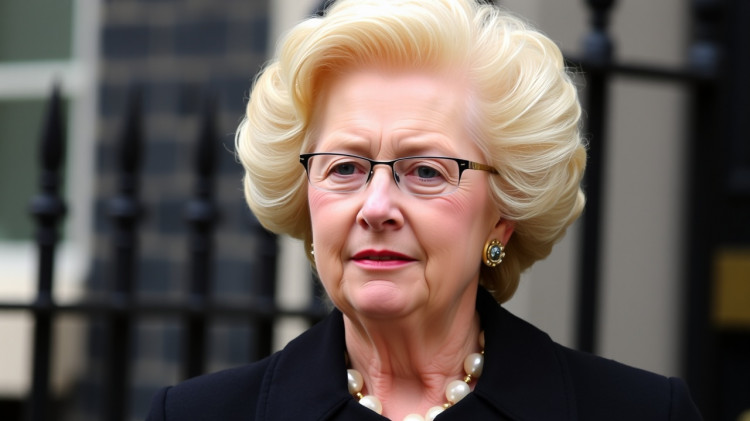
Margaret Thatcher introduced the Big Bang reforms over one weekend. They turned London into a world-class financial centre - one that still stands today
What was the Big Bang?
Forty years ago this coming week, on Monday, 27 October 1986, the London Stock Exchange underwent a sweeping programme of deregulation known as the "Big Bang." Margaret Thatcher's Conservative government introduced the reforms as part of a wider push to liberalise finance. Over the decades that followed, they reshaped the City, opening it to greater competition and international business while making it far wealthier. The changes came from a clear recognition that the City needed to modernise if it was to survive and grow - and they permanently altered its culture.
What did Margaret Thatcher change?
The reforms rewrote how London's financial markets worked. Fixed commissions disappeared, so brokers could compete over the fees they charged. The old distinction between brokers and "jobbers" - market-making intermediaries - also ended. Brokerage firms could now operate as "dual capacity" stockbrokers and "stockjobbing" market makers, working for clients while trading on their own account. Foreign ownership rules were loosened as well, allowing major international banks to enter the market or buy established British brokers. Even the trading floor changed: face-to-face dealing and "open outcry" trading, with prices shouted across the room, gave way to electronic systems. Business could move faster, at higher volumes, and across more markets. All of it happened over a single weekend.
Did the Big Bang work?
Yes. Trading in UK equities surged soon after the reforms, while international banks began moving into London. Many traditional British stockbrokers and market makers - often run as partnerships - were bought by much larger American, European, and Japanese banks. That takeover wave helped London develop into a financial centre capable of rivaling New York. Competition grew, transaction costs dropped, and liquidity improved. Pay for traders and investment bankers also climbed sharply as institutions competed for a limited pool of talent. Over time, the changes reached well beyond share trading: the City's growing international presence strengthened London's position in foreign exchange, international banking, bonds, derivatives, asset management, and specialist insurance.Try BFIA today
Get BFIA's free newsletter twice a day.
More than 165,000 subscribers already receive it. Sign up for financial news, expert analysis, and insights that clarify what matters to your finances.
Join more than 165,000 subscribers for financial news, expert insight, and clear analysis focused on what matters to your money.
Sign up
Was the Big Bang a success?
Broadly, yes. Expanding the UK's financial sector created well-paid jobs, sent a steady stream of work to lawyers, accountants and consultants, and brought in substantial tax revenue. It drew investment from overseas and strengthened Britain's influence abroad. The reforms also scrapped the old rule requiring bank bosses to work within ten minutes' walking distance of the Bank of England, clearing the way for the City's eastern outpost at Canary Wharf. Just as significantly, the regulatory shake-up made investing cheaper and less mysterious for ordinary punters. Without the Big Bang, there would be no BFIA. At the same time, the Big Bang reinforced a model of British economic success - and an uneven economic geography - that had long attracted criticism. London became a world-class financial centre, while the wider economy continued to suffer from persistently low investment and productivity. Critics also contend that deregulating and internationalising finance during the 1980s and 1990s helped lay the groundwork for the global financial crisis of 2007-2009.
How is the City of London doing now?
Pretty well. London's stock exchange has seen a sharp fall in initial public offerings since the flotation boom of 2021, and the market now ranks sixth in the world at best by market capitalisation; some calculations place it outside the top ten. Still, as David Smith writes in The Sunday Times, share trading accounts for only part of the City's business. London remains the leading centre for foreign-exchange trading, interest-rate derivatives and speciality insurance, with no serious rival in those fields. Measured across its financial strengths, it sits very close behind New York and, even after Brexit, remains the "undisputed financial capital of Europe, with no other continental financial centre in the top ten."
Is there any need to panic?
The City still has plenty going for it, so its leading position will probably endure. English, its legal system, deep accounting and consulting expertise, strong communications links, and a convenient time zone between Asia and America all help. So does the range of markets, infrastructure, counterparties, and established institutions, alongside ongoing regulatory change. London also draws a broad pool of skilled people who would choose to live there rather than in Frankfurt or Amsterdam. Brexit made London less attractive for floating businesses, but in many other respects the City seems to be "getting its mojo back" after several uncertain years, The Economist says. Across the UK, financial services employed about 1.1 million people in 2017 and still employ roughly that many now; the sector has edged up from 7% to 8% of GDP. The City - described as the place where the "EU decided not to take an axe to Europe's financial plumbing after all" - employed about 225,000 people in finance in 2024, 36,000 more than in 2019. Related professions, including law and accountancy, employed another 181,000, an increase of 51,000 over that period. That hardly looks like decline.






Leave a comment on: Forty years later: how the "Big Bang" reshaped London