
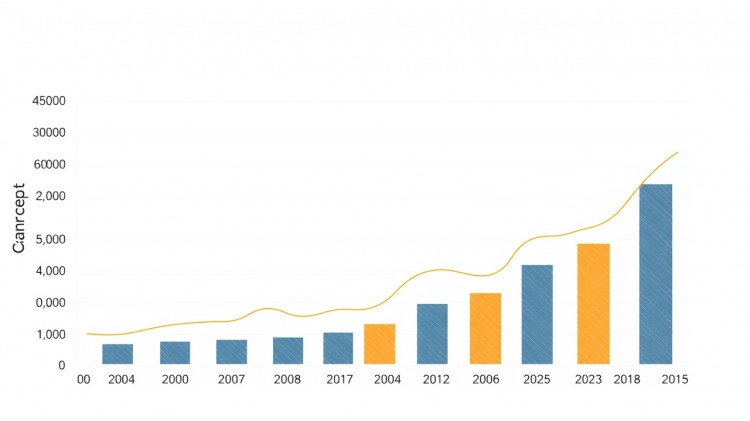
For years, cash had little to offer beyond safety. Its return was miserable.
That has changed. Cash can now deliver a return that outpaces inflation.
The top one-year savings accounts offer roughly 5%. Your money avoids the stock market's swings, so you will not wake up to a sudden, painful drop in value. Still, the question is fair: does investing in shares justify that risk, or is saving the wiser choice?
Over the ten-year periods ending in August 2026, UK shares outperformed cash 91% of the time. Global shares won in 90% of those periods, meaning international diversification barely altered the odds.
Only two non-overlapping decades appear in the period, which imposes the same limitation found in Lewis's data. Using newer data, the analysis backs up Barclays' result rather than superseding it.
Why does time matter?
Ten years gives you a much longer view. Since 1899, Barclays found that UK shares outperformed cash in 70% of rolling two-year periods and in 91% of ten-year periods. That shorter-period figure still leaves a 30% chance of lagging behind cash - one reason cash suits money you'll need by a fixed date.
Even a ten-year stretch was no sure thing. Cash still won roughly one period out of every 11. Those percentages describe past frequencies; they do not predict what comes next.
Cash also has a timing problem.
In July 2008, a one-year fixed savings account with the Bank of England paid an average of 6.06%. That rate held for twelve months; when the term ended, renewal meant accepting whatever rate was then available.
Money kept for 15 or 20 years would have to be renewed repeatedly, each time at an unknown rate. The Bank of England's average remained below 2% every month between January 2013 and August 2022. Best-buy savers earned more, though the overall trend was still downward.
Rates can go up or down. No one can secure today's rate for decades.
How much cash do you need?
I doubted Lewis's research when it came out in 2016. Cash earned almost nothing at the time, so I saw no good reason to keep more than I needed.
My wife and I will probably move within the next two years, most likely to a more expensive area. We also plan to travel far more than we have so far, with several destinations already in mind. The timing and cost are still unclear, but these expenses are easy to anticipate.
I keep a larger cash reserve now, while most of my wealth is still invested in shares. That is less a retreat from equities than a clearer split in what each holding is meant to do.
MoneyHelper, the UK government-backed financial guidance service, uses three to six months of essential outgoings as a rough benchmark. Hargreaves Lansdown, a wealth manager, takes a longer view: money you might need within five years should usually remain in savings rather than go into investments. There is a clear reason for that caution. From December 2000, global shares dropped 41% and took until March 2006 to recover their starting value.
Hargreaves Lansdown recommends that retirees hold enough cash to cover one to three years of essential expenses. That leaves two practical pots: an emergency reserve and cash set aside for spending they can anticipate. The real difficulty is deciding how to invest the rest.
What is the cost of staying in cash?
My test put 10,000 into a global tracker from December 2000 to August 2026. After charges, it grew to about 67,600. The same sum rolled into one-year fixes over that period, with an allowance for best-buy rates, reached only about 25,000. The tracker finished with more than two and a half times the cash result.
A UK tracker reached about 41,800 - roughly 1.7 times the cash return - even without exposure to US shares. Strong US performance widened the gap between UK and global results, while sterling's weakness gave the global figure a modest lift.
Cash is not the problem. The cost comes from keeping more than you need after your basic expenses are covered, since the missed growth can add up over time.
Keep enough cash for expenses you expect soon. Money you can leave untouched for many years can go into shares, provided you can tolerate temporary declines.
Then examine what remains. If it is still in cash, ask yourself why. Feeling reassured by today's rate alone is not a sufficient reason.
A one-year rate should not determine the home for money meant to stay invested long term.
Explore More London Stock Exchange FTSE Bank of England




Leave a comment on: When cash can earn as much as 5%, shares may seem hard to justify. Still, Robin Powell says the decision depends on when you'll need the money and its intended purpose.