
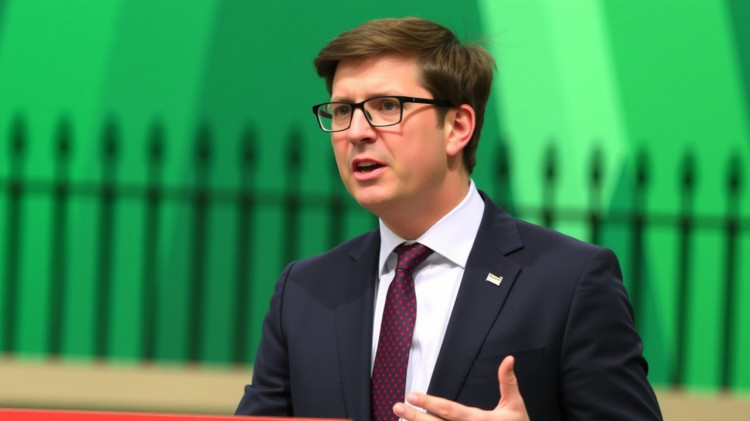
Leaders in business and investment are urging the new government to be clear, decisive, and to implement a more favorable tax system in an effort to spur economic growth
Could the UK's struggling economy under Andy Burnham's leadership see a change in tone and pace?
Business executives hope so. According to Gregor Paterson, the UK team's fund manager at Amati Global Investors, the new prime minister should have the necessary skills.
Paterson states, "Burnham himself has a lot of experience, and has a pretty heavyweight team of advisers around him." "He must know, as we all do, how difficult it was for Keir Starmers' team to get the economy going, and you would think he had a strategy."
The feeling of urgency is essential. The lack of clarity regarding policy direction, particularly with regard to the Budget, was a major source of dissatisfaction with the previous administration.
Watch the entire video here: "Businesses werent able to hire, expand or build because they didn't know what was coming," Paterson remarks, citing a series of delays related to fiscal events, while Burnham appears to be moving quickly.
"It appears that he is assembling his team and eager to move things along considerably faster than would have been the case if there had been a messy leadership struggle."
The business community views speed and clarity as more than just political virtues; they are crucial for planning. A credible and ambitious growth strategy is desperately needed.
Some aspects of the previous government's strategy were well-meaning but overshadowed by uncertainty, according to Anna Leach, chief economist at the Institute of Directors (IoD), a professional association for business leaders.
She states, "We need a better industrial strategy and it all needs to be done a bit more quickly and at a grander scale."
One important area of attention is infrastructure.
Leach would be in favor of a more transparent long-term framework that gives businesses the assurance to make investments, hire employees, and grow.
She agrees with Burnham's goals for a more balanced economy and believes that infrastructure investment and planning reform should be the two main pillars of a growth strategy.
Devolution and a regional growth agenda are excellent concepts. There is compelling economic evidence that these can attract private sector investment and provide robust growth if they are well-designed," she continues.
However, execution will be crucial.
"While Manchester appears to have been successful, I don't think one could look at Wales and Scotland and say that devolution has unleashed any animal spirits in those two regions. It really comes down to design."
The dynamics of the labor market are another area of concern. Cost pressures have increased, the employment market has cooled, hiring has decreased, and there are fewer open positions. All of this raises concerns about how to reconcile competing priorities.
Leach states, "We want to see how we shape the labor market in a way that balances everyone's needs because right now things look a little bit risky, particularly when you layer in artificial intelligence."
Everyone is watching Burnham's tax policies.
Given the £3 trillion debt load, taxes are the primary concern. Many in the business community are more interested in stability than more reform right now, especially in light of the non-domicile regime.
Leach continues, "Private sector investment is negatively impacted by the ongoing speculation about what tax increases should fall on wealth creators, following large tax increases on businesses themselves."
She also draws attention to the cumulative effect of the growing business tax burden in successive budgets.
"It would be nice to start with more certainty and less demonization of business in the near future."
The managing director of investment platform Chelsea Financial Services, Darius McDermott, concurs; he firmly believes that taxing the wealthy excessively will drive them out of the nation, reducing future tax revenues.
"I don't think there would be a significant uproar if additional rate taxpayers faced a 1% increase. However, he says, "I believe you would see a lot of unhappy wealthy people if it goes up to 60 percent over a certain number."
Markets depend on both policy and confidence.
From a market standpoint, sentiment is just as much of a problem as policy design.
A "credible, investment-friendly plan for economic growth, alongside clarity and stability on tax" is what the UK needs, according to Anna Macdonald, director of investment strategy at Hargreaves Lansdown, or investors will continue to be wary.
"At a time when the UK needs more people to invest for their future, persistent speculation, including about capital gains tax, runs the risk of making people more cautious about transferring their money from cash to long-term investments."
Starmer's detractors claim that although Labour was elected on the platform of growth and change, it soon became apparent that he lacked a clear strategy to carry it out.
"Markets are interested in how we will begin to expand the economy and increase productivity. In the past, we believed that housebuilding would be the solution, but that didn't really work out," Paterson continues.
"You have to expand your economy when you have so much debt. Additionally, I believe that neither individuals nor companies are confident enough to make investments, hire workers, construct factories, and grow."
Although it's early, Burnham could have a big impact if he can change people's perspectives.
Paterson continues, "People and businesses will hopefully start to react if he can inject some confidence back into the system."
Reducing the stamp duty reserve tax rate on the majority of UK-listed stocks and shares is one action that would attract investors to UK businesses.
Currently, investors would be required to pay 0.5 percent stamp duty if they directly bought more than 1,000 UK-listed shares, unless they were recently listed or traded on the Alternative Investment Market (AIM), even inside an ISA.
"You'll pay half a percent tax when you buy Tesco shares to put in your ISA, but you won't pay any tax if you buy Walmart shares," Paterson explains.
Those sums quickly add up when scaled up. According to him, the UK may be at a disadvantage in comparison to other markets in addition to diminishing returns.
It's something that most markets lack. The French do, but only on the biggest corporations and at a rate of just 0.3%. As a result, we are somewhat of an anomaly when it comes to charging for stock market participation."
Which investments might profit from Burnham's administration?
The major announcement that many of us were anticipating was the appointment of John Healey as chancellor.
In protest of the underfunding of the nation's defense strategy, he resigned as defense secretary on June 11. He had been advocating for a defense budget of three percent of GDP by 2030.
Following Healey's appointment, some defense names saw an increase. Following the announcement, Babcock International Group (LON:BAB) and BAE Systems (LON:BA) saw increases of about 7%. was up about 3 percent the next day as well. Over the next few days, the prices of both shares increased even more.
According to McDermott, the industry as a whole will be a definite structural winner, even though it is unclear which defense companies will benefit in the long run.
"The increase in spend is a multi-year increase, not a one-year increase," he states. I believe European defense, which was undoubtedly a subsector, is likely to see a respectable amount of growth over the next ten years, even though we may see investments in businesses from other nations, the US, or elsewhere."
As usual, as the new government lays out its plans, individual investors should try to avoid overreacting to any market noise or political headlines.
"It can easily be more detrimental than beneficial to alter a long-term investment strategy in response to a change in chancellor. According to Macdonald, the best course of action is to continue investing and concentrating on long-term objectives.




Leave a comment on: Will Andy Burnham prevail over UK plc?