
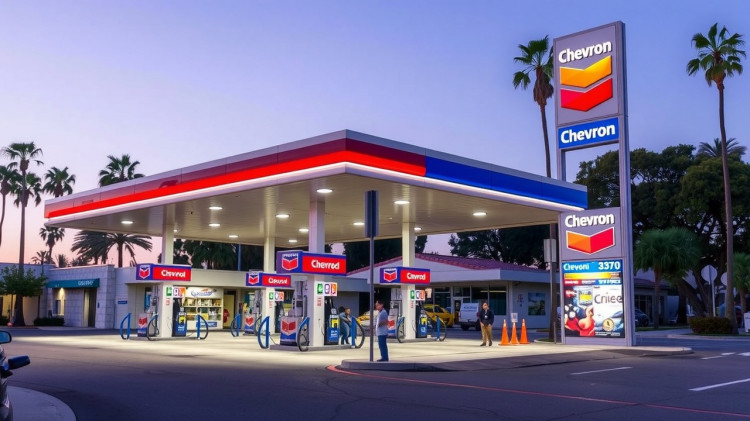
Chevron, the massive oil company, is expanding into new markets, but the share price does not show this
Should I buy now?
With a return of only 16 percent for the year, oil giant Chevron (NYSE: CVX) has significantly underperformed the larger energy sector. Compared to some of its peers, the company is more vulnerable to changes in oil prices. For instance, a £1 drop in Brent's price per barrel costs the company £600 million in cash flow.
However, oil prices have benefited from ongoing progress in the Middle East peace negotiations. The price of Brent crude has dropped from £95 to £80 per barrel since the beginning of the month, a decrease of about £15. Global economies and consumers will benefit from this, but oil producers will suffer. Over the same time frame, the SandP Commodity Producers Oil & Gas Exploration & Production index has decreased by about 13%. After rising 40% at one point this year, the index has only increased 19% so far.
However, this appears to be an intriguing moment to invest in a company that is not solely focused on oil. In fact, Chevron is growing in importance within the power industry.
Chevron is diversifying.
Although producing oil is Chevron's most well-known activity, producing liquefied natural gas (LNG) is its most exciting venture. The company breaks down earnings into upstream (oil and gas production) and downstream (refining and trading) categories, but it does not specify how much it makes from each facility and production line. UBS has projected earnings of £20.4 billion upstream and £4.3 billion downstream in 2026. According to analysts, liquids production accounts for about 60% of this upstream, with gas and LNG making up the remaining portion.
LNG markets typically function in a different way than international oil markets. Because setting up and maintaining LNG facilities requires enormous capital investments, producers must enter into multi-year contracts with customers to ensure a return. For instance, Chevron and its partners spent £55 billion on the company's flagship Gorgon LNG facility in Australia.
Eighty percent of the approximately 4.1 million barrels of oil equivalent that the company is anticipated to produce in 2026 are bound by long-term fixed contracts, with the remaining twenty percent being sold on the spot market. Despite being fixed, market prices still have an impact on these contracts. For instance, there is a three- to four-month lag before LNG contracts based on Brent prices are adjusted. According to UBS analysts, Chevron receives £450 million in after-tax profits from production from its two significant LNG facilities in Australia for every £10 increase in the price of Brent.
For people outside the industry, crunching the numbers for LNG cargoes is difficult. Natural gas prices and demand have a significant impact on prices. For instance, according to Energy Flux, an industry news website, the profit on a single LNG cargo traveling from the US to Europe increased from roughly £25 million to £50 million prior to March as the gap between US and European natural gas prices widened as a result of the Middle East supply shock. While Brent prices have been the focus of attention worldwide, Chevron's key metric is US natural gas. Due to increased demand, prices have increased by almost 30% to £3.2 MMbtu since the beginning of April. It estimates that a £1 change in price will add or subtract £700 million from its bottom line.
Additionally, Chevron has a smaller facility in Angola that, according to UBS, could increase Ebitda by £180 million for every £2 increase in the price of the European gas benchmark, which has increased by about £5 per MMbtu over the last six months.
In the end, prices are determined by demand, and since it can take decades to construct an LNG facility, the LNG market cannot swiftly adapt to demand. In the best-case scenario, demand is predicted to increase by 68% by 2040 and by 85% by 2050 due to increased electricity requirements, according to Shell, the biggest LNG trader in the world. By 2030, the IEA predicts that increased demand from electric vehicles, data centers, and similar facilities will add the equivalent of two European Unions to the world's power needs, of which only half will be satisfied by increased nuclear and renewable energy production.
Microsoft and Chevron's recent partnership.
Additionally, Chevron and Microsoft have formed a joint venture called Power Solutions, which will enter the power sales industry for the first time. In the first significant agreement, which was announced at the end of March, the partners will build a £7 billion, 2.5 gigawatt natural gas-fired power plant to support Microsoft's data centers. It will be constructed with space to double in size to accommodate demand, and it will run on gas from Chevron's assets.
Production is scheduled to start in 2027, and starting in 2028, Chevron's financial performance is expected to improve. The share price does not reflect the possibility that the company will contribute significantly to profits over the next ten years. In the upcoming years, Chevron plans to construct power plants that can generate seven gigawatts. Selling power to the technology "hyperscalers" on long-term fixed contracts will boost Chevron's top and bottom lines and lessen the volatility of earnings that has plagued the company in the past.
A higher multiple and stronger cash returns should be justified by this. According to UBS's analysts, the shares are trading at a forward price/earnings (p/e) ratio of 16.6 for 2027 and 15.8 for 2028, assuming a 4% increase in production. It is anticipated that the dividend yield will be 4 percent this year and 4.2 percent the following year. For long-term investors, recent share price declines may offer a favorable opportunity.
US dollar value of Chevron shares.






Leave a comment on: Should you invest in Chevron shares since they seem cheap?