
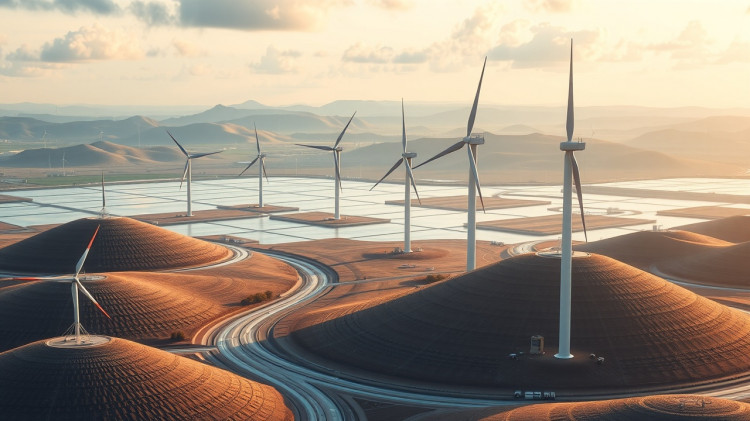
The enormous expansion of AI's data centers is not supported by enough energy, and AI cannot function without power
For astute investors, that represents a chance.
Some analysts have declared that artificial intelligence (AI) is more significant and will have a greater impact on human development than railroads. This theme will undoubtedly dominate for the foreseeable future because the biggest technology companies in the world are currently investing more than £1 trillion annually to increase their market share.
However, the infrastructure that will drive this revolution is receiving less attention as investors concentrate on the so-called hyperscalers Alphabet, Microsoft, and Amazon, which are developing their AI infrastructure at an alarming rate, as well as chip manufacturers like Nvidia and Micron, which are supplying the industry. At this point, bottlenecks are beginning to limit growth.
To power AI, the energy grid needs to be upgraded.
The power grid is the crucial one. For instance, the US grid, which is about 50 years old, was not built to withstand the current rate of rapid demand growth. Today's AI data centers rely on graphics processing units (GPUs), which are far more energy-intensive than their predecessors.
According to research compiled by JPMorgan and Goldman Sachs, AI server racks will need 50 times more power by 2027 than their counterparts that served as the foundation of cloud infrastructure five years ago.
A facility's computing power only uses about 60% of the total energy needed. Cooling systems and other infrastructure take up the remaining space.
The hyperscalers are discovering that Silicon Valley moves considerably more quickly than the rest of the world as they grow. Over the past five years, GPUs have become 50 times more energy-intensive, but global energy output has increased by only 1% to 3% annually. In practice, obtaining permits and signing the first contracts to construct the power infrastructure can take five to seven years. Over the last two years, this has begun to change, but much work remains. The International Energy Agency (IEA) projects that by 2030, data centers' worldwide electricity consumption will double to 945 terawatt-hours (TWh), or about 3% of the world's total electricity demand. That is equivalent to expanding the global grid by 34 Hinkley Point C-scale nuclear power plants. Data-center electricity consumption is predicted to increase by 15% annually between 2025 and 2030, which is four times faster than the growth rate of all other sectors' combined electricity consumption.
The most intensive facilities used to train AI models, accelerated AI data centers, will see a 30 percent annual increase in electricity consumption. In the worst-case scenario, the IEA projects that by 2035, the demand for electricity from data centers could surpass 1,700 TWh, or almost 5% of the world's total electricity demand. That amount might drop to 970 TWh if the sector improves its power usage efficiency. Demand might be restricted to 700 TWh by 2030, which is almost 25% less than the base-case scenario, if the electricity sector is unable to meet the challenge.
Since the US and China are investing the most time and resources in AI development, this bottleneck is most noticeable in these countries. According to the IEA, China and the US will be responsible for almost 80% of the increase in data center electricity consumption worldwide until 2030. Even though estimates from the US Energy Information Administration (EIA) indicate that the grid will add 86GW of new utility-scale electricity-generation capacity in 2026the largest single-year increase since 2002the US, in particular, is facing a projected power access shortfall ranging from 10.4GW to 49GW by 2028.
The emergence of the Bring Your Own Power model in data centers.
Data center providers are increasingly looking to innovate in order to get around some of these problems. For instance, the "Bring Your Own Power" (B-Y-O-P) movement uses utility-scale batteries, solar panels, fuel cells, wind and gas turbines, and on-site microgrids to get around grid-connection bottlenecks. In other places, utility companies are collaborating with data center operators and hyperscalers to buy and set up natural gas power plants.
Gas-rich areas like the Permian Basin in Texas and New Mexico, where natural gas pipeline capacity is severely limited (gas prices recently fell below zero despite the Middle East conflict), are also receiving more attention from data center providers. In order to monetize otherwise stranded gas that would have no economic value, businesses are constructing off-grid data centers directly at these extraction sites.
For instance, under a 20-year agreement, Microsoft (Nasdaq: MSFT) and Chevron (NYSE: CVX) are working together to construct a £7 billion, 2.5 gigawatt off-grid natural gas power complex in Pecos, Texas, specifically to supply Microsoft's AI data centers. A £2.3 billion project called "Neo" is being developed by Williams (NYSE: WMB), a pipeline company that transports one-third of the natural gas moving throughout the United States. It will use gas turbines in conjunction with battery energy storage systems (BESS) for a significant hyperscaler. This is the fifth BYOP agreement for the company.
Additionally, some suppliers are using AI to lessen the impact of AI on power systems. According to a recent World Economic Forum report, "power-flexible" AI factories can dynamically modulate their electricity consumption, rerouting more routine tasks (like responding to basic ChatGPT questions) to other locations and throttling energy-intensive tasks (like model training) during grid stress. Data centers can profit from the erratic nature of renewable energy production thanks to this flexibility.
In front of a screen displaying the company's most recent stock market chart on July 28, a smartphone displays the logo of Microsoft Corporation (NASDAQ: MSFT), one of the biggest technology companies in the world.
The burden is on energy prices.
Prices have increased in response to the utility market's inability to adjust to the spike in electricity demand. All international markets have seen a sharp increase in wholesale electricity prices, but the US has been most severely affected. Prices have increased by 76% in some US states in the east. The Bureau of Labor Statistics reports that electricity costs are rising nationwide at a rate that is almost 61% faster than overall inflation. The supply chain as a whole is suffering. The lead times for grid equipment delivery and production have increased dramatically. Delivery of standard electricity transformers now takes 128 weeks, as opposed to just 16 weeks in 2019. Specialty transformers are sometimes delayed for almost three years.
It can take up to four years to produce highly efficient combined-cycle gas turbines, which is more than twice as long as it took in 2022. Analysts estimate that the average price increase for all grid equipment across the supply chain is 30%. Additionally, there has been a sharp decline in the number of construction engineers and electricians; over the next ten years, the number is estimated to be close to 300,000 in the US. None of these issues have short-term solutions. It appears that producers will hold all the cards for at least the next five years as they attempt to increase output to meet growing demand.
Investors can profit from this trend in three ways. There are businesses that produce electricity, those that manufacture gas turbines and other equipment for power plants, and those that create the cables and equipment needed to move electricity from point A to point B.
Take advantage of the AI energy boom by working with key players.
Aerospace Rolls-Royce Purdue Technology Center.
GE Vernova (NYSE: GEV) is among the most popular plays. GE Vernova, which was established as part of General Electric's division, specializes in the design, production, and upkeep of machinery for the power generation sector. The company has an order backlog of £163 billion, or three-and-a-half times sales, and its technology supplies about 25% of the world's electricity. Its order backlog for gas turbines sits at around 100GW around 2.5 times the UK's total daily electricity consumption. Based on its current order backlog, UBS has projected 14 percent annual growth in organic sales for the group through 2028, with an Ebitda margin of 22.7 percent by 2028, up from 8.4 percent in 2025.
Gas turbines can last up to three decades, which secures Vernova a multi-decade service contract, in contrast to the GPUs that power data centers, which have an estimated average life of five to eight years. In order to increase dependability and efficiency, the company also provides kits for businesses operating units that are 20 years or older. The stock is heavily priced at a mid-30s price-earnings (p/e) ratio despite this growth and its important market position, but UBS contends that the valuation is justified given the revenues and margin growth potential.
Now one of the most sought-after power engineers in the world, Rolls-Royce (LSE: RR) nearly received a government bailout during the pandemic. The company reported a 12 percent increase in underlying revenue to 20 billion and a 41 percent increase in underlying operating profit to 3,462 million for the year ending in 2025, resulting in a margin of 17.3 percent. The power-systems division, which accounts for 25% of revenue, was the main driver of profit growth. The divisional margin increased by 430 basis points to 17.4%. The company attributes this to "growth driven by data centers" and hopes that its "power-dense" next-generation gas and diesel engines will keep spurring expansion. As data center providers look for ways to avoid the ever-growing lines for power-grid connections, this technology is in high demand. The FTSE 100 company recently reported that March was a record month and that orders for gas and diesel engines in the first quarter were about 50% higher than they were in the previous year. As of March 31, Power Systems' order backlog was 7.3 billion.
However, Power Systems is more than just data centers. Additionally, the company manufactures engines for Leopard tanks and battery energy-storage systems. Additionally, Rolls-Royce carried out the first successful test of a high-speed marine engine powered solely by methanol last year. The company's nuclear division is another. Rolls-Royce, a longtime provider of nuclear reactors to the Royal Navy, has started introducing its small modular reactors (SMRs) into the civil market. In the Great British Energy Nuclear competition in June of last year, Rolls-Royce's SMR was selected as the only supplier to construct three SMR units in the United Kingdom.
CEZ Group also committed to up to six units in the Czech Republic and made a strategic investment in Rolls-Royce SMR. The division was chosen to work with Videberg Kraft to deliver three SMRs on Sweden's west coast in the middle of June. Based on current estimates, Rolls-Royce is trading at a forward p/e of 38.2, falling to 32.7 in 2027, according to average analysts' estimates. Following the company's most recent positive trading report, those have increased. Berenberg has projected 8 billion in share buybacks over 2026-2028, divided by 2.5 billion in 2026, 2.7 billion in 2027, and 2.8 billion in 2028. If cash flow exceeds forecasts in the upcoming months, there may be additional cash returns.
Rolls-Royce's US competitor is BWX Technologies (NYSE: BWXT). As the only supplier of nuclear fuel to the US Navy for more than 70 years, BWX, like its UK counterpart, has a US Navy contract in its back pocket to support its general operations. Steam generators, reactor-pressure vessels, and piping are among the specialized, intricate, high-precision equipment used in nuclear reactors that it now aims to expand in the civil market. With the recent £1.4 billion set of contracts through the US Naval Nuclear Propulsion Program, it has an order backlog of £8.7 billion, or roughly two and a half years' worth of revenue. However, there is a lot built into the current share price, which is close to 50 times future earnings.
How to invest in the undersea cable kings.
Underwater cables are being installed by scuba divers for scientific purposes.
The energy-transfer market is more concentrated than the other two potential investment segments. An unprecedented demand for ultra-high-voltage subsea cables to transfer power from offshore wind and solar sites to urban centers has been sparked by the shift to renewable energy, a market that did not exist fifteen years ago. A European oligopoly made up of Prysmian (Milan: PRY), Nexans (Paris: NEX), and NKT (Copenhagen: NKT) currently controls the majority of it. These businesses triumphed in a fiercely competitive market where many smaller firms were unable to match the capital expenditures needed to produce massive underwater sea cables.
Companies frequently have to hang high-voltage direct-current (HVDC) cables inside skyscraper-high warehouses because they can be thick and need to be kept perfectly straight during manufacturing. Building this infrastructure will cost billions of dollars. For instance, the UK's largest-ever investment in electricity transmission infrastructure, the 500-kilometer Eastern Green Link 2 (EGL2) project, will cost £4.3 billion, of which £2.7 billion will go toward the cable.
Over the next ten years, the global market for high-voltage submarine cables is anticipated to expand at a compound annual growth rate of 17.3%. The major players are quickly increasing production, which reached an all-time high of 7,000 kilometers in 2025. Prysmian is expanding in the DC inside-building segment, which essentially wires up the power inside data centers, by leveraging its experience in this market. The company envisions itself as a one-stop shop for contracts involving the construction of data centers, long-haul subsea connections, shore-based transmission infrastructure, and infrastructure for powering GPUs and air conditioners throughout the building.
Over the next five years, management projects that the global demand for DC power will grow at a compound annual growth rate of 33 percent, with the majority of this growth coming from the expansion of data centers related to artificial intelligence. Earnings growth of 25 percent for 2026 and 23 percent for 2027 have been projected by analysts, with a net profit of 1.7 billion for 2027nearly ten times higher than in 2020. Based on these projections, the shares are trading at a 2027 p/e of 24.9, which doesn't seem too demanding for a high-growth business operating in an oligopoly.
Prysmian is about three times larger than its smaller competitors, both of which are entering new markets thanks to their increasing cash flow and profitability. Based on management's growth goals, Paris-listed Nexans is the least expensive of the two, trading at a 2028 p/e of about 13. By expanding its three primary businessesPWR-Transmission, PWR-Grid, and PWR-Connectthe group hopes to reach an adjusted Ebitda of 1.2 billion by 2028, up from roughly 750 million. By early 2026, sales will be locked in with a backlog of 7.9 billion, which will cover sales through 2028.
A significant portion of the future growth plan will also involve deals. Republic Wire, a US-based company, was recently added to the stable in order to increase the size of its US arm (roughly 15% of revenue). Republic, which reported 52 million dollars in sales in its most recent fiscal year, will play a significant role in Nexans' entry into the US data center market. Nexans intends to sell its own full range of medium-voltage and grid technology into upscale US end markets through Republic Wire's well-established channels. By the end of 2026, the acquired company's production capacity will have increased by approximately 30% thanks to a major expansion program that is currently being finalized.
How to use coal.
National Grid (LSE: NG) is another FTSE 100 company in a strategic position. The UK data center market is the biggest in Europe, despite still being tiny in comparison to the US and Chinese markets. According to National Grid, the UK's electricity demand will rise by 30% to 290GW by 2035, and installed generation capacity will increase by 90% to 370 TWh. The company is investing 41 billion by 2031 to increase the value of its regulated assets by 60% to 60 billion in order to meet this demand. Additionally, it plans to invest £29 billion to grow its US business to a regulated asset value of £45 billion, concentrating on its two most important markets: Massachusetts and New York. At a forward price-to-earnings ratio of 13.9, the shares currently appear cheap.
Coal is another industry that investors might take into account. Over 2,200GW of coal-powered generation are still in use worldwide, and an additional 710GW is being developed, according to Global Energy Monitor. In order to meet the rising demand for energy, China is expanding its coal-output market, and 32 nations are proposing or constructing new coal plants. Donald Trump announced plans in early June to expand the US coal fleet, which provides 15% of the nation's electricity, by constructing two new coal plants in West Virginia and Alaska under the Defense Production Act. Here are three left-of-field options to think about: Alliance Resource Partners (Nasdaq: ARLP), Peabody Energy Corp (NYSE: BTU), and Warrior Met Coal Inc. (NYSE: HCC).





Leave a comment on: How to capitalize on the AI energy boom