
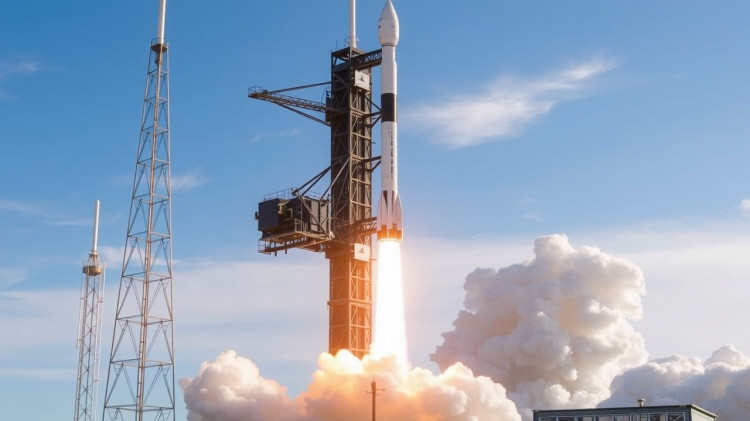
Helium is becoming more and more scarce, despite being essential to rocketry, AI chips, and medicine
What opportunities exist for investors, and what are the risks?
Every major growth theme in the global economy, including space, artificial intelligence, and healthcare, depends on helium. However, very few people discuss it, and the picture of the helium supply has just gotten much more complicated.
About 1418% of the world's daily helium production is used in a single ignition sequence during the launch of a single Falcon 9 rocket. SpaceX has aspirations far beyond the dozens of Falcon 9 rocket launches it does annually. As mega-constellations reach full deployment, the satellite industry is getting ready for yearly launch volumes of between 3,700 and 5,000 by 2030. Between 2025 and 2031, Goldman Sachs projects that 70,000 low Earth orbit (the area between 160 and 2,000 kilometers into space) satellite launches will take place worldwide. Each and every one of them requires helium. There's nothing else to do.
Surely someone is making more of it, but they're not, at least not at the rate that the market demands. Helium is not produced. In a few places where subterranean concentrations are commercially feasible, it is extracted as a byproduct of natural gas processing. Together, the US and Qatar supply more than 75% of the world. Although a sizable portion is produced in Russia, Western markets cannot access this supply. Algeria makes a small contribution. Rounding errors apply to everyone else.
The top producers of helium gas are displayed in an infographic based on USGS data.
Thirty percent of the world's supply comes from a single industrial complex in Ras Laffan, Qatar. Iranian strikes in March 2026 compelled QatarEnergy to stop producing LNG and related goods, such as helium. Overnight, nearly one-third of the global helium supply was taken off the market. Spot prices were doubled. The south site at Ras Laffan will not reopen until late summer 2026 due to direct hits. Analysts predict it will take years for permanent capacity reductions to fully recover.
The fundamental issue is not the Strait of Hormuz; rather, it is a trigger. This market had experienced four major shortages over the previous 20 years, each lasting two to three years before any equilibrium was restored, even before the first missile was launched. The market's structural deficit was merely brought to light by the conflict. The nature of helium itself complicates the supply picture. It is Earth's second-lightest gas. The rate at which it escapes containment prevents strategic stockpiling. You are unable to create a significant reserve. There is no buffer in the market when supply breaks.
Who is vying for that inelastic supply pool now? Helium is used by semiconductor manufacturers at almost every stage of wafer production, and its use in extreme ultraviolet (EUV) lithographythe process that creates the most sophisticated AI chipsis indispensable. By 2030, the market for AI-driven chips is expected to double at a compound annual growth rate of more than 11 percent. Twenty percent of the world's helium demand comes from MRI machines, each of which needs a 2,000-liter initial fill of liquid helium as well as ongoing top-ups over the course of its useful life.
The demand for healthcare infrastructure is growing structurally as India and other major emerging markets quickly expand it. Then there is the field of quantum computing, which is rapidly expanding and totally reliant on liquid helium cooling to achieve the cryogenic temperatures necessary for quantum processors to operate.
Quantum computing, medical imaging, rocketry, and AI chips. The world economy's three or four fastest-growing sectors all vie for the same gas from a small number of producers, and one of those producers was recently removed from the board for an indefinite amount of time.
The best helium stocks available right now.
Investors should take note that, despite SpaceX's own CEO acknowledging that helium supply is a binding operational constraint on its growth aspirations, the company's S-1 registration statement, which was filed ahead of what is expected to be one of the most significant listings in a generation, noticeably omits any reference to risk associated with helium. Elon Musk made it clear that there isn't enough helium produced on Earth to support a high-flight-rate Starship program. This limitation is so great that the vehicle had to be redesigned to accommodate it. It's not a footnote. That operational risk is significant.
Instead, take a look at the industrial gas firms Linde (Nasdaq: LIN), Air Products and Chemicals (NYSE: APD), and Air Liquide (Paris: AI), which are clearly the main beneficiaries of increased prices and tighter supply, with pricing power that will grow through long-term supply contracts. Special consideration should be given to the UK angle. The government of Britain has not officially designated helium as a critical mineral, nor does it have a strategic reserve or domestic helium production. The National Quantum Computing Center at Harwell, the NHS scanner estate, and the defense electronics supply chain are all vulnerable to a commodity that Whitehall does not give any policy attention to. Investors who recognize this gap before policymakers will have done so at the appropriate moment.
For far too long, helium has been regarded as background infrastructure because it is thought to be too inexpensive, too plentiful, and too dull to merit careful examination. That was a bygone era. The commodity that powers the launches that everyone watches, the chips that power the AI that everyone funds, and the scanners that keep hospitals running is the one that no one discusses. Investors don't need to know if helium is important. How long it takes the rest of the market to realize it is the question.




Leave a comment on: There is an unprecedented shortage of helium