

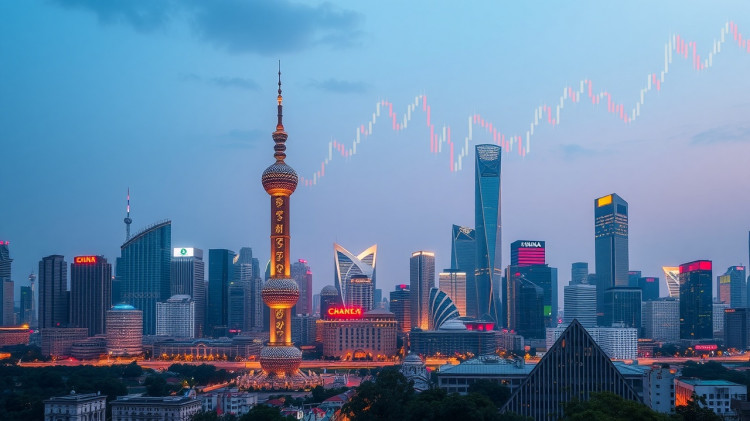
According to Terry Tanaka, it's time to invest in China since the country is benefiting from a "vibe shift" among investors
A few years ago, the main point of contention was whether investing in China was worthwhile or if it was simply "uninvestable." Regarding the Middle Kingdom, the West never seems to come to a firm decision. China, which was once mocked for being tacky and cheap, is now hip in 2026. While joking that they are "learning to be Chinese," social media influencers flaunt their indoor slippers and traditional Chinese medicine.
According to a Pew Research survey, only 28% of Britons over 50 have a positive opinion of China, but that number doubles to 56% of those between the ages of 18 and 34. Young people browse TikTok and post pictures of the futuristic "cyberpunk" city of Chongqing, which is worth visiting if you can tolerate the oppressive humidity, while older Westerners see an oppressive one-party state.
A caution to anyone considering investing in China.
There is nothing new about this pendulum swing. China's remarkable growth in the 2000s (14 percent in 2007 alone) sparked intense conjecture about when it would surpass all other economies in the world (2027, according to one frequently cited projection). As China employed a massive infrastructure stimulus package to avoid the stagnation afflicting developed economies following the Great Financial Crisis, the story remained optimistic in the early 2010s. In the process, the nation constructed the largest high-speed rail network in the world, a service whose shining modernity makes British trains seem like a donkey and cart in contrast.
However, a more pessimistic narrative emerged at the same time. When a parabolic surge in Chinese shares reversed in the summer of 2015, the first indications of trouble appeared. Between June of that year and January of 2016, the CSI 300 index fell by 44%. At the time, a dragon roller coaster was shown plummeting down a BFIA cover. Such a decline would signal the start of a disastrous recession in many nations. Not in China, where the official GDP growth rate in 2016 was 6.7 percent, a slight decline from the year before.
State banks, not investors, determine where credit will be distributed in China, where the stock market is typically thought of as little more than a casino. However, it served as a warning to investors. Even the most optimistic growth forecasts for China fell short of expectations. GDP per capita is only 15% of the US level, and overall GDP is still only 65% of the US level.
It has, however, grown at a pace and consistency that is unprecedented in world history. However, those who made the decision to invest in China have not benefited from those gains. The Chinese GDP has increased by 344 percent since the beginning of 2008. One percent of the CSI 300? Of course, investing in China still allows you to make money. Since September 2023, local shares have surged 43%. However, the argument is still unproven as a long-term investment. Although they fluctuate, most stock markets have an upward trend. Because of this, investing has a better reputation than gambling. However, the equity graph in China truly does resemble a roller coaster, with lengthy ascents interspersed with startling declines.
Though its situation is particularly severe, China is by no means the only emerging market to show a discrepancy between GDP growth and equity returns. Many people disagree about the precise causes.
Simply put, investors love a compelling emerging-market growth story. As a result, valuations skyrocket, front-loading years' worth of earnings growth into current valuations (a point that current purchasers of pricey Indian shares would be wise to consider).
A second reason is that landlords, in particular, often profit from growth by taking advantage of stock markets. Imagine the fantastical rewards of owning a plot of land in Shenzhen, a poor group of fishing villages that transformed into the hub of the world's technology manufacturing in just 20 years.
The property bubble in China has burst.
Hongya Cave in China.
Between 2021 and 2025, Chinese real estate prices decreased by 40%.
The Chinese were aware of the benefits that could be obtained from property. There were few other investment options available to newly wealthy Chinese households. Bank deposits yield pitiful profits. The local stock market is unstable, and foreign shares are prohibited. As a result, they made large investments in real estate, purchasing second and third homes. These assets were frequently not even rented out when they were constructed, for fear that tenants would take attention away from the far more crucial goal of maximizing capital gains.
What came next was an unprecedented real estate boom. China used more cement over a three-year period in the 2010s than the United States did during the entire 20th century. Clearly, the bubble was becoming unmanageable. Officials put a stop to it in 2020-2021 by tightening leverage limits. Developers of real estate reached their breaking point, most notably Evergrande, which collapsed with £300 billion in liabilities. According to Reuters, there were 7.2 million unsold homes in 2023. Between 2021 and 2025, real estate prices nationwide decreased by 40%. For a middle class that has almost 70% of its wealth in real estate, that was disastrous. The cloud over sentiment, shaped like a property, has not yet lifted. Outside of the Covid era, retail sales had their worst two-month start to any year since 2000 in January and February.
Concerns about investing in China are numerous. The nation is among the fastest-aging societies in the world, with a fertility rate of almost one child per woman. Additionally, a 2021 crackdown on tech companieswhich has since been mostly reversedserved as a reminder that the Communist Party ultimately controls all businesses.
How China took Japan's mistakes to heart.
Many economists have pointed out similarities between China and Japan since the real estate bust. Japan was considered the most technologically advanced country in the world during the 1980s. Its corporations gradually started to lag behind after the 1990s crash, failing to take advantage of the internet's growth. However, it appears China will avoid what happened to Japan.
Tokyo invested heavily in zombie companies during the 1990s; in 2021, Beijing took credit away from real estate and rerouted it with military fervor toward the "New Productive Forces," official jargon for things like batteries, electric cars, rare earths, green technology, and artificial intelligence. With startling efficiency, Chinese businesses are currently taking over new international markets. This year, one in seven cars sold in the UK were Chinese, an increase from 1.3 percent just five years ago. The Jaecoo 7, a brand that hardly anyone had heard of until recently, is currently Britain's best-selling vehicle.
China's detractors have long cited what could be euphemistically described as the nation's lax attitude toward the intellectual property of other countries. However, China's days of merely copying Western inventions are coming to an end. Chinese businesses now know how to do things that Western businesses just cannot match, as economics analyst Noah Smith points out on Substack. The concentration of electronics and tooling engineers is unparalleled. Chinese companies are establishing factories abroad, and those factories are outperforming their international rivals in terms of productivity. The Germans will soon imitate the Chinese.
Jaecoo 7 (J7) SUV in an Omoda and Jaecoo showroom.
Currently, the Jaecoo 7 from China is the best-selling vehicle in Britain.
Improved concepts are just one aspect of the problem. The other is excessive government assistance, particularly in the form of perpetual credit lines. Chinese factories are overproducing. The lack of domestic consumers to absorb an excess of batteries, solar panels, and particularly automobiles is the cause of the nation's dominance in international exports, as evidenced by the £1.2 trillion trade surplus last year. Due to extremely narrow profit margins, Chinese manufacturers are struggling to stay in business, so they have turned to international markets more out of desperation than strength. Thus, China's long-term deflation and industrial might are two sides of the same industrial-policy coin. You may contend, as Smith does, that China is merely committing a grave error in capital incineration. However, you could also contendas Jeremy Warner does in The Telegraphthat China is making the more sensible strategic decision when it comes to choosing between squandering money on excess industrial capacity and squandering it on unsustainable welfare, as the West does. Chinese industrial policy is much more sensible "if your goal is to weaken the United States." while protecting China from the kinds of supply-chain flaws that plague Western economies.
Is it wise to make investments in China?
Given the track record of equity returns, it is still very much up in the air whether Chinese shares will prove to be a profitable investment over the next ten to twenty years. A recurrence of the Russian experience, in which foreign investments were essentially zeroed out after Vladimir Putin's invasion of Ukraine, appears less likely today than it was even a few years ago.
In the event of a Taiwan dispute in 2022, the similarities with Chinese assets appeared clear. However, things have changed. It is far from certain that Donald Trump's America would prevent a Chinese invasion across the Taiwan Strait, and it is even more improbable that the UK, acting in solidarity with the US, would sever trade with China, the second-largest economy in the world, as forcefully as we have sanctioned Russia, a minuscule country.
From a one to three-year perspective, the Middle Kingdom appears to be a viable option. First of all, a "vibe shift" in the market could be hinted at by China's newfound coolness. The rise of social media over the past ten years has only intensified the trend of markets trading on narrative rather than cold, hard facts about Ebitda (how else can we explain carmaker Tesla's current price-to-earnings ratio of 324 times earnings?). Second, China has real value appeal, in contrast to Tesla's stock and similar products. If something goes wrong, the MSCI China index should be able to limit downside risks because it is trading at a very reasonable 11 times forward earnings.
It would be foolish to bet the entire pension on Shanghai, but a trade that meets both the momentum and value criteria should be taken seriously. The meme winds are favoring China in 2026. It seems silly not to take advantage of the entry price.
The top strategies for current investments in China.
It's worthwhile to audit your current exposure before making an investment in China. It's possible that enthusiastic investors in emerging-market funds will find that they already own a sufficient number of Chinese shares. China receives up to 25% of many emerging-market trackers and funds. For those who are anxious about the conflict in the Taiwan Strait, keep in mind that Taiwan's share of the emerging-market sector has recently skyrocketed due to rising semiconductor valuations, sometimes reaching a fifth or more of many funds.
On the other hand, investors who favor developed markets might be underweight China. China's share of the MSCI ACWI index is a mere 2.9 percent, placing it behind Mark Carney's Canada, an economic powerhouse. In contrast, China accounts for 17% of the world's GDP. Although there are good reasons why a typical equity portfolio shouldn't include much of Chinese markets, a 2.9 percent allocation is far too small for a nation that is dominating so many of the future's industries.
JPMorgan China Growth & Income (LSE: JCGI), Fidelity China Special Situations (LSE: FCSS), and Baillie Gifford China Growth (LSE: BGCG) are the top three active China trusts. With each fund having performed similarly over the previous 12 months and gains of roughly 25% being driven by a rising tech tide, there are more similarities than differences between them. The dividend paid by JPMorgan is 4.7%.
There is a strong argument for active management in China, where Western investors should avoid state-owned banks and subpar companies in favor of buying up tech and consumer shares. Although Fidelity has the best track record over the long term, its slight preference for small and medium-sized businesses might not be the best option during a period of persistent domestic deflation. For those looking for a tactical momentum play, Baillie Gifford, which has a stronger growth bias, is a better option.






Leave a comment on: Invest in China as it reemerges as a fashion destination