

We highlight the industries and trends that could be excellent Chinese investment opportunities for the upcoming Lunar year as the Year of the Horse gets underway
Today, February 17, is Lunar New Year. In China and other countries that use the lunar calendar, this year is known as the Year of the Horse.
Chinese astrology states that the horse is a symbol of vigor, aspiration, and perseverance developed via consistent work.
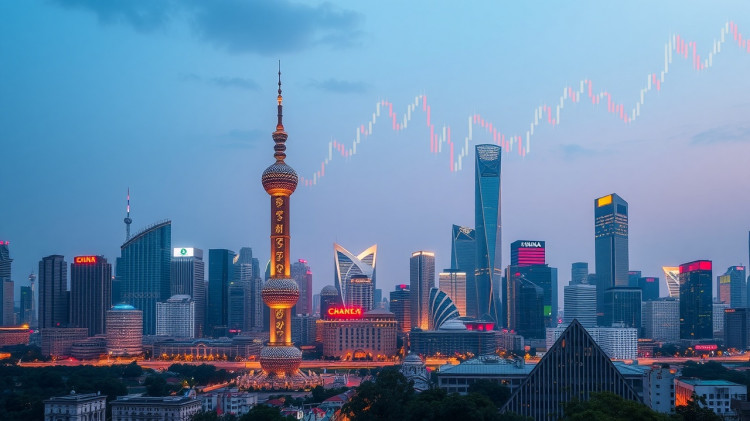
In 2025, Chinese stocks experienced one of their best years since the Covid pandemic, and investors should think about making investments in China for 2026.
The Hang Seng Index increased 32 percent between January 29, 2025, and February 16, 2026, which coincided with the Year of the Snake, marking China's stock market's strongest lunar year since 2017.
The nation's economy is rapidly evolving. Government policies that encourage consumption are supporting a rapidly expanding middle class, and China is emerging as a global leader in some of the most revolutionary technologies.
According to Fiona Yang, manager of the Invesco Asia Dragon Trust (LON:IAD), "Beijing policymakers have become more explicit in emphasizing the need to boost domestic consumption." Making domestic demand the main driver of growth and significantly raising household consumption as a percentage of GDP were two objectives of the 15th Five-Year Plan.
February 16, 2026: Chongqing, China's special Spring Festival drone show lights up the night sky.
Chongqing's Spring Festival celebrations, which mark the start of the Year of the Horse.
Stuart Rumble, head of investment directing APAC at Fidelity International, believes that this focus on consumption, even in the absence of a significant stimulus package, could be beneficial for China's prospects.
Instead of causing a sudden spike, Rumble stated, "the goal is to stabilize confidence and improve growth quality, implying selective upside rather than a broad based recovery."
Because of the selective opportunity created by the low expectations, consumer sectors offer some of the lowest market valuations. Domestic leaders continue to gain market share and profit from long-term under-penetration trends in industries like sportswear, travel, and some discretionary categories.
What major factors do experts believe will shape China's economy in the Year of the Horse, and which industries should investors focus on to make money?
China Investing: A Wild Horse?
In terms of politics, the Year of the Horse came to a rather chaotic halt. China's Central Military Commission (CMC), which normally has seven members, was reduced to just two, including President Xi Jinping, after top general Zhang Youxia was removed in late January as part of a purge.
Daniel Casali, Evelyn Partners' chief investment strategist, stated, "This represents one of the most significant upheavals in China's political system in decades." Considering that purged leaders in China usually disappear for months before an explanation is provided, the speed is unheard of.
Gen. is the Chinese Central Military Commission's vice chairman. On April 22, 2024, in Qingdao, China, Zhang Youxia salutes during the opening of the Western Pacific Naval Symposium.
In April 2024, General Zhang Youxia opened the Western Pacific Naval Symposium.
A shift in the balance between factions within the ruling Chinese Communist Party (CCP) is reflected in the purge.
"This political uncertainty raises concerns over governance and could weigh on investor sentiment given China's political opaqueness, with no clear line of succession to president Xi," Casali stated. "Investors run the risk of seeing regional equity market returns and valuations decline due to domestic political unpredictability.
However, Casali noted that the political unrest has not yet affected the stock markets in China or emerging markets, and that both are largely driven by the expansion of corporate profits in a positive global economic environment.
China's AI system.
The emergence of DeepSeek, which shook Western stock markets and wiped out nearly £600 billion from Nvidia's market capitalization in a single session, was one of the main factors contributing to China's gains last year.
"A broad revaluation of the country's AI sector was triggered by the DeepSeek moment," Yang stated.
As stated by Nicholas Yeo, head of China equities at Aberdeen Investments, "the market has yet to fully appreciate how rapidly China's domestic AI ecosystem is innovating around constraints, such as architecture choices, open-source diffusion, and engineering pragmatism that can compound quickly when capital is directed with intent and accompanied by policy support." "We anticipate seeing more examples of businesses transforming workarounds into products that are subsequently widely embraced and utilized throughout the ecosystem.
According to Rumble, valuation is the most important consideration before making an investment in China's AI ecosystem, "especially after strong rallies in many pure play names where profitability and durable earnings may still be several years away".
Major platforms and infrastructure providers are starting to make money earlier, but many application-focused businesses are still in the investment stage, and valuations sometimes seem to predict cash flows that won't happen right away, Rumble continued.
Yang identifies Tencent (HK:0700) and Alibaba (HK:9988) as the two Chinese tech giants that stand to gain the most from China's accelerating AI shift. Yang stated, "Their robust cloud infrastructure and quick integration of cutting-edge AI models have reinforced their roles as the foundational enablers of the country's AI ecosystem."
China's overall leadership in technology.
When local manufacturer BYD (HK:01211) surpassed Tesla as the world's largest EV producer last year, China's position as the world leader in EVs was solidified.
Rumble stated that "China is the largest and most competitive EV market in the world, with high penetration rates and domestic brands that have scaled rapidly on the back of deep supply chains and fast product iteration."
It is also at the forefront of robotics. Rumble asserts that automation is "both an economic necessity and a policy priority" for China due to the country's declining working-age population. But once more, he issued a warning: the valuations of relatively early-stage companies in this sector already factor in a lot of future potential.
"The discipline lies in being mindful of how much investors are paying for access to these themes and isolating sustainable earnings power from technological advancement," Rumble said.
How to make investments in China in the Horse Year.
For the Year of the Horse, investors can choose from a variety of funds and investment trusts.
Particularly, Baillie Gifford China Growth (LON:BGCG), Fidelity China Special Situations (LON:FCSS), and JPMorgan China Growth and Income (LON:JCGI) are three investment trusts that concentrate on Chinese stocks. According to data from Morningstar via the Association of Investment Companies, FCSS had the highest share price return of these in the year ending February 16th, rising 30.9% as opposed to BGCG's 22.1% and JCGI's 22.7%.
Be aware that China and other related markets are exposed through other investment trusts, such as Invesco Asia Dragon.
Invesco ChiNext 50 UCITS ETF (LON:CHNX) (up 61.1 percent) was the top-performing fund in China, according to FE fundinfo. Both the Allianz China A-Shares Equity Fund and the Rowe Price China Evolution Equity Fund saw gains of 38% and 35%, respectively.






Leave a comment on: Could the Year of the Horse see Chinese investments soar?