
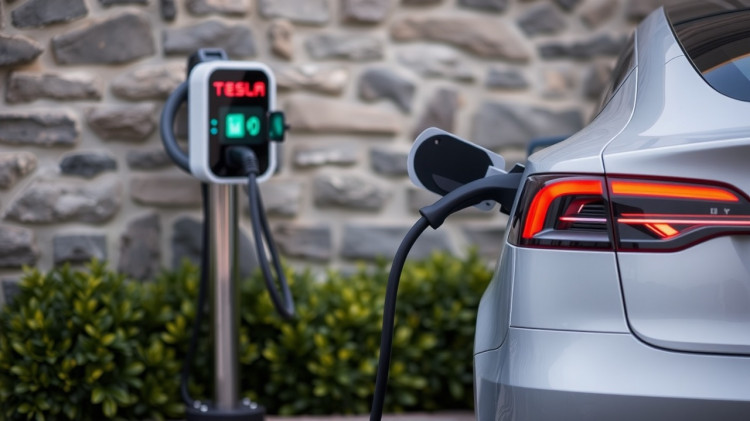
Tesla has applied for a license to provide electricity to homes in the UK, but competing with the largest suppliers may be difficult
Tesla has submitted an application for a license to provide electricity to homes in the United Kingdom to the regulatory body Ofgem. With this move, the e-vehicle giant appears to be aiming to take on major energy providers such as Octopus, OVO, and British Gas.
Given that Tesla has only applied for an electricity license, households with dual-fuel contracts (gas and electricity) might be less inclined to switch if the company's application is accepted.
The application, which may take up to nine months to process, was posted on the regulator's website on July 25.
Tesla Electric, which Elon Musk's company established in 2022, is already an electricity supplier in Texas. "A retail electricity provider that helps you power your home, charge your electric vehicle, and support the grid with low-cost, 100% Texas-generated sustainable electricity," is how it bills itself.
Customers in Texas are not required to own a Tesla product in order to qualify, indicating that if Ofgem accepts Tesla's application, a model akin to this could be implemented in the UK. However, potential benefits like free charging might encourage Tesla owners to use the service.
"Despite a significant decline in EV sales this year, Tesla still has a sizable car ownership rate in the UK and has sold thousands of home storage batteries here," stated Susannah Streeter, head of money and markets at investment platform Hargreaves Lansdown.
This could indicate that Tesla Electric has a ready market, particularly if it adopts the business strategy used in Texas, where it pays EV owners to feed excess electricity back into the grid and enables them to charge their vehicles at a low cost.
However, it may be more difficult to take on the big six suppliers and upend the UK energy market.
Adam Bell, the former head of energy at the department for business, energy, and industrial strategy and current director of policy at consulting firm Stonehaven, stated, "Tesla is entering a heavily regulated market in which margins have been squeezed to the narrowest extent and in which it faces competitors who have already invested in novel tariff offers."
"It will find making headway challenging, even with access to an ecosystem of Tesla EV and Powerwall owners," he told BFIA.
Could Tesla cause a stir in the energy sector?
Competing with the largest energy providers is not simple. According to data released last month by consultancy Cornwall Insight, small and medium-sized suppliers' share of the domestic energy market dropped to just 8.6 percent in the second quarter of 2025.
In comparison to before the energy crisis, the six biggest suppliers now control over 90% of the domestic market.
"For EV owners and households with solar panels, who have the flexibility to shift demand, Tesla's entry into the UK electricity supply market could add competitive pressure and bring more innovative tariff options," said Bridget Payne, head of energy forecasting at advisory firm Oxford Economics.
Even though this advances the broader system decarbonization objectives set forth by National Grid and the National Energy System Operator (NESO), the move may be more of an evolution than a disruption because time-of-use tariffs are already offered in the market.
Tesla Energy Plan, a clever import/export tariff for people with solar panels and Tesla energy storage batteries, was introduced in 2020 in collaboration with Octopus Energy. Customers could purchase electricity under the plan at a reduced cost and resell any extra energy to Octopus for the same price.
Though Octopus still provides a comparable plan through Octopus Flux, Tesla terminated the plan three years later.
Additionally, other suppliers provide time-of-use tariffs that adjust electricity prices according to the time of day you use it. Those who own electric vehicles may find these and EV tariffs appealing.
Study Up on Elon Musk, Tesla, Inc.



Leave a comment on: Could the energy market be disrupted by Tesla's application for permission to supply electricity to homes in the United Kingdom?