
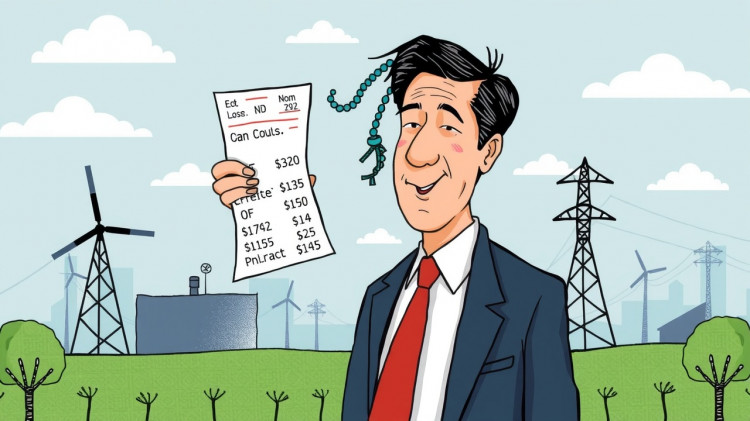
Due to the Iran war, UK energy prices are more expensive than those in nearly every other part of Europe and are highly susceptible to fluctuations
How can we proceed?
How are energy prices in the UK doing?
According to The Times, Ed Miliband, the energy secretary, will approve the first significant North Sea oil and gas project in nearly a decade. Legal wrangling has delayed the licence to exploit the Jackdaw gas field, which is located 150 miles east of Aberdeen, which was granted under the previous Conservative government.
Although approving it would not technically violate Labour's ban on "new" drilling in the North Sea, it would represent a dramatic change in Labour policy, especially for Miliband, a true net-zero supporter.
The energy shock brought on by the Iran war, according to supporters, has made the case for drilling stronger. The joint venture that owns the field's rights, Adura, asserts that it could generate 6% of the UK's future gas supply.
Is it feasible?
Others doubt it. A lobby group called Uplift asserts that Jackdaw would do little to improve the supply of gas and have no effect on our bills. According to Ambrose Evans-Pritchard in The Telegraph, the UK "would not raise this country's long-term output of oil and gas by more than homeopathic amounts" and "would not move the needle on UK energy prices" even if it were to extract every last bit of hydrocarbon from the North Sea.
The price of gas would follow the international price of liquefied natural gas "unless we cut off our European inter-connectors, tore up our EU trade deal and retreated into energy autarky." Oil is priced off the global market.
Why are energy costs in the UK so high?
The UK's high energy costs (we pay more for electricity than almost anywhere else in Europe) are caused by a number of factors. One is that while the UK is becoming more adept at generating renewable energy, it is appalling at increasing storage capacity. The UK's current capacity is insignificant in comparison to the volume required to influence electricity prices, despite advancements in battery technology.
Another is geography and climate: wind power prices have plateaued, solar power prices are still falling, and there are significant network costs associated with transporting electricity from windy areasmostly those in the north and offshoreto more populated areas. The situation is exacerbated by green levies and other so-called "policy costs," which can make up as much as 11% of a dual-fuel household's average bill and 16% if the household only uses electricity.
Being a net importer of natural gas and extremely susceptible to shocks from the outside world is another important factor. Furthermore, even though renewable energy sources now account for more than half of the electricity generation mix, the cost of our electricity is mostly based on the price of gas.
Why does UK electricity cost more than gas?
Because the UK, like nearly all other developed, liberalized economies, matches buyers and sellers using a "pay as clear" system of "marginal pricing" to ensure that the market clears and that there is enough supply to meet overall demand. In actuality, this means that every power plant that has the capacity to produce and market electricity is constantly submitting "bids" to do so at a specific price. After that, a "merit order stack" of the bids is created, going from the cheapest to the most expensive.
Gas is nearly always the supplier of the "marginal" unit of energythe point at which the market clears and supply meets demandbecause it still makes up a sizable portion of the mix. According to one study, even though gas produced only 37% of the electricity in 2021, it set the price of power 97% of the time. Only 7% of the time does gas determine the price in France, where nuclear power dominates the market.
How about altering the energy system?
There are a number of ways we could. One is to switch to a "pay as bid" model, in which the higher marginal price is not paid to each power plant, but rather the amount they have bid to supply electricity. However, the danger there, according to Simon Evans of Carbon Brief, is that all biddersincluding low-cost renewableswould try to maximize their profit by placing their bids at the price they anticipate the market will clear rather than at their own generation costs. Therefore, the system would not result in lower prices.
Creating two distinct marketsa "green power pool" for renewable energy sources and another for conventional oneswould be a second choice. In the government's "review of electricity market arrangements" in 2024, this option was deemed undeliverable and rejected.
What other options exist for bringing down the cost of energy in the UK?
Removing gas from the market entirely would be a third, more drastic way to reduce energy costs in the UK. While the rest of the market continues to use marginal pricing, the sector would be managed as a strategic national reserve, receiving a regulated return for continuing to be open and available as a standby resource. Though politically divisive, it is feasible.
According to consultant LCP Delta's Jon Ferris, marginal pricing is actually the "worst approach to clearing markets apart from all the others." In the UK, where gas still sets the price, this means that we are currently stuck in a very costly halfway house, paying the current fuel costs of the outdated fossil fuel system while also bearing the capital costs of building a low-carbon system.
How can the high cost of energy in the UK be resolved?
According to The Economist, some more practicality and less ideology would be a good place to start in the absence of a new pricing mechanism for UK energy. Gas is still used for heating in over four-fifths of British homes, which is significantly more than in the EU. The goal of achieving 95% clean electricity from nuclear and renewable sources by 2030 will therefore eventually falter.
The National Energy System Operator, which plans Britain's grid, predicts that the nation's energy-related expenses (including transportation, heating, and electricity) could drop from 10 percent of GDP in 2025 to less than 6 percent by 2050 in a low-carbon world, making this a sensible long-term economic and geostrategic goal. We wouldn't be as susceptible to outside shocks. However, the UK will still require gas as a backup in 2050. Recognizing this, the government must now permit more drilling and exploration in the North Sea. It would improve UK energy security and provide financial support, even though it wouldn't lower domestic prices.





Leave a comment on: Why is energy so expensive in the UK?