
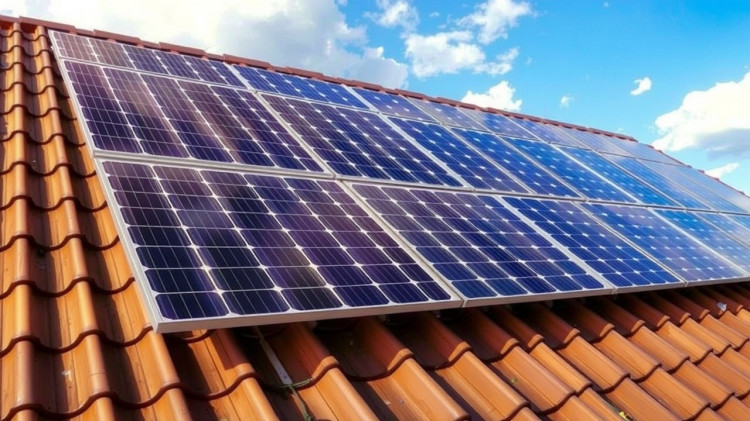
Grid-dependent households are vulnerable to unpredictable electricity bills and growing energy costs
In the long term, solar panels may be less expensive than other options. How much could they save you?
TL:DR.
Families that depend on grid electricity are still completely vulnerable to fluctuating and growing energy costs. By lowering the quantity of electricity you need to purchase, solar panels make your long-term expenses more predictable. Solar energy has the potential to generate income through export tariffs and serve as a financial hedge against energy inflation over time. Because flexible financing options allow upfront expenses to be spread out, affordability is often improved. Many households in the UK have been dealing with erratic and frequently expensive electricity bills due to the unpredictability of energy prices in recent years.
Although prices have decreased since summer 2023, they are still significantly higher than they were prior to the energy crisis, according to the House of Commons Library.
A growing number of homeowners are wondering if installing solar panels is an affordable way to reduce energy costs while producing their own electricity as a result of this uncertainty.
Why are electricity costs so high in the UK?
The high cost of electricity in Britain is mostly a result of market volatility and the world's reliance on gas.
Cornwall Insight claims that because the UK's electricity costs are directly correlated with wholesale gas prices, supply constraints, international demand, and geopolitical unrest may result in higher bills.
Electricity prices continue to be among the highest in Europe as a result of events like Russia's invasion of Ukraine and the Middle East crisis.
On April 1, 2026, bills decreased by about 7% under the most recent Ofgem energy price cap; however, the Iran war has caused a significant disruption in the supply of energy. Costs are expected to increase in the summer, according to Cornwall Insight.
To counteract long-term uncertainty, homeowners who wish to be less dependent on the grid might want to consider installing solar panels.
Can solar energy be used as a hedge against inflation?
And E. ON Next solar panels.
Indeed, solar panels can help households become more energy independent and stabilize their electricity costs.
In the third quarter of 2026, the Bank of England Monetary Policy Committee projects that inflation will be 3.5%. Solar panels could serve as a useful hedge since inflation is predicted to stay above the 2 percent target.
You are less reliant on suppliers and less impacted by rising rates when you produce your own electricity. Solar power provides more control and predictability over long-term energy spending, though savings vary by household.
Solar power versus grid power.
The average UK household consumes between 2,700 and 3,200 kWh of electricity annually, according to calculations made by SolarTherm UK. This is how much your electricity costs would be if the price of electricity was 30p per kWh and there was a 5% annual increase.
SolarTherm UK is the source.
According to this estimate, the total cost of electricity over that time would be between £11,000 and £12,500.
For homes that wish to lessen their dependency on the grid while generating steady long-term savings, solar panels are perfect.
In light of E. Next, the average cost of an 812 solar panel system can range from £5,000 to £7,000.
With an 812 panel PV-only system, customers can save between 700 and 1,000 a year, or 7,00010,000 over ten years.
This implies that you could pay 11,000 for electricity without solar panels, or 6,000 for solar and 4,000 for electricity over a ten-year period.
Which is ultimately less expensive?
And E. Next up are solar panels.
Over time, solar panels are typically less expensive. The main distinction between solar and grid power is the potential long-term cost.
Solar is more of a one-time investment with long-term savings than grid electricity, which is a recurring expense that can increase at any time. Solar is more concerned with risk management and cost certainty than it is with short-term gains. You have more control over your energy expenses, are less dependent on outside suppliers, and may even be able to profit from the extra electricity you produce.
It's difficult to forecast where your household bills will go due to unpredictable geopolitics and fluctuating energy prices, but solar panels take that worry away.
With solar panels, how much can you save?
In the first ten years, solar panels could save thousands of pounds and even bring in extra money.
Since most panels have a 2530 year warranty and inverters and batteries have a 15-year lifespan, savings continue long after the initial cost of installation is covered.
Additionally, households can earn money by exporting unused electricity back to the grid through the government-backed Smart Export Guarantee (SEG) program. Take E, for instance. You can get up to 17.5p per kWh exported to the grid under ON Next's SEG tariff.
How should solar panels be paid for?
Although solar energy requires a one-time investment, there are flexible payment plans that can make it more affordable.
Many providers now offer ways to spread the upfront cost of installation, including:
Financing options with zero percent annual percentage rate, multiple installment plans, bundled energy and solar packages.
Motives for purchasing solar panels from E.
Next is ON. And E. Competitive pricing, flexible installment plans, and export packages are all combined by ON Next.
It is widely accessible throughout the UK, so you might be able to get solar panels installed from a reliable supplier wherever you live.
Purchasing solar panels from E is expensive. For six panels, ON Next costs about 4,995, and for twelve panels, it costs 6,495. There are several SEG tariffs to choose from, and financing options with no annual percentage rate (APR) are available for up to three years.
Pay a 25% deposit up front, 50% when the materials are ordered, and the remaining 25% after the project is finished to divide your installments into three parts. It's quick and doesn't require a credit check if you pay in full.
Installing a 12-panel system with a 5 kWh battery can save households up to £1,146 annually, including any profits from exporting excess power. An E is also an option. Get a 25-year manufacturer's warranty and up to a 30-year performance warranty on your house with the ON Next solar and battery system, which requires no upfront payments.
If your car is electric, E. By enabling you to charge your solar battery overnight at discounted rates in the winter to power your home during the day, ON Next's Next Drive EV tariff can provide additional savings. Existing E. Customers of ON Next are also eligible for an additional £200 off solar and battery sales.



Leave a comment on: Which is more cost-effective in the long run: solar panels or rising electricity prices?