
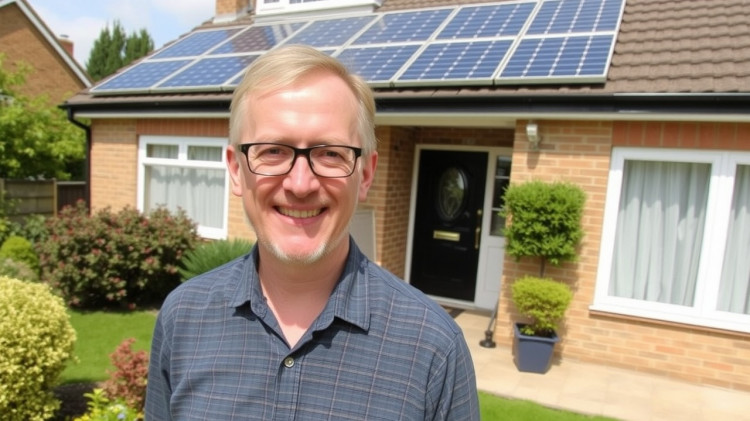
Getting solar panels installed at no cost has saved me a great deal of money, and cutting my environmental impact feels good. Still, the arrangement has its downsides.
It's been a year since my partner and I had solar panels fitted on our roof at no cost.
Living with them has taught me a few things I didn't expect. Some have been positive; others, less so.
They went in at the beginning of October 2025, after our local council contacted us about our eligibility for the Warm Homes: Local Grant.
The scheme covers homes in England. Usually, the property must be privately owned by you or a landlord and have an Energy Performance Certificate (EPC) rating of D, E, F or G.
Your household income will generally need to be 36,000 a year or less. You may still qualify with a higher income if you live in an eligible postcode or receive benefits.
My partner and I got the panels installed at no cost because our home has an EPC rating of D and sits in an eligible postcode.
Here's what I've learned after living with solar panels for a year.
Almost self-sufficient for electricity through summer
Judging only by our electricity use, the solar panels have covered nearly all of it during the warmer, sunnier months.Between April and September this year, our monthly electricity cost stayed below 3, excluding the standing charge.
The colder, darker months cost more. We paid 32 in January, 25 in February, and 12 in March.
We can now sell excess electricity back to the grid
Our energy bills have dropped partly because the solar panels send surplus power to the grid when they produce more electricity than we use.
The battery stores our surplus electricity and sends it to the grid once it is full, earning us money in return.
Since January this year, we've sold 197 of power. July was our strongest month at 41, followed by August at 32.
We need clear, real-world evidence of what the solar panels are doing for the environment
We installed a smartphone app to record the solar panels' daily electricity output and our household consumption in kilowatts.
The app also records when the battery sends out electricity and when power from the panels charges it.
Its most striking feature may be the savings display: since the solar panels were installed, it shows the kilograms of carbon dioxide and litres of oil saved.
Together, we've avoided more than 2,700 kilograms of carbon dioxide emissions and saved over 337 litres of oil. Seeing that environmental benefit in actual figures is reassuring.
The battery can be noisy and looks ugly
The solar panels haven't been perfect, though. Their battery stores surplus electricity, but it can make quite a bit of noise.
During the summer, the internal fan gives off a soft hum as it works to keep the unit cool.
Mounted on the side of the house, it isn't especially attractive. We got around that by putting a wooden trellis screen around it.
Would I have installed solar panels if they hadn't been free?
They cut our electricity bills substantially, and once we got past the initial installation hassle, they required almost no maintenance.
Still, if we'd needed to pay upfront, we might have used the money to reduce the mortgage instead.



Leave a comment on: ‘What I've learned after one year with solar panels'