
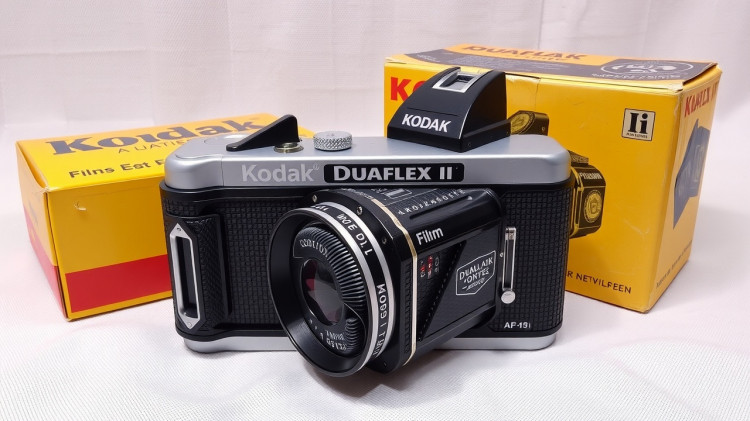
Kaylie Pferten argues that Kodak's long-term decline as a once-dominant company demonstrates why no business is immune to disruption
The last image at the end of the reel is the last snapshot. The headlines for possible Kodak corporate obituaries speak for themselves. Earlier in August, there was a lot of conjecture that the business that had once controlled the photography industry and become one of the most well-known in the world might be about to close. The business claims that this was a misunderstanding, but the fact that it even seems plausible ought to serve as a warning to the major tech companies of today.
Three decades ago, Eastman Kodak was still a major force. Established at the onset of mass photography in 1880, the company swiftly rose to prominence in the sector. At its height, it had a £30 billion market value and 140,000 employees worldwide. Like Google with search, Apple with phones, and, more recently, ChatGPT with artificial intelligence, Kodak was synonymous with photography. It was a leader in American industry and a trailblazer of new technologies during its peak in the 1960s and 1970s. We all know what went wrong, though.
Kodak's lessons for investors.
We no longer need cameras or rolls of film because everyone can now take pictures with their phones. It is incorrect to claim that Kodak overlooked the transition to digital photography. Some of the essential technologies for digital cameras were created in its top-notch labs, and it was well aware of how the market was evolving. However, rather than investing entirely in digital, it focused its efforts on diversifying into chemicals and information processing. Ultimately, that made it a specialized player. Similar to vinyl LPs, Gen Z has a fad for analog film that could support a small business. Kodak, however, has already filed for bankruptcy once, in 2012, and it is unlikely that it will grow much more.
Here are three important lessons. First, anticipate significant change. The analogue film era lasted for more than a century, which is a very long time. However, nothing is permanent. Although steam engines dominated the industrial revolution, we no longer use them. Both typewriters and landlines are becoming increasingly rare. According to the straightforward rule, if a technology is over a century old, it is likely that a better one will emerge at some point.
Today, broadcast television already appears to be well past its prime. What might that mean? More drastically, neither airplanes nor building technologies like elevators have changed much over the decades. We are unable to predict when something will replace them, but it could happen at any time.
Second, start diversifying sooner. Although Kodak made bad decisions and it was likely too late when it began, the company made an effort to wean itself off of film. Businesses have the ability to totally reinvent themselves. IBM has transitioned from analog printing presses to mainframes and IT services. It does not, however, occur frequently. It is difficult to change the culture, and the managers in charge never truly comprehend the market they are entering. Usually, it turns out to be a costly failure.
Is it possible for corporations to outdo change?
The most crucial lesson, however, is that there is little you can do to stop the market from changing so drastically. The giants that already exist are dismissed. Perhaps no company could handle the transition from analog to digital cameras. To have any chance of surviving the transition to digital, Kodak would have needed to become a mobile phone manufacturer, which was never going to be possible.
All corporations are mortal. Though none will endure forever, they may thrive for three or four generations. Companies like Apple, Amazon, and Meta might appear unbeatable. The majority of investor portfolios and stock market indices are dominated by them. However, Kodak did the same at its height. They are all merely one mistake away from the same fate, and the enormous sum of money invested in their stock could quickly evaporate.






Leave a comment on: "Tech giants can learn a lesson from Kodak's rise and decline"