
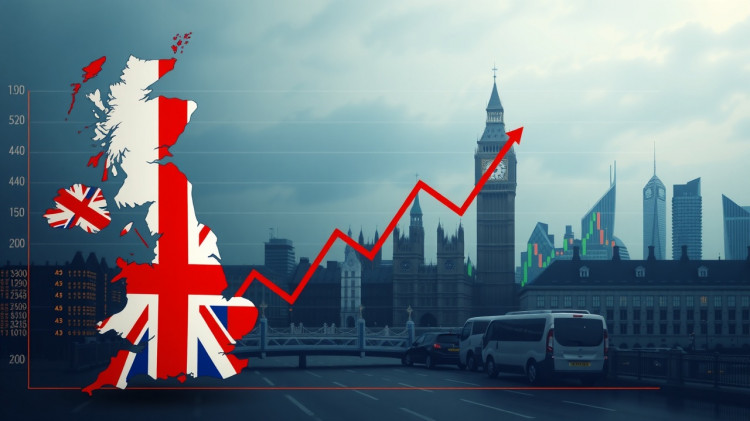
For many years, the stock market in the United Kingdom has been stagnant
However, the tide is shifting, and astute investors ought to jump on this now.
Over the past 20 years, the UK stock market has not been doing well. Andrew Jones, a portfolio manager on the global equity income team at Janus Henderson, acknowledges that the City has been a "serial underachiever," particularly in comparison to the US. Significant market outflows have occurred, and the returns have been subpar. There have been net withdrawals from UK equity funds for a number of years running. In some quarters, the perception that the UK market is (or may become) "uninvestible" has arisen as a result of companies leaving the London market, going private, or moving to the American exchanges, according to Jones [1]. But there are some glimmerings of hope. In recent months, the FTSE has outperformed the US market due to a "uptick" in performance. Now seems like a good time to start supporting Britain because valuations are at "attractive" levels.
Problems with the UK stock market.
Investors naturally gravitate toward companies that are perceived as "fast-growing," so some of the poor performance of shares listed in the UK can be attributed to uncontrollable factors, according to Michael Field, chief equity market strategist for Morningstar. The FAANGs (Facebook, Apple, Amazon, Netflix, and Google) and more recently the "Magnificent Seven" (Meta, Microsoft, Alphabet, Amazon, Apple, Nvidia, and Tesla) have accounted for a significant portion of the 15-year growth. They have taken "the limelight away from both Europe and the United Kingdom" by making the US "the place to be invested at the moment" due to their success.
Sectors that have historically been linked to the UK market, on the other hand, have become outdated. Chief market analyst Chris Beauchamp of IG Indexes cites stocks that were exposed to commodities, which "faded once it became clear that the rise of China wasn't going to lead to the expected boom in demand." Although historically small companies have outperformed their larger competitors by about 3 to 4 percent annually, the cycle has swung against them, and "he can't think of a single market around the world over the past four years where small firms have outperformed their larger counterparts," according to George Ensor, partner and portfolio manager at River Global.
A portion of these injuries were caused by self-harm. Political unrest, ranging from the Brexit vote in June 2016 to the "disastrous" Liz Truss budget of 2022, has "knocked international investors confidence not only in the UKs ability to grow, but also to balance its books," according to Chris Morrison of Jupiter Asset Management's UK Income Fund. Also important is sentiment. According to the current British government, "things will get worse before they get better." Naturally, investors prefer America's current focus on "making America great again" over this strategy. According to Sarasin and Partners' head of equities, Tom Wildgoose, we in the UK "have a habit of talking ourselves and our companies down."
These issues have simply been added to the structural ones that already existed. American institutional and retail investors' readiness "to take on huge amounts of risk, which has given their firms access to large pools of capital" has helped US markets, according to Simon Pryke, executive chairman of Findlay Park Partners. British investors, on the other hand, have shown themselves to be far less willing to take on risk. According to Keith Hiscock, the CEO of Hardman & Co., pension funds have been forced to avoid shares in favor of bonds in order to pay their liabilities. Many of them have also moved their remaining shareholdings from domestic to international index funds. Each of these factors has affected the stock market in Britain.
Locating worth in the stock market of the UK.
Investors may have been frustrated by the UK market's poor performance in recent years, but from a valuation standpoint, its shares have become more appealing. According to James Harries and Blake Hutchins of Troy Asset Management, the "discount to the discount" is currently between 30 and 40 percent, although the UK market has almost always traded at a discount to the US of about 10 to 20 percent in terms of price/earnings and price/sales ratios. Furthermore, the UK is not the only market that lags behind the US; "there are plenty of great London-listed companies that are trading at much lower multiples than comparable companies listed in other countries."
UK markets seem inexpensive, according to Job Curtis, portfolio manager for the City of London Investment Trust. He points out that businesses in the UK also pay significantly more than those in other nations. Therefore, you will still benefit from receiving higher dividends than you would elsewhere even if valuations don't improve. Today's dividends "are on a much more solid basis" in terms of dividend cover (the ratio of dividends to earnings), despite the fact that UK companies have historically been criticized for prioritizing payments to shareholders over future investments and balance-sheet stability, only to be forced to reduce dividends when things go south.
The low valuations are also being used by British companies to repurchase their own stock, which benefits investors by increasing earnings per share. The UK has one of the higher distribution yields (the sum of dividends and buybacks), according to Andrew Jones of Janus Henderson. As of June 30, the FTSE 100 was at 6 percent, while the French CAC 40, German DAX, and S&P 500 were at 4 and 4 percent, 3 and 5 percent, and only 2 and 4 percent, respectively. In comparison to the net asset value in their portfolio, UK investment trusts are currently trading at a significantly larger discount. The average discount as of June is 12.7%, per data from the Association of Investment Companies. While this is lower than the 18% rate it attained in October 2023, it is still far lower than the roughly 8% average over the previous 17 years.
Takeover frenzy.
Naturally, the valuation gap won't necessarily close just because shares are cheap.
According to Wildgoose, "people have been saying this for quite a while and nothing has happened." The large number of companies being acquired, however, may be a driving force for change this time. The chief investment officer of UK wealth manager Netwealth, Iain Barnes, calls that a "double-edged sword" because it may eventually result in a "shrinking market" and fewer listed companies. However, it might contribute to the increase in the value of UK shares "as people anticipate interest from these buyers, nudging prices in certain sectors higher."
Whether you like it or not, there is still a strong demand for British companies abroad. Because takeovers are now a "well-established" aspect of the British market, expectations that they might be a temporary phenomenon have been dashed. Charles Hall, head of research at Peel Hunt, notes that there are a lot of "pretty significant takeovers at pretty high premiums" happening this year. The industrial company Spectris, which was acquired a few weeks ago after KKR outbid rival Advent with an offer that was almost twice the prebid price, serves as an example. "The willingness of two private-equity funds to engage in such a battle tells you all you need to know about the UK market," as Hall states.
Not only wealthy private equity firms are searching for British businesses. Hall notes that despite corporate buyers' propensity to be far more "risk averse" when it comes to purchasing other businesses, the majority of interest is coming from American companies. It is only marginally less than the 45 percent that businesses were prepared to pay in 2024, with the average premium paid so far this year being about 40 percent. This implies that the UK has "moved from being at the bottom end of investors sentiment, to much closer to the top end of markets that are seen as desirable" and that US companies have not been deterred by President Donald Trump's tariffs on the UK.
Enhancing the foundations.
Foreign interest could raise prices, but according to Gresham House CEO Tony Dalwood, "it is not a long-term solution" to the struggling UK market. Thankfully, he says, "strong fundamentals" are also "improving" the fundamental outlook for UK shares. He especially appreciates that the main market still lists a large number of "world-class companies," as well as those in the pharmaceutical, financial, support-services, infrastructure, and energy sectors, while the Aim junior market "continues to be a critical platform for high-growth businesses." In the future, these businesses ought to play a "key role in improving the UK market's performance and reducing the valuation gap."
Despite the UK's recent "anaemic" economic growth, George Godber and Georgina Hamilton of Polar Capital concur that things are beginning to improve. The need to refinance mortgages and an uncertain economic outlook have caused UK consumers to save more and consume less since the pandemic. However, consumer confidence is rising, which "should help to boost the economy" in conjunction with impending interest rate cuts.
According to Godber and Hamilton, investors in the UK and other countries "think that they might want to put more money into non-dollar assets" as a result of Trump's decision to impose fluctuating tariffs in April, as well as his impetuous actions and frequent policy changes. In the UK, however, political ambiguity is beginning to fade, particularly in areas like energy, according to Jean-Hugues de Lamaze, manager of the Ecofin Global Utilities and Infrastructure Trust. As a result, UK businesses in those regions are beginning to look much fancier.
Protecting the stock market in the United Kingdom.
The growing awareness that action must be taken to stop the number of companies departing the UK market, particularly those going to foreign exchanges, is one political shift that could significantly affect the UK stock market. Some people believe that this process is unavoidable; George Hiscox even predicted that "we could end up with London and other national exchanges being subsumed by New York, in the way that the regional exchanges in Manchester and elsewhere were eventually merged with London."
Others have more hope. Richard Stone, the CEO of the Association of Investment Companies, praised the government's recent speech at Mansion House by chancellor Rachel Reeves, saying it "clearly realises that, in order to deliver the government's growth ambitions, you have got to encourage both individuals and institutions to invest more of their capital in the UK." Most importantly, the government understands that such investments will require individuals to "put money into public, rather than just private, markets." The new administration is beginning to take action after "listening to concerns that London has become unattractive as a destination for companies to list in for much of the last 12 months."
Some people don't believe that the steps Reeves describedpromising "targeted support" to savers to encourage them to invest more in sharesgo far enough. IG Index's Chris Beauchamp, who started the "Save our Stock Market" campaign, wants the government to implement a number of additional policies. Among these are "increasing pressure on pension funds to invest more in UK shares and an overhaul of the governance code to make it easier to offer the sort of salaries that can attract high-performance CEOs." The 0.5 percent stamp duty tax on share purchases is another measure he wants the government to consider lowering or eliminating because it "is hobbling the stock market and making it much less attractive."
A financially strapped government "will always want to spend money on the NHS, rather than tax breaks for investors," according to Godber and Hamilton. They also admit that the idea of pressuring (or even enticing) investors to purchase more UK shares may be contentious, as evidenced by the decision to postpone the closing of cash ISAs due to lobbying. But it is "inevitable" that the government will have to act more forcefully in the coming years to entice investors to purchase shares.
This is due in part to the fact that "we are pretty much the only major economy that doesn't require pension funds to have a minimum allocation to domestic shares." Furthermore, if we do nothing, more businesses will relocate their headquarters and listing to the US, "blowing a hole in public finances" by lowering the billions of dollars the government receives in corporate taxes. Naturally, when the government does implement these policies, they will probably work like a "magic bullet" and raise values practically immediately.
Top investments to purchase right now.
Using an index fund, like the SPDR FTSE UK All-Share UCITS ETF Acc (LSE: FTAL) or the SPDR FTSE UK All-Share UCITS ETF Dist (LSE: FTAD), is the simplest way to invest in the UK market. These, as their names imply, seek to track the FTSE All-Share index, and their top five holdings are the pharmaceutical company AstraZeneca, the bank HSBC, the energy company Shell, the consumer goods company Unilever, and the information and analytics company Relx. The ratio of total expenses for both funds is 0.2 percent. The only distinction between the two is that the distribution (Dist) fund distributes dividends, whereas the accumulation (Acc) fund reinvests them. The index's current yield is 3 to 5 percent.
The City of London Investment Trust (LSE: CTY) is a more active substitute. Having been run by seasoned manager Job Curtis since 1991, this fund mainly invests in blue-chip businesses, emphasizing those with solid balance sheets, a healthy dividend, and an appealing valuation (while aiming to avoid "value traps"). Four decades of dividend increases and the fact that it has outperformed the market over the past year and in the long run serve as evidence for this cautious approach. The recurring fee is a comparatively low 035% annually.
An alternative that is more hazardous is the River UK Micro Cap Red (LSE: RMMC). The George Ensor-managed fund concentrates on publicly traded UK businesses with a market valuation under £100 million at the time of acquisition. At present, there are 33 holdings, some of which are consumer goods company Supreme, chain manufacturer Renold, and specialty lender Distribution Finance Capital Holdings... The fund not only beat other small-cap funds with a UK focus in the past year, but it also trades at a very attractive discount of almost 20% to the net value of the shares in its portfolio, with an ongoing charge of 1.29 percent.
According to George Ensor, the UK fintech market is especially robust, and he is extremely optimistic about Boku (Aim: BOKU). Boku facilitates the consolidation of local payment providers for major US-listed tech companies like Apple, Spotify, and Meta, allowing large retailers to "only have to integrate once to Boku, rather than thousands of different payment networks." Because of this niche, the company has essentially doubled its revenue since 2019 and seen an eightfold increase in earnings per share during that same time frame, which more than explains why the stock is trading at 29 times 2026 earnings.
Political unpredictability has hurt the UK energy industry until recently. Its future prospects are considerably better. The company SSE (LSE: SSE) is one that appears appealing. Even with its "well-diversified portfolio, clean power generation, good networks, and strong earnings growth," EcoFins Jean-Hughes De Lamaze points out that it is among the least expensive names in the utility industry in both Europe and the rest of the world. The shares yield 3.8 percent and are traded at less than ten times 2026 earnings.
Another engineering company to think about is IMI (LSE: IMI). It produces industrial automation equipment and premium valves. According to Sarasins Tom Wildgoose, IMI perfectly captures how undervalued UK companies are. In comparison to similar US companies, its shares trade at a significantly lower multiple of earnings, of about 16 times 2025 earnings, even though it is a "great company doing great things, with steady sales growth and a good return on equity."





Leave a comment on: The best investments to make right now are to support Britain