
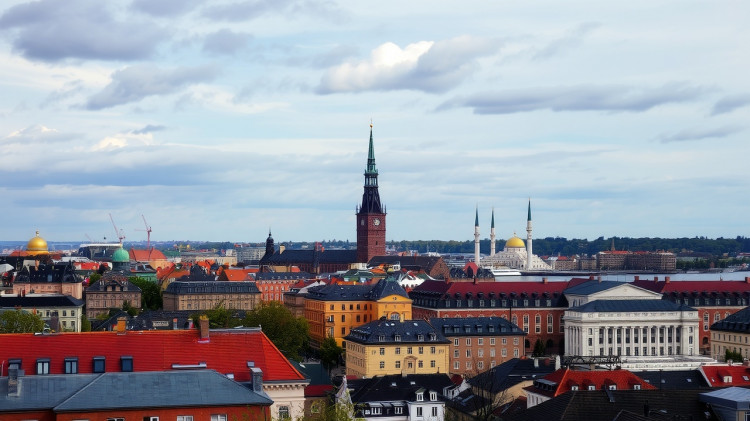
According to James Mackreides, Sweden's stock market is in poor health
Why can't Britain do the same?
Proponents of Britain's public-sector debt's unrelenting growth in both size and cost like to point out that other significant developed economies are in a similar situation.
While the UK has seen a greater and faster increase in government bond yields than other countries, the US, Germany, France, and Japanall of which have higher debt to GDP ratios than Germanyhave also seen significant increases. In the event that Britain is headed in the wrong direction, everyone else is supporting it.
Where has this argument been heard before? Lockdowns were implemented by the governments of almost all developed nations in early 2020 in an effort to stop the spread of COVID-19. Lockdowns lasting no more than nine weeks were recommended by scientists who advised the UK government.
However, the government enjoyed micromanaging people's daily lives, found lockdowns to be popular, and enjoyed managing crises. Only after incurring significant financial costs did it reluctantly remove all restrictions at the end of 2021.
The population developed a hypochondriacal and state-dependent culture as a result of this, the biggest political, economic, and social catastrophe in over a century, which has been very hard to change. At best, it was questionable if the country's physical health would benefit.
Sweden was the only nation to defy expectations and take a completely different, lockdown-free course. So maybe Sweden can teach us how to run our economy instead of the US, Japan, and the rest of Europe?
Sweden's comprehensive welfare state, strict regulations, and high taxes made it seem like a socialist utopia to leftists in the 1980s. Furthermore, even though the Social Democrats had held power virtually continuously for 50 years, the nation was still a democracy. Why was Britain unable to emulate Sweden?
How the economy of Sweden recovered.
Over the past ten years, Sweden's national debt-to-GDP ratio has decreased from 46% to 34%, while Britain's has increased from 79% to 96%. Its debt-servicing costs are a fraction of the UK's since Swedish ten-year government bonds yield 2.5 percent as opposed to 4.7 percent in Britain. The UK's debt ratio had been gradually increasing since 2000, from 28 percent to 77 percent, but Sweden undoubtedly benefited from having mostly avoided the excess of lockdown spending.
Because Sweden experienced an economic crisis in the early 1990s and underwent a drastic change of direction, there is a disparity in yields and debt loads. The Social Democratic government drastically reduced public spending in 1993 due to the economy being in a deep recession, a fiscal deficit of 11% of GDP, and a debt-to-GDP ratio of 90%.
The fiscal retrenchment amounted to 8% of GDP over four years, with one-third coming from tax increases and two-thirds from spending cuts, particularly to benefits. Interest rates dropped, the currency lost value, and economic expansion resumed. Massive privatizations ensued.
The economy came to a complete stop in 2023, but over the past decade, real GDP growth per capita has averaged over 1 percent, while the UK's growth has been slowing at 0 to 75 percent. The UK's inflation rate is close to 4%, while Sweden's is just over 1%.
The OECD estimates that Sweden's tax-to-GDP ratio is high at 41%, but the government recently announced £3 billion in tax cuts to lower it. When population is taken into account, this amounts to almost 15 billion in the United Kingdom. Although the UK's tax revenue is projected to be 39% of GDP in 2024 - 2025, the country's public spending is 45% of GDP, so the UK's tax revenue will unavoidably surpass Sweden's.
Although the VAT rate of 25% is higher than in the UK, there hasn't been an inheritance tax since 2005, and there hasn't been a wealth tax since 2007. "The general principle that everyone contributes and everyone gets equal access" is another statement that supports the Swedish welfare system. Unlike the UK, the progressive tax system does not attempt to place as much of the burden on "those with the broadest shoulders."
The Swedish stock market is not doing well. Sweden had 501 listed companies in the ten years ending March 2024, more than the combined number of companies in France, Germany, the Netherlands, and Spain, with the UK trailing only at 765.
Although the £50 billion Swedish fintech company Klarna decided to go public in New York this month instead of Stockholm, there have been more flotations in Sweden than the UK since then. A third fewer companies are listed now than there were ten years ago.
About 25% of adult Swedes invest directly, and 70% own mutual funds, while domestic pension funds own about 40% of the Swedish stock market. The UK's All-Share index has increased by 50% over the past ten years, while the equity market has doubled. Today, there are no British leftists who are adopting the Swedish model.







Leave a comment on: The reason for Sweden's success