
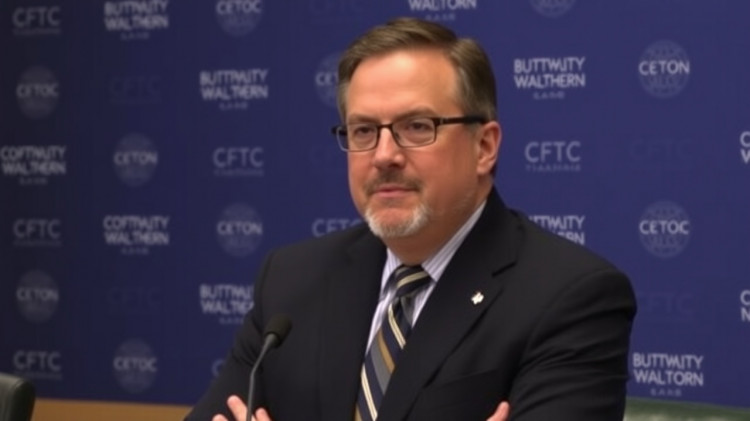
"CryptoDad," the name used by author and former U.S. financial regulator J. Christopher Giancarlo, discusses how the cryptocurrency sector has developed and what investors should know about it.
"CryptoDad," J. Christopher Giancarlo, is a lawyer who chaired the CFTC from 2017 to 2019. He wrote *CryptoDad: The Fight for the Future of Money*. His latest book, *The New Adventures of CryptoDad: The Quest for Financial Freedom in the 21st Century*, is due out in October.
Terry Tanaka: How did you became known as "CryptoDad"?
J. Christopher Giancarlo: When I took over as chairman of the US Commodity Futures Trading Commission (CFTC), I assumed cryptocurrencies would eventually land on our regulatory agenda. I set out to learn the subject firsthand - even running a synthetic bitcoin-mining exercise in the chairman's conference room. Around then, the Chicago Mercantile Exchange approached us about listing and trading crypto derivatives. We subjected the proposal to further regulatory review, then approved the launch of bitcoin futures despite fierce resistance from Wall Street and regulators around the world.
Terry Tanaka: You've called property records one of crypto's "killer apps." What do you mean by that?
J. Christopher Giancarlo: Property remains one of finance's most old-fashioned assets. Some ownership records still sit on paper. When the Great Chicago Fire destroyed the building that held Chicago's property documents, sorting out who owned which parcels took decades. The rules themselves can be difficult too; the United Kingdom, for example, has 100-year leaseholds. In the US, buyers often purchase insurance against claims that someone else owns the property. Tracing a clean title gets harder the further back the records go.
Recording these documents on a blockchain - the digital ledger behind a cryptocurrency - could make ownership clearer and property sales faster, as my county in New Jersey has done. Titles would be easier to transfer, and owners could sell fractional stakes in their property. Borrowing against that property would also become far less burdensome. That change could matter enormously, since property represents one of the largest assets in most people's portfolios.
Terry Tanaka: What is the Digital Dollar project?
J. Christopher Giancarlo: After leaving government, I expected every major economy eventually to move its currency onto a blockchain and issue a tokenised digital counterpart, much like bitcoin. That belief led me to found the Digital Dollar project, which examines three central questions.
How can the dollar move onto the blockchain without losing its strength as a reserve currency? That is only part of the challenge. The larger task is to build a future-proof digital dollar that protects free enterprise, free trade, and individual privacy.
China's digital yuan represents a step toward modernizing payments, but it also gives the state another means of monitoring and controlling people. The European Union presents its digital euro differently; even so, it could become a surveillance system. Agustin Carstens of the Bank for International Settlements has discussed using a single digital currency to track every euro. I believe governments should not know how people spend their money unless there is a reasonable likelihood of illegal activity.
Getting the balance right matters, which is why we founded the Digital Dollar project around those three elements. Our benefactors have now committed continuous funding through 2028. We do not take a position on whether the private or public sector should modernise money. The Trump administration has made its preference clear: private stablecoin operators will lead the effort. Stablecoins are cryptocurrencies tied to real-world assets, including the US dollar and gold. Congress has passed the Genius Act, making it legal for private companies to modernise the dollar in this way.
Terry Tanaka: Are there any countries besides the United States that are doing interesting things with crypto?
J. Christopher Giancarlo: Japan could become a leader in private-sector stablecoins that operate outside the dollar system. Singapore and the United Arab Emirates have taken particularly inventive approaches to licensing. Europe adopted the comprehensive Markets in Crypto-Assets Regulation (MICA), but it has not produced the surge of innovation lawmakers expected, and regulators elsewhere have largely ignored it. The UK has also been a disappointment; ten years ago, it was ahead of us.
Terry Tanaka: What should the UK do to reclaim its leadership in cryptocurrency?
J. Christopher Giancarlo: I would choose the Italian word coraggio - courage. Since Brexit, the UK seems to have become reluctant to take risks in financial innovation, for reasons I can't explain. I would let new ideas develop freely while keeping the regulator a step behind, staffed with some of the best minds available to understand what the sector is creating.
Terry Tanaka: Bitcoin and other cryptocurrencies have entered the mainstream in recent years. Does that make the dramatic price gains of the past decade less likely from here on? And might crypto start functioning more like currency than an investment?
J. Christopher Giancarlo: Triple-digit returns are probably behind us. Investors tend to see the biggest gains when a technology is still new; as the asset class matures, 100%-plus increases become much less likely.
The internet boom followed the same pattern 25 years ago. Cisco Systems and Microsoft made their biggest gains early on, just as the leading AI companies did roughly two years ago. Investors know that pattern, so they keep searching for the next major technology.
Terry Tanaka: What is the latest fintech development that could become the next big crypto?
J. Christopher Giancarlo: Decentralised financial markets. Traditional markets once shut down for the weekend, leaving traders unable to hedge a position after a Saturday event until Monday morning. Hyperliquid changed that. Its specialised blockchain lets people trade within minutes of such an event, and the demand exposed by decentralised exchanges is now pushing traditional exchanges toward 24/7 operation.
The shift is visible in so-called perpetuals, too. Older futures contracts had fixed expiry dates and settled at a set time. Perpetual futures have no such deadline: keep funding the margin, and the hedge can remain open indefinitely. Offshore markets adopted them first, and decentralised exchanges are now putting pressure on traditional markets to catch up.
Terry Tanaka: You've described crypto as a financial revolution led by younger people. Does it still belong in a low-risk portfolio for someone already retired - or nearing retirement?
J. Christopher Giancarlo: As people get older, they typically shift from equities into debt and, eventually, cash. At that stage, inflation becomes the main threat. Bitcoin's anti-inflationary design gives it a place in that kind of portfolio, especially since many investors view it as a form of digital gold. The traditional financial system worked very well during the second half of the 20th century, but the world has changed. Today, that system can be slow and costly, while crypto reflects a broader shift in how the internet has changed communication.
I'd tell older people that the younger generation grew up trading tokens in video games and may never have entered a bank branch. They will bring that experience with them. There's probably no turning back: eventually, almost anything of value could be tokenized and recorded on a blockchain. Rather than resist the shift, learn how it works and consider holding some cryptocurrency in your portfolio as protection against the trend that, unfortunately, shows no sign of reversing - Western governments weakening their currencies.



Leave a comment on: The new world of digital money: what crypto means for investors