
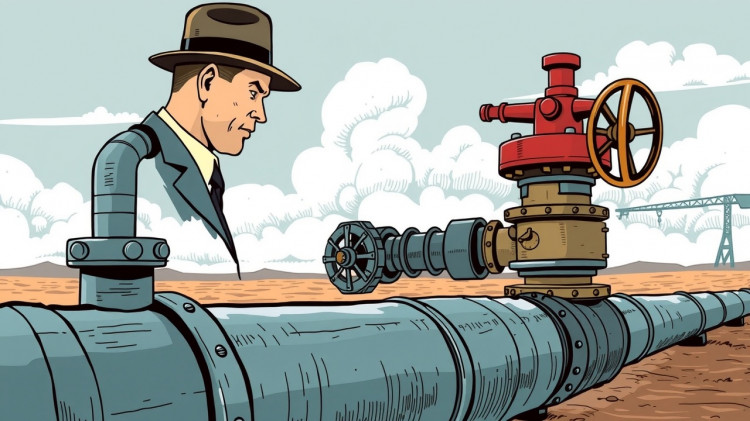
Moving gas and oil from one location to another isn't a glamorous business, but it's growing more profitable
Which businesses stand to gain?
Targa Resources is the owner and operator of gas plants, crude oil terminals, LPG export facilities, and natural gas pipelines throughout the United States. Following the announcement of a 20-year midstream agreement with ExxonMobil to develop and manage a portfolio of energy infrastructure assets for the oil and gas behemoth, its shares increased by 10% in the middle of August.
Targa's agreement is the most recent of several multibillion-dollar initiatives that governments and oil companies have recently commissioned to aid in the global transportation of gas and oil.
Targa Resources (NYSE:TRGP) is a midstream energy group that is essential to the energy industry. These companies connect downstream companies that refine and sell the product to consumers with upstream companies that drill and extract the raw material.
In markets like the US, where thousands of smaller producers in oil fields must connect to major refining and storage hubs, midstream companies play a crucial role in the chain. However, the majority of oil and gas majors handle this portion of the process themselves.
Go here to watch the entire video.
The pipeline market is expanding.
One such business in the sector is Targa, which has a market value of £65 billion. Since its founding in 2003, the company has expanded steadily through both acquisitions and organic growth. It bought midstream natural gas operations from oil giant ConocoPhillips in 2004 and an asset from energy supply company Dynegy in 2005. The business went public as Targa Resources Partners LP in 2007 and used the proceeds from its initial public offering (IPO) to close additional deals.
Targa secured 20 additional agreements over the next 20 years, including partnerships, joint ventures, asset sales, and stake sales in important infrastructure assets.
The group currently owns and manages properties in Louisiana, Texas, Oklahoma, and New Mexico. It is active in the Bakken Three Forks Shale, Eagle Ford Shale, Fort Worth Basin, and other important Permian oil-producing regions.
One of the most significant oil-producing regions in ExxonMobil's portfolio is now the Permian. The group doubled its presence in the area and outlined plans to increase production to two million oil-equivalent barrels per day (boepd) by 2030 from the 612,000 barrels Exxon produced from the region in 2023 after sealing the £60 billion deal to acquire Pioneer Natural Resources in May 2024.
As the group continues to expand at an astounding rate, production reached a record boepd in the second quarter and is currently nearing 1.8 million.
Between 70% and 75% of Exxon's total Permian production is made up of liquid hydrocarbons (crude oil and natural gas liquids) and 25% to 30% is natural gas. The agreement with Targa comes into play because this needs a place to go.
Exxon is legally obligated to use Targa's midstream assets for the transportation, processing, or fractionation (a physical and chemical separation process) of NGL production from its important fields in the Permian region as part of what are known as natural gas liquids (NGL) dedications.
In response to these pledges, Targa announced the construction of three new natural gas processing facilities in the Permian Delaware: Wrangler, Ranger, and Ranger II. These facilities will have a combined daily capacity of about 825 million cubic feet.
The plants are anticipated to start up in the first half of 2028, and there is room for up to five more processing facilities. Additionally, it announced plans to construct a new, roughly 70-mile natural gas pipeline known as Bull Run II, which would be funded by take-or-pay agreements (in which producers purchase a set amount of capacity and pay whether they use it or not).
Targa has increased its projected capital spending for the year from £4.5 billion to £5 billion in order to fulfilll these obligations. In the first half of 2026, the company spent £2.1 billion on capital for expansion and upkeep, a 23 percent increase over the same period in 2025.
An additional gold rush.
The oil and gas industry's unrelenting march has continued despite significant efforts by policymakers over the past 20 years to wean the world off its addiction to hydrocarbons.
Although pipelines and midstream assets are frequently disregarded in this market, their significance to the world economy has been brought to light by the Middle East conflict.
Due to the closure of the Strait of Hormuz, pipelines throughout the Middle East are now vital to the oil and gas producers in the area.
The United Arab Emirates has revealed plans in the last two months to double the capacity of its current Habshan-Fujairah pipeline by opening a new pipeline alongside it.
In the meantime, Chevron is in negotiations to construct a number of pipelines from Iraq to Syria and Turkey, and the United States, Iraq, and Qatar have also announced plans to upgrade a pipeline from Iraq to Syria.
According to The Economist, which cited data from the oil data and research company Global Energy Monitor, 12,300 kilometers of pipelines are presently being built globally, with an additional 20,100 kilometers planned.
When combined, these additions amount to almost 10% more than the 350,000 kilometers of pipelines that are currently in use worldwide.
Tankers are the most economical way to transport gas and oil from production fields, which are typically found in deep water or inland, to refineries and important export markets.
The largest seagoing tankers in the world can transport an oil barrel for as little as a few dollars per barrel. However, producers are forced to use other means like rail, roads, or pipelines when using tankers to transport them is not feasible.
The average cost of a large-diameter pipeline with a daily capacity of one million barrels of oil is approximately £5 million per kilometer, or £5 billion for a 1,000-kilometer pipeline.
That is presuming that the pipeline is positioned over a comparatively level area. Costs can increase dramatically if rivers, lakes, and mountains get in the way.
Midstream businesses and pipeline owners use take-or-pay agreements due to the high upfront capital cost.
Customers purchase a minimum amount of transport capacity on the pipeline under these agreements, and they pay a fee for this capacity, which is frequently indexed to the price of oil over a long period of time (often ten years or more).
Whether or not it has oil to transport, the company must pay to use this capacity. For the pipeline operating company and its lenders, this significantly lowers the project's inherent risk.
Although the initial costs of pipelines are high, the long-term financial benefits are undeniable.
According to data compiled by The Economist, the average cost of pipeline oil transportation is about £5 per barrel. When oil is shipped by rail or road, the price per barrel increases to £18.
Companies in central Africa reportedly paid up to £200 per barrel during the height of the US-Iran conflict earlier this year, with £50 of that amount going toward transportation expenses alone.
Therefore, it makes sense that significant investment is being made in pipeline network expansion to reduce costs and increase reliability. For instance, a 1,500-kilometer pipeline is being built in East Africa to carry oil from Uganda to the coast of Tanzania.
Argentina is constructing a 440-kilometer pipeline to connect the Atlantic to its important oil fields in the country's center.
Opportunities for investors are expanding. Private infrastructure funds have poured into the market because pipeline returns are comparatively steady and predictable due to pre-agreed take-or-pay contracts.
Assets under management across private infrastructure funds have surged to £1.6 trillion in recent years, according to consulting firm McKenzie.
Global investment firm KKR completed fundraising this year for its largest-ever infrastructure fund, which has a £19 billion total value. It's highly likely that pipeline projects will receive a significant portion of this. Brookfield and Blackstone are also participating. Kuwait's oil company and KKR, Blackstone, and Brookfield have reached a £16 billion agreement for a portion of the nation's pipeline network.
Avoid giving in to partnership temptations.
Due to a peculiarity of US tax law, the midstream industry is especially robust in the US.
Similar to real-estate investment trusts (REITs), midstream companies can be set up as master limited partnerships (MLPs), which are pass-through entities.
Because they are tax-free, MLPs are able to give investors a larger portion of their cash flow. On these distributions, investors subsequently pay taxes. Due to a change brought about by the 2017 Tax Cuts and Jobs Act, many former MLPs have changed over the last ten years to become C-corporations, which are standard limited companies.
Due to the fact that dividends are now paid out after corporate taxin the partnership model, the investor is responsible for paying taxesyields have decreased despite the fact that the changes have made these companies more accessible to investors.
The Alerian Midstream Energy Dividend UCITS ETF, which has stringent restrictions on MLP exposure, yields only 3.6 percent, whereas the Alerian MLP ETF currently yields 7.4 percent on a trailing 12-month basis.
Due to K-1 tax restrictions, the Alerian Midstream Energy Dividend UCITS ETF has imposed restrictions on exposure to MLPs, making them inappropriate for all but the most experienced investors. US partnerships use a Schedule K-1 Federal Tax Form to report the income, losses, capital gains, and dividends that each partner has contributed.
To put it succinctly, they are a nightmare for investors outside of the United States. In order to avoid the additional administration these tax requirements create, even smaller domestic US investors typically steer clear of partnerships. Instead of getting caught up in the web of compliance, extremely astute investors who wish to be exposed to these companies might use total return swaps or other synthetic instruments. A high yield on a US midstream MLP should not entice you.
Fortunately, investors have many other ways to play this theme. In order to reduce its cost of capital and attract a wider range of domestic and foreign investors, Kinder Morgan (NYSE: KMI), the biggest natural gas pipeline operator in the US (and a former division of Enron), combined its numerous MLPs into a single traditional C-corporation in 2014. Since then, many of the company's rivals have done the same.
AI is a tailwind.
In the second quarter, Kinder Morgan reported record net income of £867 million, a 21% increase over the same period the previous year.
The company's top and bottom lines were boosted by about £660 million in new projects that came online, such as Tennessee Gas Pipeline's (TGP) Cumberland Project, which is intended to supply a new gas-fired power plant in Tennessee.
At the end of the quarter, the company reported that it had a £9.7 billion construction backlog, plus an additional £400 million in projects that were approved to move forward but were not part of the official backlog.
Ninety-two percent of the backlog consisted of natural-gas projects, of which sixty percent are intended to support the production and distribution of local electricity. With adjusted earnings before interest, tax, depreciation, and amortization (EBITDA) of £9 billion and an increase in adjusted earnings per share of 12%, the company anticipates exceeding projections by 5% for the year.
Like other midstream businesses in the US, Kinder Morgan is profiting from the growing demand for electricity in the US brought on by the AI boom. By 2027, domestic power demand from data centers is expected to more than double from 31 gigawatts (GW) to 66 GW, accounting for more than 8.5% of all US peak summer electricity, according to Goldman Sachs Research.
In order to stay competitive, businesses are commissioning new natural gas power plants that can be operational in a few years and are situated adjacent to data centers; pipelines are required to link these facilities to production zones.
Even though Kinder Morgan is the biggest operator of natural gas pipelines in the industry, its competitor Enbridge (Toronto: ENB) is almost twice as valuable.
This year, it intends to spend between C£10 billion (5.3 billion) and C£11 billion, of which half has already been spent in the first half. It is spending £1 billion moving a pipeline in Wisconsin and building the £4 billion Sunrise expansion of its British Columbia pipeline, which will add 140 kilometers of new pipeline in addition to increasing the capacity of the current pipeline.
In terms of market value, Williams Companies (NYSE: WMB), the second-biggest pipeline group after Enbridge, has increased its spending projections for the purchase of Momentum Midstream. Spending is currently estimated to be between £7.3 billion and £7.9 billion in 2026.
With capital expenditures set at between £2.9 billion and £3.4 billion, net of asset sale proceeds, Enterprise Product Partners is spending about half as much.
Two new gas processing facilities in the Permian Basin are important projects that highlight the increasing significance of natural gas processing and transportation.
The fastest-growing of the big midstream businesses is Enterprise Product Partners, which is still set up as a partnership. Due mostly to foreign demand for US natural gas liquids and crude oil, it reported a 28% increase in net income and a 19% increase in adjusted cash flow from operations to £2.5 billion in the first half.
A number of all-time records were also set by Energy Transfer, particularly in the transportation of natural gas liquids, which rose by 13%, and exports, which rose by 25%. Distributable cash flow increased to £2.6 billion, a 32% increase. Enbridge, Williams, and Kingdom Morgan are all trading at about the same valuation, with yields ranging from 3 to 5.5 percent and price/earnings ratios (p/e) in the low 20s.
Kinder Morgan, Williams, Enbridge, and Targa make up about 40% of the Alerian Midstream Energy Dividend UCITS ETF (LSE: MMLP), which provides exposure to all three companies as well as 16 others. The Alerian MLP index is also artificially exposed to investors.
The shovels and picks.
The return on infrastructure is consistent and predictable. However, if you're looking for something a little more exciting, think about the businesses that supply the picks and shovels needed to construct future pipelines. Companies like Primoris Services Corporation (NYSE: PRIM), Tenaris (NYSE: TS), MasTec (NYSE: MTZ), and Caterpillar (NYSE: CAT) are worth investigating. Caterpillar is a wide-ranging play about the state of the US economy. For the first time, Caterpillar reported more than £20 billion in revenue in a single quarter, with record revenue of £20.5 billion in the second quarter, up 24 percent year over year.
The company's order backlog, which is not solely attributable to its diggers, reached a record of £72.1 billion in the meantime. Although most people associate Caterpillar with construction and earthmoving machinery, the company also runs the SPM oil and gas brand and produces equipment for gas power plants. Sales in this division of transportation and energy grew by 17% annually. The stock is still trading at 25 times projected 2027 earnings despite a recent decline.
Among the more intriguing businesses in the region is Tenaris. It provides pipelines all over the world with tubular steel. The conflict caused shipments to customers in the Middle East to be delayed, which led to a 4% decline in sales in the second quarter.
Higher sales to Venezuela and Argentina, along with the beginning of offshore line pipe deliveries to the Sakarya Black Sea development in Europe, counterbalanced lower deliveries to Kuwait and Iraq.
At the end of June, the company's net cash position was £3.6 billion, while its market capitalization was £19 billion. The stock has a forward p/e ratio of 13.9.
Primoris and MasTec are two of North America's biggest engineering construction companies. While the former has a sizable pipeline and energy business, the latter is more concentrated on utilities. However, both recently reported record order backlogs and record second-quarter sales.
Primoris reached a record total backlog of £13.9 billion (which included £7.7 billion in the utilities segment and £6.2 billion in energy), while MasTec reported a record 18-month backlog of £21.4 billion, of which £1.8 billion was allocated to its pipeline segment.
In order to broaden its offerings into datacenter infrastructure, MasTec recently purchased The Superior Group, trading at the higher valuation of the two companies (21 times 2027 earnings versus 14 for Primoris). This is because, despite record sales, Primoris reported a loss for the second quarter. Cost overruns on six renewable energy projects were the cause of the losses. By the end of the year, all of these will be finished, which should put a stop to the situation.






Leave a comment on: How gas and oil pipelines can be profitable