
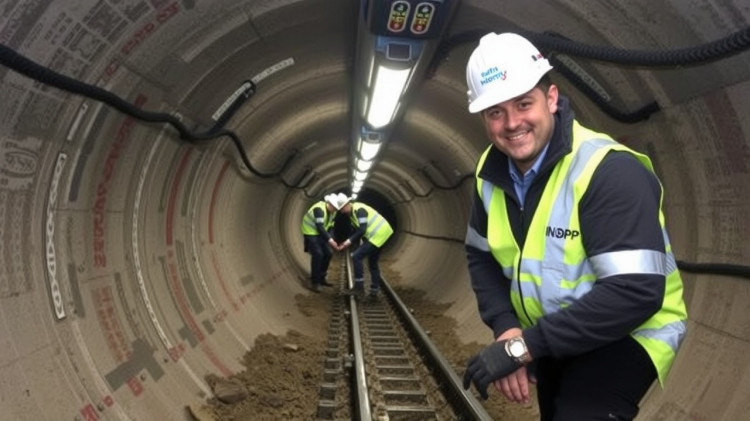
The Thames Tideway tunnel was a success for the infrastructure fund INPP, and other projects like Sizewell C show promise
Is it wise to invest?
When INPP International Public Partnerships (LSE: INPP) made an investment in the Thames Tideway Tunnel project in 2015, many investors believed that its managers and directors were insane. The project was a carve-out from the financially strapped Thames Water and would undoubtedly be dragged down by it; weren't infrastructure projects in the UK always delivered late and significantly over budget?
Rather, in March 2024, the 16-mile super-sewer under the River Thames from Acton to Beckton was finished as scheduled. It "diverted over 20 million tons of sewage and drain overflow that would otherwise have polluted the River Thames and prevented over 1,000 spills" during the year ending March 31. The amount of untreated waste water that enters the river has been reduced by 95% as a result.
INPP investing is profitable.
Infrastructure investment is frequently disparaged as costly off-balance-sheet funding for initiatives that the public sector ought to handle on its own. Nonetheless, Tideway's success demonstrates how the private sector can assist in building and overseeing infrastructure projects at a fair cost to the taxpayer while also providing investors with strong returns.
With 15.6% of its 2.9 billion net assets, INPP has one of its biggest stakes in Tideway. While a stake in 11 offshore transmission owners (OFTOs) is more than 20%, the investment in gas distributor Cadent is comparable. Connecting offshore wind farms to the onshore grid is a tedious but crucial task performed by the latter.
The 4.2 percent invested in BeNEX is at the bottom of the list. Germany has imitated the British railroad system's division into network infrastructure, rolling stock, and operating franchises, despite the British political class's disillusionment. BeNEX owns more than 130 trains and has concession agreements with 14 of Germany's sixteen federal states.
In exchange for a 3 percent stake in the Sizewell C nuclear power plant, the trust secured a deal last year to contribute 254 million, of which 35 million has already been invested. Through construction and initial operations, the investment is "expected to generate an annual cash yield of 6 percent, with a significant step-up in yield once fully operational."
In the meantime, it is selling a portion of its ownership in Angel Trains, which owns more than one-third of the passenger rolling stock in the UK, for £3 million. Additionally, it has decreased its exposure to public-private partnerships (PPPs) by selling assets this week. For 58 million, it sold shares in 15 London schools and returned concessions when they expired.
INPPs become more profitable.
This is a component of a larger pattern. Over time, International Public Partnerships and its competitors have shifted from lower-risk PPP projects to riskier ones with higher returns, like Sizewell and Tideway. International Public Partnerships and Pantheon Infrastructure (LSE: PINT) were the next to follow 3i Infrastructure (LSE: 3IN). More recently, HICL Infrastructure (LSE: HICL) announced a further move away from the PPP "yielders" (which currently make up 53 percent of the portfolio) and toward "growers" (which make up 47 percent) and "enhancers" like data centers and recreational facilities. This is anticipated to raise its annualized total return from the previous 8.5 percent to 10 percent.
Rising gilt yields have held back the infrastructure funds in recent years, but in the past year, discounts have decreased and operations have performed well. From 5% (3iIN) to 15% (HICL), discounts to net asset value (NAV) vary. Dividends are expected to increase in line with inflation, and yields range from 3.5 percent (3iIN) to 6.1 percent (HICL).
With 72% of its assets located in the UK, International Public Partnerships is on a 7% discount, yielding 6%. This week's writedown of its £24 million investment in a UK broadband company is not significant (0.9 percent of NAV), and the guidance remains the same. It still appears appealing even after a one-year return of 24%.





Leave a comment on: The INPP infrastructure fund disproves the doubters