
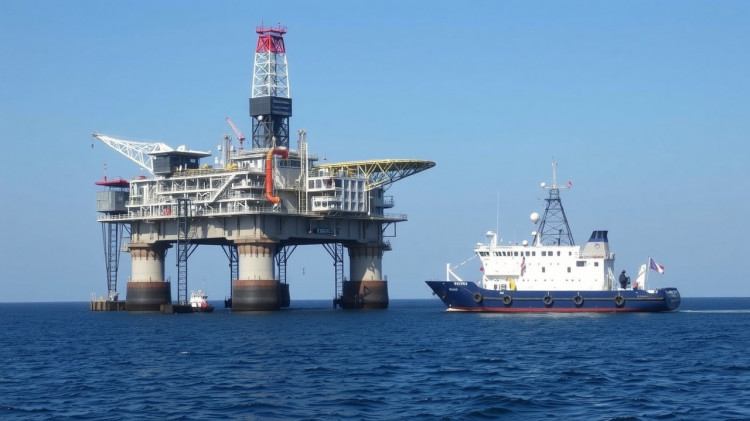
The valuations of two UK-focused oil stocks, Harbour and Serica, are heavily influenced by negative news
Why does the market have such negative expectations for them?
Among the least expensive stocks on the London market right now are two oil stocks. According to data gathered by Peel Hunt, Harbour Energy (LSE: HBR) and Serica Energy (LSE: SQZ) are trading at price-to-earnings (p/e) ratios of 5.3 and 2.7, respectively, for 2026. The companies appear even more affordable when considering cash flow. A significant portion of the cash is returning to investors, and the shares are trading at free cash flow yields of 35 percent and 29.9 percent, respectively. According to Peel Hunt, Serica is projected to yield 7% for 2026 and 2027 at the current share price, while Harbour is currently trading with a forward dividend yield of 9.9%, which will increase to 15.4% next year.
Investors are clearly avoiding these companies. Both are oil and gas firms with a focus on the UK, and they are heavily impacted by the nation's insane tax and energy policies. However, the market is currently valuing these oil stocks at such a deep discount that it will be difficult for the market to continue ignoring them. According to billionaire distressed-debt investor Howard Marks, there are no bad assets, just bad prices.
These oil stocks should be purchased collectively by investors.
In my opinion, Harbour and Serica are a very affordable pair that ought to be purchased together rather than separately. Although both are inexpensive (Serica is half the cost of Harbour), purchasing both reduces the risk associated with management execution. Harbour Energy is the biggest independent oil and gas company listed in London. After a number of transactions, it is now globally present, with assets in the UK, Norway, Germany, North Africa, and the Americas. Previously, it was solely focused on the UK. Additionally, it owns 15% of Southern Energy SA, Argentina's first significant project to export floating liquefied natural gas (FLNG).
The share price of Harbour Energy in pence.
Due to increased output from the newly acquired US LLOG assets in the Gulf of Mexico, the group began the year with production of 506,000 barrels of oil equivalent per day (boepd) in the first quarter. The management is now aiming for between 480,000 and 500,000 boepd for the remainder of the year, with average operating costs of £14.5 per boe, thanks to its Norwegian assets, which also contributed to an increase in output, along with new wells.
Based on these expenses, the company is projecting free cash flow generation of £1.4 billion for 2026, up from £600 million at the start of the year, assuming an average price of £13 for gas and £80 for oil. For the remainder of the year, these figures don't seem all that shocking. At the start of July, when it appeared that the US and Iran would reach a long-term peace deal and the Strait of Hormuz would reopen, the Brent benchmark fell to the low £70s per barrel. However, since hostilities have resumed, oil has risen to £88 as of this writing.
According to Canaccord Genuity analysts, Brent will average £83 in 2026 and £75 in 2027 before dropping to £70 in 2028. These projections show that Harbour will produce free cash flow of £1.9 billion in 2026, £0.7 billion in 2027, and £1.1 billion in 2028. Zeus analysts predict a Brent price of £75 for the remainder of the year, which is a little more cautious.
Based on Harbour's objective to distribute between 45 and 75 percent of free cash flow to shareholders annually, the analysts predict that even at this lower target, the company will give shareholders a dividend yield of 6.9 percent, or about £500 million. Peel Hunt's yield of 9.9 percent is the most optimistic, while Canaccord's yield is 8.3 percent. Whichever way you look at it, it's obvious that Harbour is inexpensive and throwing off cash, even though the yield will most likely fall somewhere in the middle.
Serica's price is very reasonable.
Serica's bargain-basement valuation can be partially explained by the company's listing on the Aim market and its production profile, which is primarily based in the United Kingdom. Serica is attempting to eliminate some of the uncertainty by entering the main market in the third quarter of 2026, but there is little it can do about the first point.
Based on its current portfolio and well-executed capital spending, Serica's management believes the company can sustain production at over 50,000 boed into the 2030s (it aims to exit 2026 with production in the 65,000 boed range), despite its focus on the UK.
Up until the end of the decade, capital spending is predicted to increase, which will reduce free cash flow. However, management has stated plans to distribute 30% of operating cash flow over the next few years. Based on an average oil price of £75, Berenberg calculates that this will yield an 11% dividend yield in 2027 and then an average of 7% through 2030.
In contrast to Harbour, which has amassed a substantial debt load as a result of several mergers and acquisitions, Serica is anticipated to increase its net debt position from £203 million in 2025 to +£91 million in 2026 and +£192 million by 2027. Berenberg analysts predict that this will enable management to start thinking about larger bolt-on acquisitions. It finished merging with Prax, One Dyas, and Spirit Energy last year, adding production from 25 North Sea fields.
Serica has been able to take over as a buyer of last resort as other businesses have chosen to leave the UK-owned portion of the North Sea. These agreements were made for £2 to £4 per barrel of reserves. In contrast, at the end of last year, Harbour paid about £12 for the US LLOG assets. Following Harbour's example, Serica is searching for deals outside of the United Kingdom. Southeast Asia has been mentioned by Serica as a possible area of interest in discussions with analysts.
The market may eventually catch on and re-rate the stock as the company proceeds with these expansion plans.





Leave a comment on: Two deep-value oil stocks for your portfolio are Harbour and Serica