
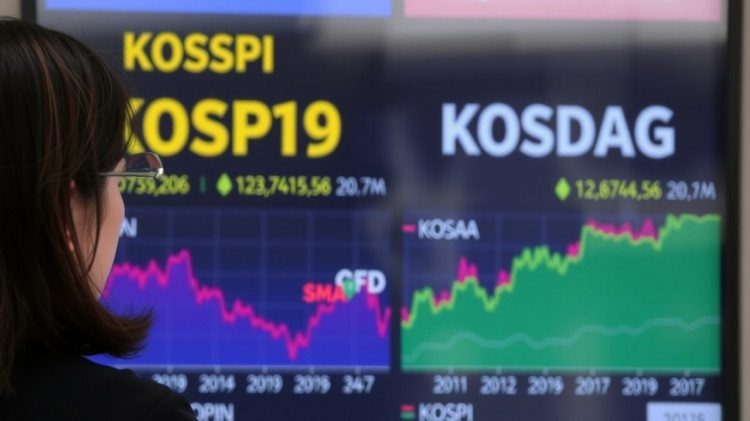
According to Kaylie Pferten, the current AI boom makes it unnecessary for Korean stock markets to upgrade to developed-market status or implement governance reforms
MSCI believes that Korea is still an emerging market. The MSCI World and MSCI Emerging Markets, the most significant global index providers, once again declined to place them on the watch list for an upgrade to developed status on Tuesday. These indices are far more significant than their equivalents from the FTSE Russell and S&P Dow Jones.
This situation seems more and more absurd on the one hand. Key tech companies like Samsung Electronics and SK Hynix are based in Korea, which has a highly developed, high-tech economy. In terms of purchasing power parity, GDP per capita is greater than that of the UK, France, Japan, and numerous other powerful nations. In what sense can this be considered an emerging economy?
However, Korea has certain characteristics that make it seem like an emerging market. Although FTSE Russell has classified Korea as developed since 2009, the significance of the restrictions mentioned by MSCI is not clear-cut. One of the most significant restrictions is the prohibition on trading the Korean won offshore.
But the dominance of big business conglomerates (chaebols), the largest of which is the Samsung group, may be more important for the long-term future of the Korean stock market. These groups are still under the control of their founding families, who frequently make decisions for their own gain at the expense of minority shareholders and use a variety of shareholdings between various listed entities.
In Korea, generational shifts are occurring.
Corporate governance is a major reason for the "Korean discount" the fact that Korean stocks trade at lower valuations than peers elsewhere but there are signs that this is changing. Inspired by the positive effects of Japan's governance reforms on that market, policymakers have been promoting reforms with varying degrees of success.
The MSCI Korea stock market index chart.
A Korea manager stated at a recent conference that a structural shift in attitudes is unavoidable due to generational changes. Since Korea has a very high inheritance tax, the people who founded chaebols in the 1960s and 1970s placed a great deal of importance on transferring control to their heirs as cheaply as possible. The handovers are being finished, the tax bills are being paid, and they are now mostly dead. Unlocking the full value of their businesses may often better serve their heirs' different priorities.
Thus, making the case for Korea seems simple. Despite the fact that being added to the developed index would result in substantial inflows from tracker funds, it is not dependent on MSCI one day. Additionally, the MSCI Korea stock market index has a projected price/earnings ratio (p/e) of eight, which makes Korean stocks appear extremely cheap.
However, this is a reflection of Samsung's and SK Hynix's enormous weight (65 percent combined) and their anticipated rapid growth. The MSCI Korea Equal Weight has an expensive forward p/e of 15. Above all, take note that in just one year, the market has increased by 260% in won terms. Without any illusions, the AI boom will continue to rise. As of right now, a Korean stock market tracker is solely an AI play rather than a valuation or reform play.





Leave a comment on: AI is causing Korean stocks to soar