
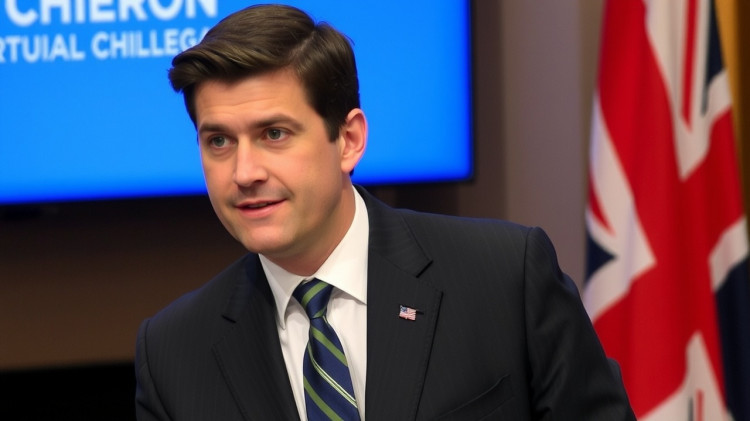
David Gauke, a former government insider, told BFIA in an exclusive interview that chancellor Rachel Reeves will "need to show the richest are making a big contribution" in the next autumn budget
The process of creating a budget and how Whitehall's fiscal chess game affects your tax bill, pension benefits, and savings returns are not well understood by those outside the Treasury.
David Gauke, the former chief secretary to the Treasury (201617), who held the second-highest position in the department after the chancellor, is one man who is familiar with the horse trading that takes place inside the UK Treasury's headquarters at 1 Horse Guards Road in London prior to a budget.
Speaking exclusively to BFIA, Gauke, the chair of Negotient, which advises on government-private sector partnerships, stated that although public speculation about possible policy changes, such as whether taxes will increase, is being loudly expressed, the real story of this budget will be told behind closed doors.
"Budgets aren't invented in a week," Gauke stated; rather, they are the result of intricate discussions involving departments, the Treasury, No. 10, and key economic sectors like housing, finance, and energy.
According to Gauke, a common error made by many organizations is to view the run-up to a budget as merely a lobbying exercisea one-sided campaign for a specific tax cut or subsidy.
"That rarely gets a good response from the Treasury. He continued, "What works is negotiation, a two-way process where both sides understand each other's constraints and build something sustainable, together."
The former Treasury insider was asked by BFIA what Britain should anticipate from chancellor Rachel Reeves' second budget, which is due on November 26. He presented a nuanced picture of conflicting priorities and difficult choices.
What might the Autumn Budget include?
As we speak, officials and ministers are considering ways to close what the Office for Budget Responsibility refers to as a "fiscal black hole" without inhibiting expenditure. Every discussion is dominated by the trade-off between political promises and fiscal regulations. Treasury wants restraint, while departments want more.
It won't be easy to close the gap, with analysts at KPMG estimating the shortfall at 27 billion and the independent think tank, the National Institute of Economic and Social Research, estimating it at 50 billion.
Gauke clarified, "When the fiscal headroom is thin, the question becomes not what the chancellor wants to do but what she can responsibly afford to do."
Silent talks with sector bodies and industry groups are part of this process every year, and their suggestions have the power to influence policy. Gauke stated that although these discussions "rarely make headlines," they determine whether a tax or spending measure is implemented successfully or is ultimately repealed.
Clearly, the chancellor will need to generate a significant amount of extra revenue. She must be able to persuade both her political party and the nation at large to support the measures, though. According to Gauke, Reeves will thus "need to show the richest are making a big contribution."
Gauke said that the following are the main considerations that Reeves will make before making any decisions.
Can this be portrayed as fair, particularly to Labour voters? Does this discourage investment and enterprise? How might this affect workers, pension savers, and homeowners? Gauke suggested that it might look something like this.
1. Tax on income.
"It is very difficult to do that without using the big tax levers, the most likely of which will be income tax," Gauke said, referring to the chancellor's need for a substantial amount of money.
"That would clearly violate a manifesto commitment not to raise income tax, National Insurance, or VAT, but it would do less economic harm than a series of smaller tax increases," he said. Gauke added that Reeves "needs to show the wealthy will pay a greater share."
Higher earners would pay more than one penny in additional taxes every day if the basic rate of income tax were raised, according to an analysis by investment platform AJ Bell. HMRC estimates that it could also generate nearly 7 billion for the Treasury next year.
2. . taxes on real estate.
A number of property tax reforms have been proposed, such as replacing stamp duty with a national tax on homes sold for more than half a million dollars and enacting a type of mansion tax that levies a capital gains tax on homes sold for more than 1.5 million dollars.
According to additional Daily Telegraph reports, the chancellor may impose a standard 1 percent tax on properties valued at more than £2 million.
Gauke said, "A property tax must be tempting, in that our current council tax system fails to distinguish between a quite expensive property and a very expensive property." He added that the appeal of a property tax is greater because it "is also simple to explain."
3. . tax on inheritance.
According to Gauke, changes to the inheritance tax are "also possible," but the ongoing dispute over business and agricultural property relief demonstrates that raising inheritance tax revenue comes at a significant political cost.
Gauke stated that "for instance, restricting the ability to make gifts outside of the IHT regime will not generate much revenue but will elicit strong opposition, including from those who are unlikely to be impacted."
"But, the Treasury may believe that they need a dispute to show that they are attempting to collect money from people who have more wealth.
4. . pensions.
Reductions in tax relief and tax-free cash amounts are just two of the proposed changes to the budget pension policy. Gauke has previously served as the Work and Pensions Secretary from 2017 to 2018, so he is aware of the challenges associated with pension reform.
According to him, people invested in their pensions with the expectation that they would receive 25% tax-free, so drastically lowering the pension tax-free amount could be criticized as retroactive. Gauke noted that if the change is scheduled for a later date, it won't result in a significant increase in revenue for many years.
On the other hand, he stated that persistent conjecture regarding modifications to the pension tax-free amount "is detrimental for our system and Reeves needs to end the uncertainty one way or another."
5. ISAs.
The cash ISA allowance is currently at 20,000, but Reeves is expected to reduce it to between 10,000 and 4,000 in order to encourage British investors to put their money into UK businesses.
Gauke stated, "I anticipate that they will proceed with some reforms here." However, I believe there will be some opposition because it will limit the tax-efficient options available to those who have already paid taxes on this money.
Where might Reeves make a mistake?
According to Gauke, some of the policies Reeves will unveil in her budget will be more political in nature than they will be pragmatic. He did, however, add that "she needs to be careful about a couple of issues."
1. . Excessive double or triple taxation.
Gauke stated, "A lot of the options that seem to be being considered may well involve the same people being hit multiple times, and that might mean very vocal opposition."
2. . Too antagonistic toward the rich.
The wealthiest people already pay a disproportionate amount of taxes. According to Gauke, there is a chance that more wealthy people will relocate abroad or that people won't travel to the UK at all if the government appears to be antagonistic toward them. It is not a good message to send out when the government wants to stimulate economic growth.
Negotiations on the budget behind closed doors.
Reeves has limited leeway, so the actual impact on your personal financial balance sheet will depend on how the Treasury bargains with important industries.
"As the government contemplates longer-term energy-price reform, expect renewed discussions with utilities," Gauke stated. "Bad news for mortgage rates and bond portfolios, a poorly structured deal could see bills spike again, feeding inflation and higher interest rates."
Similarly, if ministers bring back home buyer incentives, the outcome of negotiations with developers and lenders will determine whether this boosts supply or just raises home values. "A well-crafted transaction could stabilize real estate values; a hurried one could rekindle volatility," Gauke stated.
Budget compromises that have been successful.
Negotiation, not conflict, has produced some of the most effective policies in recent years. One example is the tax on single-use plastics, which was implemented following lengthy negotiations between the Treasury, manufacturers, and environmental organizations like Greenpeace.
Gauke clarified, "That policy worked because environmental campaigners, business, and government found common ground." Instead, the Treasury created a tax that encouraged investment in cleaner production and rewarded recycled content.
The 2022 energy crisis is one of the most glaring instances of how budget-era negotiations shaped individual finances. To protect households from skyrocketing bills, the Treasury, Ofgem, and energy suppliers negotiated the Energy Price Guarantee as wholesale gas prices skyrocketed.
"It was the right instinct," Gauke stated. However, the discussion centered more on immediate relief than long-term resilience. The government and suppliers could have achieved more stability and reduced inflationary pressure by taking a more innovative, risk-sharing approach.
The real value of savings and mortgage rates are directly impacted by inflation, so that is significant.
He also mentioned the Help to Buy program, which was created as a result of Treasury talks with developers and lenders to increase market confidence following the financial crisis. When the goal is to unlock credit and stimulate investment, Gauke stated, "That demonstrated what Treasury negotiation can achieve."
He also added that it demonstrated the significance of striking a balance, making sure policies to boost supply complement those to support growth. He went on to say, "The government is now facing the same challenge of getting that right."
"The government will have to negotiate intelligently with the private sector on a number of issues," Gauke stated, including housing, pensions, and the energy transition. That's how you create opportunities for investors and provide value for taxpayers.






Leave a comment on: The chess game behind your tax increases is revealed by the former Treasury minister in Inside a Budget