
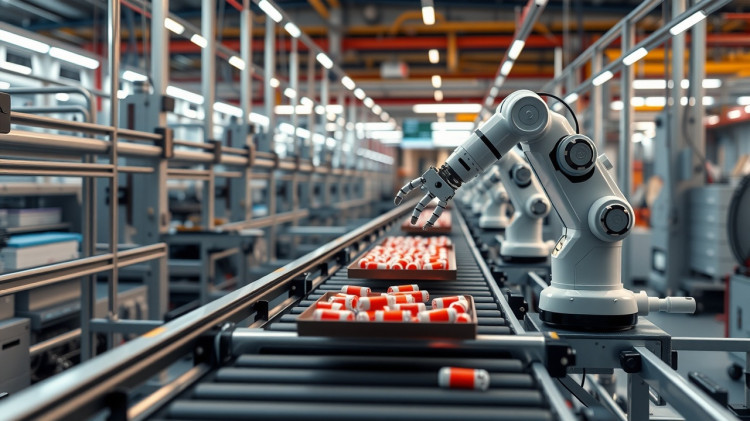
For more than ten years, one of AI's biggest promises has been drug discovery
Every aspect of working life appears to be about to be disrupted by artificial intelligence (AI), with the pharmaceutical industry being one of the sectors most likely to be affected.
AI stocks like Nvidia and Palantir were among the most popular stocks for do-it-yourself investors in August, according to data from Interactive Investor; however, pharmaceutical stocks have recently lost ground.
However, the two industries appear to be becoming increasingly intertwined.
According to Morningstar principal Kenneth Lamont, the UK stock most commonly held in AI funds is AstraZeneca (LON:AZN). Lamont stated that companies that use AI to enhance their models, like AstraZeneca in drug discovery, "may have the last laugh" in reference to the AI boom. "They may end up being the true long-term winners by utilizing increasingly potent and affordable AI tools to increase margins with minimal risk.
During Donald Trump's state visit to the UK earlier in September, with a group of top executives from big tech companies eager to invest in the UK economy, GSK (LON:GSK), which had fallen off Interactive Investors' August top stocks list, was one of the companies that threw open the red carpet.
A £30 billion investment plan for GSK's US RandD manufacturing capacity has been revealed.
"GSK is keen to stress that introducing AI technology into their manufacturing across the States is part of the plan," stated Steve Clayton, head of equity funds at Hargreaves Lansdown, in reference to the new £1.02 billion investment in the package.
What usage of AI are pharmaceutical companies making?
The application of AI to the pharmaceutical industry, especially the time- and cost-intensive process of drug discovery, has the potential to be revolutionary due to its ability to analyze large amounts of data in a comparatively short amount of time.
Jim Weatherall, chief data scientist for BioPharmaceuticals R&D at AstraZeneca, stated that the company is "applying AI throughout the discovery and development process, from target identification to clinical trials." "Data science and AI are transforming R&D, helping us turn science into medicine more quickly and with a higher probability of success," he added.
The FT recently revealed that, over the past ten or so years, progress on AI-driven drug discovery has been slower than anticipated. This is mostly due to the fact that scientists still don't fully understand some important aspects of biology, like the interactions between cells and medications, which prevents AI models from receiving the data they require to produce reliable predictions.
However, advancements like AlphaFold2, a system introduced by Google DeepMind in 2021 that can predict a protein's shape based on its amino acid sequence, may signal a paradigm shift.
Will AI put a stop to Big Pharma?
According to a recent Causeway Capital report titled Will AI Make Big Pharma Obsolete?, artificial intelligence is expected to have a big impact on the industry, but in the end, it will benefit the biggest incumbents in the sector.
Alessandro Valentini and Steve Nguyen, both portfolio managers at Causeway Capital, write the report. "Investors and innovators of artificial intelligence, such as Vinod Khosla and Sam Altman, contend that drugs of the future will be developed by small, agile teams, sometimes fewer than 20 people wielding AI," the authors write.
According to them, "AI will lessen the cost of discovering new molecules and speed up discovery timelines, but it won't replace the most intricate, valuable phases of the drug business."
The lengthy process of transforming a promising molecule into a medication that is approved worldwide is difficult for small teams to replicate, they contend. In fact, AI's ability to shorten the time and expense of the drug discovery process may even increase the scale advantages enjoyed by large pharmaceutical companies.
Valentini and Khosla stated that "the probability of success for early-stage assets rises if AI truly delivers higher-quality drug candidates." As a result, big businesses may see higher returns on the same amount of investment, especially if they introduce programs before extensive proof-of-concept testing.
This might result in early-stage R&D becoming less expensive even as its value rises, strengthening the position of big pharma as a scale operator and consolidator.
The conclusion drawn by Valentini and Khosla is that "AI is not a death sentence for big pharma." Instead, it ought to serve as a driving force behind changing the industry's economics, probably in the best interests of shareholders. Even though small biotech teams might make more discoveries, they should still depend on big incumbents to handle global trials, manufacture at scale, manage complicated regulatory frameworks, and deliver medications to patients all over the world.






Leave a comment on: How will AI affect the pharmaceutical sector?