
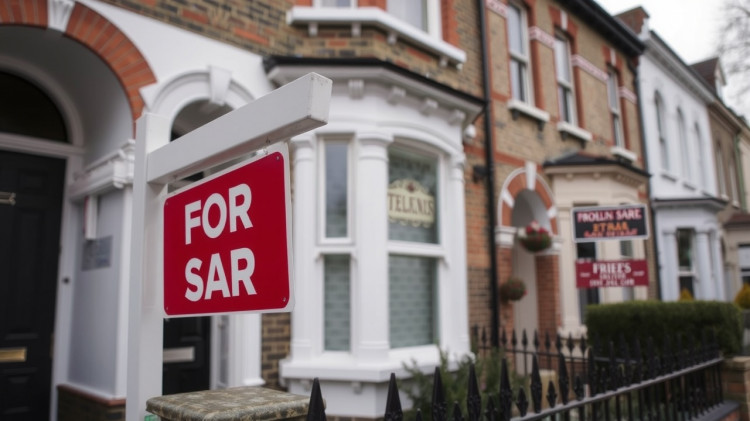
Due to difficulties in the south and in London, where affordability is tight, asking prices are 01 percent lower than they were a year ago, according to the real estate website
According to recent data from property listing website Rightmove, the average asking price for a property in Britain is 0.1 percent less than it was a year ago.
Now, the average property is listed for 370,257, about 500 less than it was in September 2024. This indicates that the housing market has been stagnant this year, even though it is a minor decline in the overall context of a home purchase.
Part of the problem is that there are too many properties for sale in southern England. The region has 9% more homes for sale than it did a year ago, while the national average is only 2%. According to Rightmove, it takes an average of five more days to find a buyer in the south than in the north or Wales.
London and the south east were disproportionately affected by the April stamp duty changes because their homes are typically more expensive than the national average, making them subject to higher taxes.
Pressures on affordability in the region have also had an effect. The Office for National Statistics (ONS) reports that the median home in the south-east costs about ten times median earnings, while in London, it costs about eleven times earnings.
In England overall, this equates to eight times earnings, six times in the north west, and five times in the north east. Home prices are considered affordable by the ONS when they are approximately five times earnings.
In September, Rightmove reports that asking prices in Britain increased by 0.4 percent on a monthly basis, despite declining on an annual basis. Although it is lower than the usual price increase for this time of year, it is the first monthly increase the property site has seen since May.
Colleen Babcock, a property specialist at Rightmove, stated, "We would expect to see a slight uptick in new seller asking prices in September, with the traditional back-to-school season boosting activity heading into autumn."
"The September price increase of 0.4 percent this year is somewhat less than the average of 0.6 percent during this period.
Pricing competitively is "vital".
Despite pressure on asking prices, the real estate market is still active, as evidenced by the 4% increase in agreed sales over the previous year. According to Rightmove, agreed sales have increased by 3% even in the southern region of England.
HMRC's official data, which was released with a longer time lag, shows a similar pattern. Compared to the same month last year, there were 4% more transactions in July.
Babcock says that "sensible and attractive seller pricing" is what has caused this increase in sales activity. Competitive pricing, according to Rightmove, is "vital" to closing a deal, especially in the south.
Given the economic challenges, pricing should continue to be crucial in the upcoming months. Concerns about inflation and the high cost of borrowing may persuade the Bank of England to hold off on raising interest rates for the remainder of the year.
According to Matt Smith, a mortgage expert at Rightmoves, "global events have made mortgage financing a little more expensive, which has caused mortgage rates to edge upward over the last few weeks." According to Moneyfacts, a website that provides financial information, the average rate for a two-year fixed mortgage is currently 4 percent. 5.03 percent is the average for a five-year agreement.
Rumors about property taxes were not immediately addressed.
The main topic of discussion in the run-up to the Autumn Budget, which is scheduled for November 26, has been speculation regarding property taxes.
Rumor has it that an annual property tax, assessed at the point of sale on homes valued over 500,000, may take the place of stamp duty.
There have also been rumors of a potential mansion tax, with the Treasury allegedly considering imposing capital gains tax on the sale of primary residences valued at more than a specific amount, like 1 million.
According to the most recent sentiment survey conducted by the Royal Institute of Chartered Surveyors (RICS), pre-Budget jitters were cited by a number of respondents as the reason for the decline in property market confidence in August as rumors circulated.
Rightmove's real-time data shows no significant changes, so far, this has not resulted in lower asking prices. But if tax changes do come to pass, the real estate website warned that they might affect areas with limited affordability where buyers are already finding it difficult to move up the property ladder.
Babcock remarked, "Our analysis highlights how London and south England-centric the changes would be, and these are the areas that are already performing less strongly."






Leave a comment on: Rightmove: The glut of southern England real estate leads to a decline in asking prices