
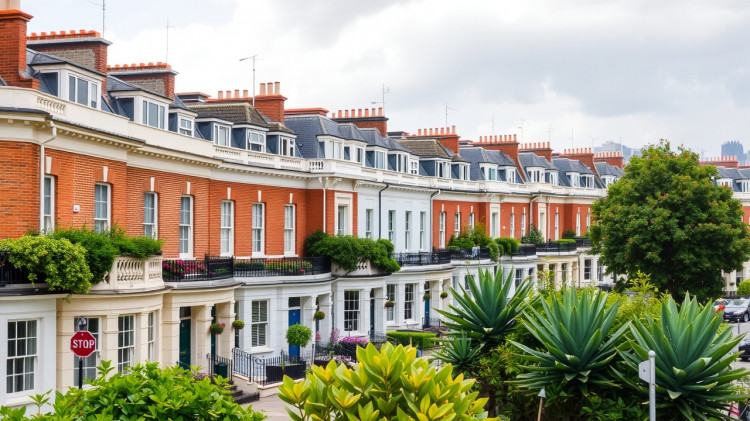
Due to fewer buyers and agreed sales, real estate brokers report that house prices fell in July
The UK housing market has had a mixed year. Stamp duty changes in April caused a rush in the first three months of the year, followed by a period of inactivity in the immediate aftermath.
Although there had been early indications of a recovery, the most recent sentiment survey from the Royal Institute of Chartered Surveyors (RICS) indicates that activity fell once more in July, according to estate agents.
The property experts surveyed saw a decline in house prices, agreed sales, and new buyer inquiries throughout the month.
"How have average prices changed over the past three months (down/same/up)" is one of the questions that results in net balance scores ranging from -100 to +100 in the RICS report.
It subtracts the number of respondents who reported a decline from the number who reported an increase. The net balance would be +25% if 30% of respondents reported an increase and 5% reported a decrease.
In contrast to June, when the percentage was -7 percent, a net balance of -13 percent of respondents in July stated that house prices had decreased over the previous three months, indicating a deterioration in sentiment.
It may not come as a surprise considering that agreed sales dropped from -4 to -16 percent, while the net balance score for new buyer inquiries dropped from +4 to -6 percent.
"Ongoing difficulties in the housing market are highlighted by the flatter tone. Even though interest rates were lowered at the most recent Bank of England meeting, Simon Rubinsohn, chief economist at RICS, expressed skepticism regarding the timing and scope of additional reductions due to the split vote.
In the meantime, some people are becoming concerned about the lack of clarity surrounding the possible contents of the chancellor's autumn budget. In this context, respondents continue to state that the market is still very sensitive to price right now.
Home prices: Halifax and Nationwide present a more optimistic picture.
Although RICS respondents' sentiment is obviously negative, new lender data on home prices presents a more positive picture.
According to Halifax, the biggest monthly increase in house prices the bank has seen this year was 0.4 percent in July.
A higher increase of 0.6 percent was reported by Nationwide during the month, raising its estimate of the average UK property to 272,664. The difference from a year ago is 2 points 4 percent.
Robert Gardner, chief economist at Nationwide, contends that activity is surviving quite well. According to the most recent data from the Bank of England, "64,200 mortgages for house purchases were approved in June, broadly in line with the pre-pandemic average, despite the changed interest rate environment," he notes.
A busy July is also indicated by separate data from Zoopla, which differs from the RICS report. Despite the typical summer slump, the real estate website reported that buyer demand was up 11% from a year ago and agreed sales were up 8%.
Modifications to the mortgage affordability test may serve as a spur. Following the regulator's encouragement, lenders recently relaxed the regulations in an attempt to assist more buyers in obtaining real estate.
"With no change in their income or the mortgage rate they're offered, those using a mortgage can borrow up to 20 percent more than they could three months ago," stated Richard Donnell, executive director of research at Zoopla.
Will the cost of homes continue to increase?
Although respondents to the RICS survey expressed less optimism in July, they were more upbeat about the long-term outlook. Eight percent of those surveyed believe that sales will increase in the upcoming year.
Prices won't necessarily rise significantly as a result of this. The RICS measure has not been this low since January 2024, despite the fact that +19 percent of respondents anticipate an increase in home prices over the next year.
The growth of home prices will be restrained in the near future, according to other real estate experts. The mainstream UK real estate market's 2025 forecast was recently downgraded by estate agency Savills from 4% to 1%.
In the last few weeks, Rightmove and Zoopla have also cut their projections in half. In 2025, Rightmove now projects a 2 percent overall price increase, compared to Zoopla's 1 percent forecast.
Regional differences are unavoidable; in the north, where homes are more costly and affordability is stretched, prices are rising faster than in the south.
The recent downgrades to property market forecasts are partially due to a glut of supply. According to Rightmove, there are ten times as many homes on the market, so sellers must be reasonable in their price setting.
According to Colleen Babcock, a property specialist at Rightmove, "discerning buyers can quickly spot when a home looks overpriced compared to the many others that may be available in their area."
In order to attract buyers and sell their house, more new sellers seem to be aware of this and are reacting to the high supply market with distinctive pricing.





Leave a comment on: RICS: The recovery of the property market is faltering