
In order to focus on its advantages, Camellia is selling off its historically varied collection of assets
For investors who are prepared to accept its peculiarities, it presents a unique opportunity.
As a holdover from a bygone era, Camellia (Aim: CAM) is a unique company that frequently goes unnoticed. When it was first established in 1889, this British holding company had a vast empire. It is currently consolidating into a targeted agricultural player with a well-defined plan, significant cash reserves, and a price that is still below book. Camellia provides a unique opportunity for investors who are prepared to accept its peculiarities: a modernizing company with a strong balance sheet that is actively attempting to reduce the discrepancy between its market price and intrinsic value.
The history of Camellia is legendary.
The history of Camellia dates back to the British Empire and the Victorian era. However, the majority of its greatest growth took place between the 1960s and 1980s, when it became the biggest private tea producer in the world. Over 78,000 people are currently employed by it across its global estates, which generate a range of agricultural products. About 80% of group turnover is made up of tea, with additional crops like avocados and blueberries contributing as well.
In addition to private banking, a Bermuda-based insurance company, small engineering firms, and a vast collection of fine art, manuscripts, and stamps, Camellia's past was diverse and extended beyond agriculture. Its former headquarters, a stately home in Kent called Linton Park, has been for sale since 2022 and doesn't look much like a corporate office. The management found it difficult to convert its assets into shareholder value, and the broad, diverse portfolio clouded focus. By the beginning of the 2020s, the share price was stagnating at about 4,000p, far below its book value, which took into account both cash and physical assets.
Camellia's global reach.
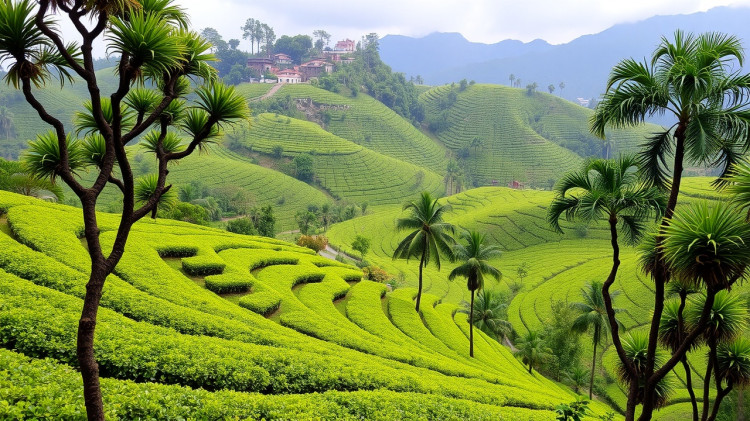
The size and geographic diversity of Camellia's tea operations reflect the company's lengthy history in the market. Over 34,000 hectares of established tea plantations are owned by it, including some of the most recognizable tea estates in the world. It operates on two continents. Its estates in India, which include famous Darjeeling gardens like Castleton, Margaret's Hope, and Badamtam, produce both whole leaf and CTC black teas. Bangladesh, which is adjacent, is another important area for the group's tea production. The company is well-established in Malawi and Kenya in Africa. This worldwide distribution lessens the impact of local hazards like bad weather and unstable political conditions.
Camellia's contemporary makeover.
With its "value enhancement plan" (VEP), Camellia formally outlines the modernization program it has been pursuing in recent years. The business is concentrating on sustainable agriculture by selling off non-core assets. When its stamp and art collections were disposed of, this change started. In order to liquidate its property portfolio, which included Linton Park, it relocated to a standard business park.
The balance sheet was considerably strengthened by the agreement to sell its 37 percent stake in the insurance group BFandM for £100 million (75 million), which was the most significant divestment. As a result of these actions, Camellia now has over £100 million in net cash and liquid assets. Enhancing operational performance, lowering risk through diversification, and funding agricultural expansion prospects are the objectives.
Camellia's share price, which is only a small portion of its book value, is stubbornly low in spite of these efforts. The company's complicated structure and wider difficulties in the Aim market are partially to blame for this discount. For instance, the Camellia Foundation charity, which formerly held 52% of the common equity, is now the company's largest shareholder.
Share price of Camellia.
Management, however, is dedicated to bridging this valuation disparity. By purchasing up to 350,000 shares at a price of 54 per share, the VEP is intended to create value and long-term profitability, which includes a restored dividend and a return of 18 point 9 million to shareholders. The Camellia Foundation increased its ownership of the company to nearly 60% by refusing to tender any of its shares, solidifying the minority position of the remaining shareholders.
Hazards and benefits.
Camellia is subject to inherent risks. The weather, labor disputes, and international supply chains all have an impact on the tea market's volatility. Emerging-market reputational risks were brought to light by a 2020 lawsuit alleging human rights violations by its Kakuzi division, which was settled for £4.06 million. Other difficulties include political unrest and currency fluctuations in Malawi and Bangladesh. Its unique ownership structure, which is connected to the Camellia Foundation, also calls into question governance.
Nonetheless, it could be argued that the current valuation accounts for these risks. The VEP works hard to address operational and climate-related issues. Camellia presents an attractive risk-reward profile, with a sizeable cash position and management carrying out a formal value-creation plan. In addition to direct shareholder returns, this cash pile offers flexibility for investments in high-margin crops and efficiency initiatives (like solar and mechanization). Resilience is promoted by the decentralized model, which enables subsidiaries to quickly adjust to local difficulties.
A unique chance for patient investors is Camellia. It's an exciting prospect because of management's clear commitment to closing the valuation gap and their exposure to expanding markets for specialty crops and tea. As its modernization strategy pays off, Camellia promises enormous returns.







Leave a comment on: Camellia is a unique tea company that pays investors who wait