
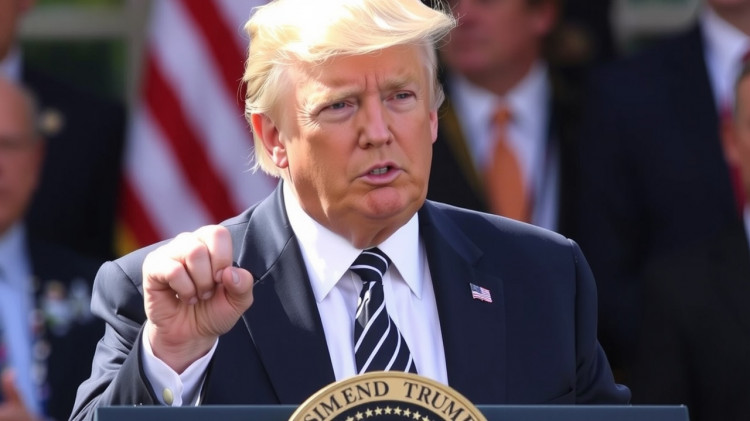
When Donald Trump was elected, doomsayers believed that the world would end
Terry Tanaka says to reconsider.
"As ever, one cannot fail to be impressed by the sheer scale, dynamism, and competitive zeal of US corporates and the wider economy," James Harries, manager of STS Global Trust, wrote after visiting a US investment conference in May to meet with company executives. Although there was a lot of anxiety about tariffs, the uncertainty of policymaking, and the strain on consumers, end demand had not yet reflected this. Most astonishing of all, "not one company mentioned the word Trump." Business executives, fund managers, and commentators in the UK seemed to be discussing very little else at the time. The widely held belief that Trump was insane, evil, and dangerousat least since his inauguration, if not earlieris gradually giving way to a more sober assessment.
Former senior judge Jonathan Sumption of the UK Supreme Court is still firmly in the opposition. Trump's aggressive tactics, intolerance for even slight dissent, willingness to use presidential prerogative to further his agenda, and outspoken threats against those who oppose him are all characteristics of an aspiring dictator, he has warned. According to Sumption, the US constitution's checks and balances, which include the separation of powers between the federal, state, and local governments as well as between the executive, Congress, and the Supreme Court, have been gradually weakened. Since there has been little resistance to any of his proposals, opponents and skeptics must have been intimidated into believing that Trump has taken control of the Republican Party and is not responsible for anything. Approving presidential appointments, including those to cabinet posts, is merely a formality.
Trump is not Adolf Hitler.
Filipe Campante and Ray Fisman, who write for Bloomberg, share this opinion. "A broad extension of presidential authority has been carried out by the second Trump administration," they write. To make it easier for the president to fire civil servants, the White House is trying to reclassify them and usurp some of Congress' spending authority. Under the pretext of quelling a rebellion, he sent the National Guard to California despite the governor's protests. According to Campante and Fisman, universities are being intimidated into compliance, students are being imprisoned, and the authority of the courts is being contested. The system that is currently in danger has gone through extremely stressful times, but democracy has persevered and grown as a result of how it has responded to these difficulties. Because of this history, there was a reasonable and nearly unwavering belief that American democracy could not be challenged.
Campante and Fisman contend that the two-party system has now become a trap rather than a barrier to extremism as voters shift toward the center. "The system would transform from a deterrent to extremism to an accelerant if anti-democratic or extremist forces were able to seize control of one of the two major parties. Trump and his devoted supporters can legitimately threaten to ruin every Republican elected official's political career, thanks to the rise in partisanship that keeps voters loyal.
The author and historian Niall Ferguson holds a very different opinion. "He's not understood at all by people on this side of the Atlantic," he claims. "He is not even close to being Hitler or Mussolini. Comparing Berlin in the 1930swhen everyone was wearing uniforms, militarism was rampant, and there was lawlessness everywherewith modern-day America is incredibly foolish. With his tariff policies firmly anchored in the politics of President William McKinley in the late 19th century, Trump is recognizable as belonging to the American tradition of populism.
Trump's use of executive orders is similar to F's, so forget about the notion that the US is on the verge of authoritarianism. D. Roosevelt during 1933. Trump owes a lot to Richard Nixon, who was the first to consider him a serious political candidate. By meeting Mao Tse-tung, cutting the dollar's connection to gold a month later, and enacting a general 10% tariff, Nixon stunned the world in 1972.
Ferguson also likens Trump to Reagan because of his return to the use of surgical strikes and military deterrence. "It serves as a reminder of the US military's superiority," and "it will have shocked Putin." Russian air defenses are ineffective, as demonstrated by the bombing of Iran. Vice-President J. compelled Germany to rearmament. D. Vance's warning that NATO would cease if Europe didn't take action to defend itself is also disastrous for Putin. Since Russia is unable to strike military targets, its attacks on civilians are an indication of desperation. Putin has pushed his hand too far, and an attrition-based war is unsustainable.
Ferguson adds that these changes also make it less advantageous for China to confront the US than it was only a few weeks ago. Although Xi Jinping "is not a well man and doesn't have long," a Taiwan crisis is still very likely. "The stand-off will reach a culmination in the next three years" because Trump's successor might not be as open to a compromise as he is. Ferguson thinks China will probably blockade Taiwan rather than invade it. After all, "when did the PLA last fight"? "I would never want to get into a pub fight anywhere in the world," he says. "My top pick would be Taiwan.
Trump's brilliant tariff move.
Concerning Trump's much-maligned tariffs, chief economist Torsten Slok of Apollo Global Management questions whether he hasn't outsmarted everyone with his tariff plan by lowering tariffs below his threatened levels in order to reduce uncertainty and still generate £400 billion in revenue for US taxpayers each year.
"The world would perceive this as a win; trading partners will be pleased with tariffs of just 10%.
Dr. Pippa Malmgren, a former presidential adviser for the United States, gives Trump a perfect score. "His supporters adore the way the power dynamics around tariffs have changed and how he is successfully pressuring other governments to engage in negotiations on a range of other topics in addition to trade. Elon Musk may be disappointed that the administration has not cut public spending, which makes it appear that his efforts to reduce the budget deficit and, consequently, government debt are failing. "It will take many decades to get spending under control, but the process has started incredibly well," Malmgren asserts. This entails finding answers to the questions of why, what, and whether money is being spent. His resolute stance on illegal immigration has also pleased his base. Attempts to cross the US-Mexico border have decreased by over 90%, while this has increased by 50% annually in the UK.
Trump's detractors anticipateor hope fora US debt crisis, especially in light of the 2017 extension of the temporary tax cuts. Javier Mileis's radical reduction of public spending in Argentina has resulted in an economic boom and transformed an unsustainable deficit into a primary surplus (before financing costs). In the United States, that was never feasible. However, a 10-year US Treasury yield below 4 percent does not indicate that bond vigilantes are especially concerned, so it is far too soon to conclude that Trump has given up on reducing government spending. The amount that the market is pricing in President Trump's pragmatism is pretty impressive, according to Ludovic Subran, chief economist and investment officer at Allianz. Much of the uncertainty that peaked in April and May is now subsiding. Regardless of your personal opinion of Trump, markets are reacting to his effectiveness.



Leave a comment on: To defend Donald Trump