
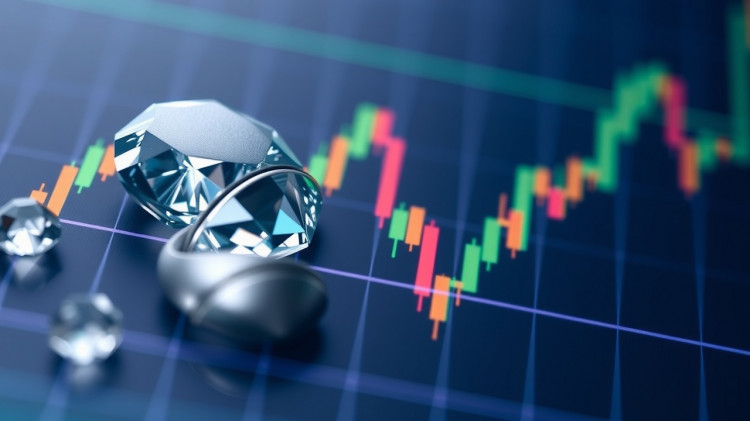
The industry faces a turning point as lab-grown stones make the traditional gem less appealing. For investors, diamonds may no longer be the best friend they once were.
?
Diamonds - especially diamond rings - have represented marriage for generations. As marriage gradually moved away from a formal arrangement for joining families and protecting property, the ring took on a more romantic meaning.
Diamonds became the preferred jewel during the 20th century. Rising prosperity after World War II and expanding South African mines helped, but clever marketing mattered most.
Frances Gerety, an American copywriter, wrote "A diamond is forever" for the mining company De Beers in 1947. The line linked a diamond's lasting physical quality to the promise of a marriage that would endure. Advertising Age later named it the greatest advertising slogan of the 20th century, helping propel De Beers, which held near-monopoly control over diamond production for most of the past 100 years.
De Beers entered the laboratory-grown gem market in 2018 with Lightbox, its own brand. Prices for synthetic jewellery gems then collapsed, and mounting competition from lower-cost companies in India and China - including Power Diamond, Huanghe Whirlwind, Yasheng, and Caraxy - helped force Lightbox to close in May 2025. The brand had initially charged £800 per carat; by 2025, prices had dropped 90%, according to De Beers.
Duncan Wanblad, CEO of Anglo American (LSE: AAL), De Beers's parent company, recently told the Financial Times that the company "could have been a little bit more aggressive on the signals we were getting" from competition posed by laboratory-grown gems.
De Beers' sparkle is dimming
De Beers once controlled as much as 90% of the world's rough-diamond supply. Founded in South Africa in 1888, the company grew from a merger between the businesses of British colonists Cecil Rhodes and Barney Barnato, with financial backing from the Rothschild family. De Beers Consolidated Mines then emerged as a cartel designed to control both diamond production and prices.
The Oppenheimer family later owned De Beers, but Anglo American took control in 2011. The mining group now holds 85% of the company, while Botswana - the world's second-largest producer - owns the remaining 15%. De Beers has a 25% share of the market and has lost about £7 billion in value since 2023 after a series of write-downs. Last year, it recorded an underlying loss of £787 million before interest and tax, alongside revenue of £3.5 billion. Anglo American has been seeking a buyer since 2024. Recent reports say Richemont, Cartier's owner, may join a consortium headed by former De Beers CEO Gareth Penny to bid for Anglo American's stake. The company could sell for as little as £1 billion.
Meanwhile, the natural-diamond industry is struggling, putting pressure on producers such as Botswana, where the economy relies heavily on diamond sales. According to the International Monetary Fund, diamonds accounted for 80% of exports, 33% of fiscal revenues, and 25% of GDP in 2024.
Collect, don't invest
De Beers convinced generations of buyers that diamonds are forever. That slogan does not make them sound investments: diamonds can be difficult to sell and often fetch far less than expected. Unlike many commodities, they have no liquid trading market or transparent spot price, says Russ Mould, investment director at broker and investment platform AJ Bell. Production costs also vary sharply because geological conditions and yields are so unpredictable. That makes it nearly impossible to set a minimum baseline price, unlike with other raw materials.
Diamonds may be simple to store and insure, but jewellery carries a "hefty retailer's mark-up." That makes it an "obstacle to anyone hoping to use diamond jewellery as an investment," says Mould. Anglo American's "buyer's remorse" over De Beers - and its current struggle to sell the business - should tell investors something: "investors should take the hint."
Diamonds may be valuable, but unlike gold, they do not protect investors from inflation or turbulent markets. Akoner puts it this way: "From a portfolio perspective, the test of a hedge is whether I can value and sell it when markets are stressed."
Gold comes through that test far better than a single diamond. Diamond quality varies widely, transactions are relatively uncommon, and the resale price can fall well below the original retail cost. I wouldn't treat diamonds as protection against inflation or a crisis.
Akoner recommends a diversified fund for investors who want broad exposure to commodities. She would consider a diamond miner only after examining its balance sheet closely and accepting considerably greater risk.
Laboratory-grown diamonds may offer consumers better value upfront, but they are a poor investment: improving production can expand supply while wholesale prices keep falling, which works against the buyer. "I would see the lower purchase price as the benefit, rather than expect to make money on resale," says Akoner. Jeweller Queensmith estimates that sellers of second-hand laboratory-grown or natural diamonds may receive 30%-40% less than they originally paid.
Diamonds may still attract collectors, but mostly at the highest end of the market. That includes exceptional stones such as the Motswedi diamond and the "azure blue" 32-carat diamond, which fetched £8.4 million at auction this June. Akoner says serious buyers tend to seek rare-coloured stones or jewellery made by a recognised designer with a documented history. They are "betting that another collector will pay more for that rarity in the future". Still, she cautions that a "headline auction result is not the return every owner will achieve".
I'd regard these pieces as a specialist purchase for someone with an already diversified portfolio. Ordinary diamond jewellery, though, is mainly something to wear and enjoy. Whatever the cut - square or pear-shaped - diamonds rarely make good investments.






Leave a comment on: Diamonds have lost their sparkle - are they still worth buying?