
Vietnam began its economic rise in the 1980s. It has since become a manufacturing powerhouse, though there is still room for the dragon to climb. Vietnam Enterprise Investments Limited provides diversified exposure to that growth.
The country is often called the ascending dragon, partly because its shape on the map resembles one. Look at Vietnam's progress over the past four decades, and the name also makes sense to investors.
Vietnam now ranks as a major manufacturing base for electrical goods. Reuters reports that factories there produce about 60% of the 220 million phones Samsung sells annually. The country also accounts for roughly 20% of iPad production, according to CNBC.
These two cases show how much the frontier economy matters to global trade. In 2024, Vietnam ranked as the United States' eighth-largest trading partner, while China ranked fourth.
Vietnam, Asia's Ascending Dragon | A film by David Stevenson, the influential Adventurous Investor - YouTube Vietnam, Asia's Ascending Dragon | A film by David Stevenson, the influential Adventurous Investor - YouTube Watch On
A sleeping dragon wakes
Vietnam has changed dramatically since opening its economy in 1986, roughly a decade after the Vietnam War ended. That year, inflation stood at about 700%, according to figures cited in an IMF paper. Food shortages were hitting families hard, while the country depended on roughly £4 million in daily aid from the Soviet Union.
Today, Vietnam looks very different. Over the past 40 years, the country has urbanised rapidly while expanding digital access and infrastructure. Electricity now provides the main source of lighting for almost 100% of the population, compared with just 14% in 1993, according to World Bank figures.
People are becoming wealthier, and Vietnam's young population adds to that shift. A large share of its workforce is under 30, with many workers receiving a good education. As the middle class expands quickly, the country could grow into a strong consumer economy.
Vietnam's transformation during the 1980s began with i Mi, a reform program whose name means "restoration" or "renovation." It moved the country away from central planning and toward a market-oriented economy. Vietnam joined the World Trade Organization in 2007.
Vietnam's reform program has delivered sustained economic growth. Data from the investment firm Dragon Capital puts the country's average annual growth at 6.5% over the past couple of decades.
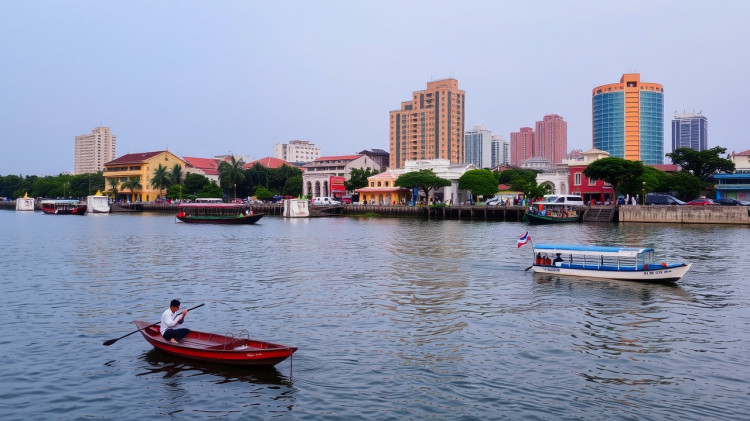
At twilight, Ho Chi Minh City's skyline reflects in the Saigon River.
Broad reforms could spur more growth
Vietnam's government has launched Doi Moi 2.0, a programme aimed at cutting bureaucracy, reshaping local government and giving private businesses a larger role in the economy. The plan also backs science, technology and innovation.
These reforms could carry Vietnam further and help it avoid the middle-income trap, in which fast-growing countries lose momentum after attaining middle-income status.
Donald Trump's tariffs still threaten the economy, though investors grew less anxious after the two countries reached a trade deal in July. The United States had initially threatened a 46% tariff on Vietnamese exports; the rate has since fallen to 20% for goods made in Vietnam.
Vietnam's government has set its sights high. The economy grew 7.1% last year, ahead of both India and China, and officials are targeting 8% growth in 2025, followed by double-digit expansion in the years after that. Their longer-term goal is to make Vietnam a high-income country by 2045.
Vietnam's growth will draw on several sources, including international trade and ongoing advances in technology. The semiconductor industry is one clear example: Dragon Capital expects it to expand by 1.3 billion between 2022 and 2027, with compound annual growth exceeding 6%.
The government plans to train 50,000 semiconductor engineers, a move that reflects Vietnam's effort to attract investment and keep pace with the surge in AI.
How to invest in Vietnam
UK investors can get broad exposure to Vietnam through an investment trust such as Vietnam Enterprise Investments Limited (LSE: VEIL), the London Stock Exchange's best-performing Vietnam-focused investment trust this year.1
Dragon Capital, one of Vietnam's largest and most long-standing asset managers, oversees the trust.
Established in 1995, the trust now sits in the FTSE 250 and manages 1.5 billion in assets.2 Since its London Stock Exchange listing in July 2016, it has returned 12% a year on an annualised basis.3
Its strategy is to pursue long-term growth through companies with appealing growth and value measures, supported by sound corporate governance. Each holding must also fit Vietnam's underlying growth drivers.
The trusts' biggest sector exposures right now are banks at 40%, real estate at 22%, and consumer discretionary stocks at 11%.
The trust's shares are trading almost 15% below their net asset value, which may appeal to investors looking for a cheaper valuation. That gap is part of a wider pattern among London-listed investment companies, several of which also trade below NAV.
Investors have largely avoided emerging and frontier markets in recent years, favouring a "risk-off" stance instead. If sentiment turns, though, today's discount could become an advantage.
The outlook could improve for a few reasons. A weaker dollar would help emerging and frontier markets, while continued investor diversification away from the US could bring them additional inflows amid Trumps unpredictable policymaking.
For Vietnam, the bigger development is the growing expectation that FTSE Russell may upgrade the country in its next index review. Vietnam remains classified as a frontier market and has been on the index compiler's watchlist since 2018.
An upgrade to emerging-market status could come as early as September this year. Bloomberg, citing available figures, reports that Vietnamese stocks might attract as much as £6 billion if FTSE grants the upgrade.
MSCI could follow later, with a larger potential effect. Some estimates put the combined net inflows from upgrades by both index providers at £25 billion by 2030.
Footnotes
1Source: Dragon Capital, data as of 31 August 2025.
2Source: Dragon Capital, data as of 28 August 2025.
3Source: Dragon Capital, data as of 28 August 2025.






Leave a comment on: Vietnam Enterprise Investments Limited: Investing in the ascending dragon