
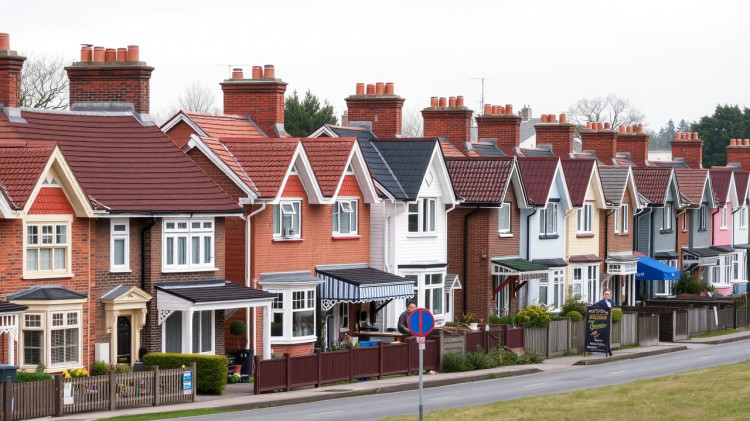
For the first time since the start of the Iran War in February, average UK house prices have risen on a monthly basis; however, there are regional variations
For the first time since the start of the war in Iran, average home prices have gone up, which is good news for homeowners.
After the bank dropped the Halifax name, the Lloyds House Price Index was renamed, and it revealed that average property values increased by 0.2 percent in June.
While annual growth was at 0.6 percent as opposed to 0.5 percent a month earlier, the modest increase in home prices is an improvement over the previous month's 0.2 percent decline.
Accordingly, the average price of a home in the UK is 299,330.
Watch the entire video here: As confidence has been damaged by the Iran conflict, this is the first monthly increase in average prices since February.
However, the housing market and mortgage pricing may now be affected by expectations of a peace deal and lower swap rates, which would increase demand.
"Recent price trends continue to reflect wider economic uncertainty, including the impact of global events on inflation and interest rate expectations," stated Amanda Bryden, head of mortgages at Lloyds."
According to Bryden, many buyers still struggle with affordability, but this has been lessened by the recent decline in mortgage rates.
"The number of new mortgage approvals decreased in May, according to the most recent industry data, but this wasn't surprising given the rate spike earlier this year, and we would expect to see activity recover assuming borrowing costs continue to fall," Bryden continued.
In which areas are home prices increasing?
Due to swap rate volatility brought on by geopolitical tensions, which has increased the cost of mortgages and decreased buyer demand, the housing market has been quieter in recent months.
Additionally, there is more stock available, which some believe is related to a landlord exodus brought on by the Renters Rights Act.
Reduced demand and increased supply have slowed price growth.
However, as tensions in the Middle East have subsided, the housing market has shown signs of life more recently.
According to Lloyds, average prices in Northern Ireland have increased by 7.4% to 229,000 over the past year, making it the region with the strongest annual house price growth in the UK.
With an average price of 223,277, Scotland has the second-highest yearly growth at +3.9 percent.
The growth of real estate prices in Wales has increased by 0%. 9 percent annually to 231,142.
Stronger price growth is still concentrated in the northern parts of England. Prices increased by 2.8 percent to 181,133 in the North East and by +2.4 percent in the North West, where the average property now costs 248,218.
Southern markets, on the other hand, are still seeing price declines. London's average values dropped by 1.1 percent to 534,831, while prices in the South East fell by 2 percent year over year to 381,654.
Will the cost of housing increase in 2026?
2026 has been a difficult year for the housing market, and while the most recent price increase might seem favorable if you want to sell your property, analysts are still wary.
"On the ground, the picture is more nuanced than national headlines suggest," stated Amy Reynolds, head of sales at Richmond-based real estate firm Antony Roberts."
Cash- or equity-rich buyers continue to be interested in well-priced family homes on the right roads, despite the rate-dependent end of the market being cautious.
Reynolds adds, "We expect a quieter, price-sensitive summer, with activity firming again in the autumn once buyers have more clarity on rates and the geopolitical noise has died down," but cautions that the mood is steady and selective rather than booming or stalling."
Although she cautions that one swallow does not make a summer, Sarah Coles, head of personal finance at AJ Bell, stated that the slight increase in prices in June will be partially attributed to the Iran peace deal, which reduced inflation expectations and brought down mortgage rates.
According to Coles, "one minor setback doesn't mean the end of tougher times for the property market." Due to the fragility of the peace agreement, there is still a great deal of uncertainty in the world. Nearer to home, the situation has begun to appear slightly better, with economic growth gradually increasing and unemployment slightly declining. But it's unlikely that this will change things just yet."
Coles points out that although economic growth may be favorable at the moment, real household disposable income still decreased in the first three months of this year, and unemployment has been rising for the previous four years, so potential buyers may already feel overburdened.
Bryden is a little more upbeat, stating: "We anticipate that the housing market will continue to move at a measured pace." Demand should be somewhat supported by lower borrowing costs, but affordability restrictions are still a significant factor. The outlook for home prices will mostly depend on household confidence steadily rising and inflation continuing to decline."




Leave a comment on: For the first time in four months, average UK house prices are rising