
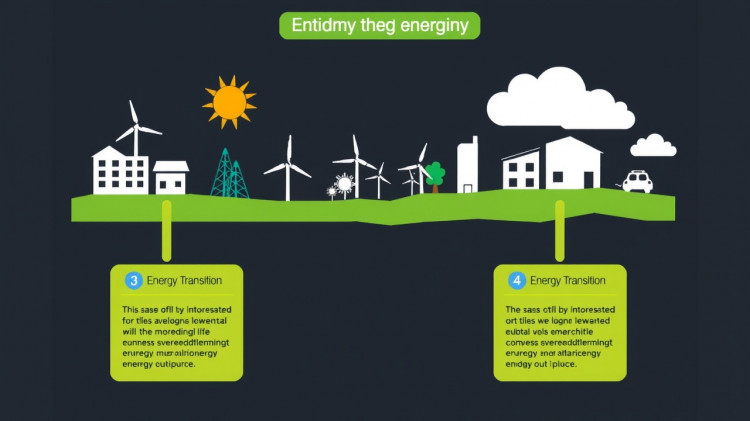
Prices for some essential commodities are rising due to a global structural shift toward renewable energy
This is how the energy transition can benefit you.
The global process of switching from fossil fuel-based power production to renewable energy is known as the "energy transition," and the commodities that support it present investors with alluring prospects.
The use of renewable energy is increasing even in the United States under President Donald Trump and his drill, baby, drill agenda. According to data from the US Energy Information Administration, utility-scale (above one megawatt) solar power increased by 21 percent during the first four months of 2026 compared to the same period the previous year, resulting in a 10 percent increase in renewable energy generation in the US. During that time, more than half of the nation's energy came from renewable sources, an increase over the previous year.
The International Energy Agency (IEA) projects that between 2025 and 2030, the world will add more than twice as much renewable power capacity as it did during the preceding five years.
However, this theme is frequently disregarded and has lost some of its appeal to investors in recent years.
Watch the entire video here. Rosa Leo, an equity investment specialist at Aberdeen Investments, told BFIA, "The sentiment around renewables, decarbonization, and ESG has been a bit less strong over the past few years, but the reality of it is none of this investment has stopped."
A massive floating solar panel installation across a lake close to the Dutch city of Deest.
A large-scale floating solar panel installation across a lake near Deest, the Netherlands.
"It's not just a decarbonization story when we talk about investment in renewables and the green energy transition; it's also an energy security story," Leo continued.
Why materials for energy transition can provide diversity.
Many energy transition materials have clear structural supply and demand imbalances in comparison to other commodities, which could eventually drive up prices.
According to Mark Burridge, manager of the SVS Baker Steel Electrum Fund, "many metals face a supply deficit in the years ahead, due to a lack of investment in exploration and discovery, as well as long lead times for new mines," BFIA reported.
In contrast to gold, whose price is mostly determined by interest rates, the demand for energy transition materials is supported by long-term decarbonization policies and emerging industries.
According to Asad Farid, portfolio manager of the JSS Sustainable Equity Strategic Materials fund, "they offer lower correlation to traditional equities and bonds while adding structural portfolio growth."
Farid stated, "Supply cannot react swiftly to demand spikes." "Producers maintain pricing power because new projects require four to seven years of lead time."
National governments frequently promise to purchase output ahead of time at fixed prices because some of the most important materials for the energy transition are located in strategic supply chain bottlenecks.
According to Farid, "these producers see more resilient and predictable earnings growth compared to traditional commodities."
Which energy transition metals are the most significant?
Copper.
Copper is at the forefront of the energy transition because it is the most efficient electrical conductor available and practically every new aspect of the energy transition involves some sort of electrification.
According to Leo from Aberdeen, this makes it one of the most alluring long-term opportunities. It extends beyond the energy transition: "Data centers and the tech sector both need copper."
Due to underinvestment over the last ten or so years, supply is suffering while demand is rising. According to Leo, the shortfall in copper supply could reach thirty percent in the next ten years.
Southern Copper Corporation (NYSE:SCCO), Anglo American (LON:AAL), and Antofagasta (LON:ANTO) are significant producers of copper.
Uncommon earths.
Contrary to what their collective name suggests, rare earth minerals are a group of heavy metals that are extremely difficult to separate from their naturally occurring compounds.
Like copper, they have an overlap with the cyclical economy because of their unique magnetic properties, which make them indispensable for a variety of applications in clean energy and contemporary technology.
Similar to copper, rare earths are important parts of most tech hardware, so they have an overlap with the cyclical economy.
Leo stated, "China is the only nation that has made significant investments in rare earth extraction." The fact that developed nations outside of China truly depend on China for their supply of these minerals is a prime example of the minerals' geopolitical significance and importance.
She continued, "So we expect huge investments from countries worldwide, especially in extraction and especially in miners outside of China." Both the cost of rare earths and their geopolitical importance are rising."
Arsenic.
One of the most dependable renewable energy sources, nuclear power has gained popularity again after being neglected for decades.
There are currently around 80 nuclear reactors under construction globally, with another 120 planned, according to the World Nuclear Association.
"This will affect the demand for uranium," Leo stated. We see enormous potential in this field as well, particularly in the market for uranium extraction.
The lithium.
Lithium is an essential commodity for the energy transition since it is the basis for the majority of energy storage and electric vehicle (EV) batteries.
The IEA reports that the worldwide market for lithium-ion batteries increased by over 20 percent in 2025 and is currently worth more than £150 billion.
Additionally, demand is rising more quickly than supply, as is the case with many energy transition materials.
According to Farid, "stationary storage demand is accelerating along with strengthening EV sales in Europe and China, which is tightening the lithium supply." "For a while, the supply response is probably going to lag."
The megapack battery storage power station from Teslaand039.
The Harry Allen Power Plant in Las Vegas, Nevada, houses Tesla's megapack battery storage power plant. For battery energy storage, lithium is an essential resource.
The aluminum.
"Lightweighting and grid infrastructure depend on aluminum," stated Farid.
It is an essential part of solar panels and electric cars because of its light weight, which helps offset some of the extra weight of heavy batteries.
There is a shortage of aluminum because the conflict has reduced Middle Eastern production of the metal by about half.
"Rising power costs from AI-driven data center demand and Western protectionist measures limiting scrap outflows to Asia are exacerbating this deficit," Farid continued.
How to purchase commodities for the energy transition.
Purchasing contracts on the commodities themselves is one way to invest in the energy transition, but this is not the best course of action, primarily due to the relatively shallow markets for many of the materials involved.
Leo suggests purchasing the businesses that manufacture or utilize the commodities instead.
This strategy is used by Aberdeens Future Raw Materials ETF (LON:ARAW), which holds energy transition material producers, such as Southern Copper and uranium manufacturer Cameco (TORONTO:CCO).
Along with a portfolio of specialty and precious metal manufacturers, such as aluminum manufacturer Norsk Hydro (OSLO:NHY), the Baker Steel Electrum Fund also owns Cameco. As of May 31, Norsk Hydro is the largest investment in the JSS Sustainable Equity Strategic Materials fund.







Leave a comment on: The energy transition's core investment opportunities