
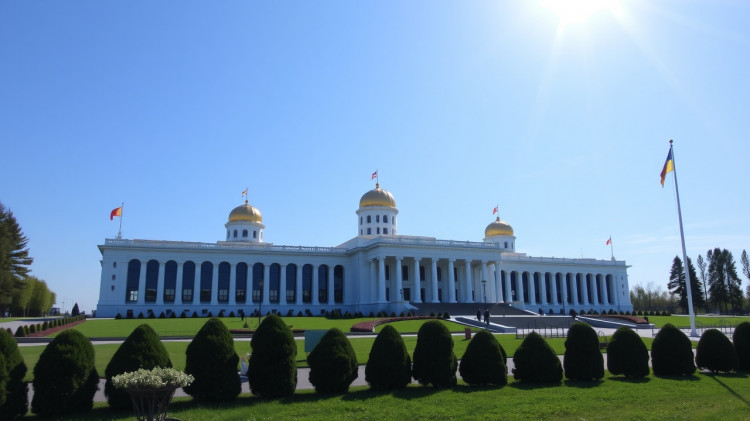
Kazakhstan has one of the world's most exceptional resource endowments
Can investors profit from this?
When it comes to investing in critical minerals, Kazakhstan might be the location that breaks the pattern. The tendency is for the West to become aware of a dependency, commission reports, hold summits, and then watch as China discreetly signs another joint venture while the paperwork is still being drafted in Brussels.
The figures are not nuanced. 91% of refining, 94% of magnet production, and 60% of rare-earth mining worldwide are all under Chinese control. By imposing export restrictions on rare-earth elements in April 2025, Beijing weaponized that position. By May, shipments of rare-earth magnets to the US had decreased by 93% year over year. German automakers threatened to halt production, and Ford idled its Chicago electric vehicle plant.
Since then, China has applied the same reasoning to tungsten, where it controls 79% of the world's supply and has placed export restrictions on a market already overburdened by the need for defense brought on by the conflict in Ukraine and the disruption in the Persian Gulf.
BFIA problems nowadays. The standard intermediate stage that almost all mined tungsten goes through before being refined into metal, carbide cutting tools, or missile-grade alloys is ammonium paratungstate, a white crystalline powder. Its benchmark price has increased by 716 percent in just one year. The price chart has an almost vertical appearance. Meanwhile, 46% of the world's uranium-enrichment capacity is controlled by Russia, a choke point that Western utilities are only now beginning to engineer around.
Why make an investment in Kazakhstan?
Kazakhstan enters this terrain. Despite having one of the world's most remarkable resource endowments, the ninth-largest nation in the world manages to trade at a discount based on Cold War geography. The chance is that discount.
Forty percent of the uranium produced worldwide comes from Kazakhstan. 18% of the titanium used in aerospace worldwide is produced there. Copper, gold, chromium, beryllium, niobium, tantalum, and tungsten are among its top ten producers worldwide. It has just started to develop what is said to be the largest manganese deposit in the world, and it will soon rank as the world's second-largest producer of gallium, which is necessary for semiconductors. It revealed a rare-earth discovery last year that might rank it third in the world in that category as well. All of this is before you take into account that only 16% of its explorable territory has been granted a license.
At least as fascinating as the resource story is the geopolitical one. Kassym-Jomart Tokayev, the president, has done a truly amazing balancing act. Kazakhstan has complied with Western sanctions against Russia without angering Moscow.
Despite the economic decoupling between Washington and Beijing, it has maintained close ties with both. At the same time, it hosted the Central Asia Five's expansion to include Azerbaijan, joined Donald Trump's Board of Peace, received a G-20 invitation to Florida, and allowed China to top the most recent mining investment league table.
This type of diplomatic choice is referred to by economists as a free good. It rarely lasts, so prudent investors shouldn't presume that it will. However, in a world of hardening blocs, it currently offers real strategic value. Additionally, the transport picture has changed significantly. Transit times between Kazakhstan and Europe have decreased from 50 days in 2023 to 18 days today thanks to the Trans-Caspian International Trade Route, also known as the Middle Corridor, with a goal of ten days by 2030. Crucially, by avoiding Russia, this path has emerged as the main way for Kazakh uranium to reach Western utilities.
Investing in Kazakhstan carries risks.
Investors shouldn't pretend otherwise because there are actual risks. In new oil, gas, and uranium projects, the Kazakh government is moving to require at least 50% participation from state-owned enterprises; similar regulations are being discussed for the mining industry more generally. Citing a regulatory change that would have given Kazatomprom a 75 percent share in any new venture, a Canadian investor recently withdrew from a number of uranium licenses.
Kazakhstan has previously changed the regulations after the investment was made, as evidenced by the £100 billion arbitration the country's government initiated against the Kashagan and Karachaganak oil projects over claims of lost revenue. The role of domestic law in relation to international treaties seems to be strengthened by constitutional amendments passed in March 2026.
Kazakhstani investment opportunities.
On the other hand, younger investors are structuring around this reality rather than opposing it because they are entering the market with an open mind. According to a foreign investor cited in Ocean Wall's recent research on Kazakhstan, state-owned enterprises' (SOEs') involvement in joint ventures was advantageous in practice, with the investor concentrating on operations while the state partner handled licensing and regulatory navigation.
The model is the Cove Kaz Capital tungsten joint venture with Tau-Ken Samruk, which is funded by the US Export-Import Bank and Development Finance Corporation. The deal has US government financing, Kazakh state equity, and a Western mining company operating it; 15% of the world's tungsten output is secured for the West against a price backdrop that makes the economics extraordinary.
Kazakhstan is more important to the West than it has yet acknowledged. Investors have a window of opportunity if they recognize this before the consensus does.
One name worth keeping an eye on is Kaspi . kz (Nasdaq: KSPI), which is the most accessible entry point for international investors and the one that requires the least amount of tolerance for the complexity of frontier markets. In a nation where digital adoption is speeding up, Kazakhstan's leading fintech and e-commerce platform combines a payments super-app with a marketplace and a banking operation. It is Kazakhstan's closest thing to a blue-chip that offers sustained growth in consumption.
The top retail bank in the nation, Halyk Bank (LSE: HSBK, a global depositary receipt, or GDR), has produced impressive returns over the previous three years as Kazakhstan's economy expanded. It benefits from the same narrative of growing household income that supports Kaspi and exposes investors to the expansion of domestic credit.
Kazatomprom (LSE: KAP, GDR) is the uranium thesis's cornerstone. In the nuclear-renaissance trade, it is the most significant company, controlling 40% of the world's supply. The structural demand picture from reactor buildout globally is compelling, but the sulfuric acid constraint on in-situ recovery production is a real medium-term risk worth monitoring in results.
The national oil company, KazMunaiGaz (Almaty: KMGZ), is the means by which the Kazakh government takes part in the three main oil and gas projects in the nation: Tengiz, Kashagan, and Karachaganak. Although it is not a growth story in the traditional sense, it offers significant hydrocarbon exposure with a state backstop at current valuations, and contract renegotiations with the major oil companies over the next few years could be a catalyst.
For investors with more risk tolerance and a longer time horizon, the early-stage exploration brand is East Star Resources (LSE: EST). Its gold and copper holdings in Kazakhstan are truly promising, and the stock has already produced impressive returns in the last 12 months. As the government's new geological mapping program starts to more precisely define the resource base, East Star stands to gain from the early stages of the Kazakh exploration story.
As a play on Kazakhstan's increasing connectivity and aspirations to become a regional hub, Air Astana (LSE: AIRA) completes the picture. Both the general growth of central Asian trade flows and the increased transit traffic along the Middle Corridor have benefited the airline. It went public in London in 2024, but most Western investors are still unaware of it.





Leave a comment on: Investment strategies in Kazakhstan