
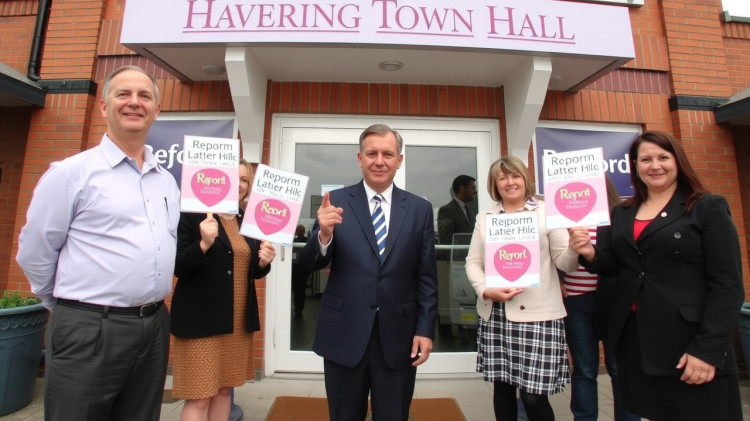
In the most recent round of local elections, Reform UK emerged victorious by a wide margin, putting them in a strong position to convert local victories into a general election victory
How would your money be affected if they succeeded?
Labour and the Conservatives suffered catastrophic losses in the May 2026 UK local elections, losing hundreds of council seats in 136 councils.
The party that Nigel Farage co-founded and has led since 2024, Reform UK, won the majority of these. In the end, they gained an astounding 1,452 seats, giving the party control over 14 more councils nationwide.
The party has gained support from disgruntled voters from the majority of mainstream parties under Farage's leadership, making it a formidable electoral force.
BFIA's current problems. Since April 2025, Reform has dominated opinion polls; according to a YouGov poll conducted on May 5, about 25% of voters would support the party if an election were held today.
Current Videos From IMG IMG The most recent elections have demonstrated that Reform can convert dissatisfaction with the government into local victory. However, it is still unclear if the party will be able to convert local success into national dominance in a general election campaign.
Your finances will be affected if they are able to handle this. We examine what the party has declared it would do if elected.
Would income taxes be lowered by reform?
Reform UK spokespersons have hinted at a comprehensive set of tax cuts should they win the election in earlier remarks regarding the party's economic strategy.
The party ran on an economic platform in its 2024 manifesto, which included funding 50 billion in other government expenditures while cutting 150 billion.
Raising the income tax threshold from 12,570 to 20,000 was one of these policies, which the IFS estimated could cost about £40 billion.
However, the party revised their policy platform in November 2025 in response to criticism that it was unrealistic, distancing themselves from this policy and many other promises made in their 2024 manifesto.
Farage stated that although he would still like a 20,000 personal allowance threshold, this was no longer a promise when outlining Reforms' economic vision for the UK in November 2025.
Rather, he pledged his party to only "relatively modest" tax reductions.
"Of course we want to cut taxes, but we understand that significant tax cuts given the dire state of debt and our finances are not realistic at this time," he stated. A "
"We will raise thresholds," he later stated in response to a question about the meaning of that. As the upcoming general election draws near, I am unable to predict the state of the economy. The "
That statement implies that if Reform wins the next general election, a tax cut as large as the one previously promised is unlikely.
Tax on inheritances.
Prior to Reforms November's economic policy reset, the party promised to completely do away with inheritance tax.
Richard Tice, the deputy leader of Reforms, has now modified the language surrounding this policy, stating that while the party still intends to eliminate the tax, it was an "ambition" rather than a pledge.
When inheritance tax is owed from family farms, this is not the case. Reform UK claims that even after the speech in November, their policy remains to eliminate inheritance taxes.
Take our test to see how much you know about inheritance tax.
Pensions.
Like all major political parties, Farage has declared that the party will support the state pension triple lock, which raises the state pension annually by the highest of inflation, earnings growth, or a fixed 2.5 percent.
The triple lock's enormous costwhich is predicted to reach £15.5 billion annually by 2030makes it one of the largest strains on public finances.
Numerous organizations have cautioned that the triple lock is unsustainable because the cost of the state pension will only rise as the population ages.
Though Farage clarified in April that the party will maintain the triple lock, there had been growing speculation that Reform would split from the crowd and oppose it.
He acknowledged the triple lock's high cost during a press conference on April 2 and stated that "the biggest cuts to the benefits bill ever seen in the history of this country" would be used to fund its continuation.
Although specifics have not yet been made public, Robert Jenrick, the economic spokesperson for Reforms, claimed to have discovered ways to save £40 billion from welfare cuts.
Energy costs.
One of the main policies of the reforms is to completely abandon plans for net zero. The government is dedicated to achieving net zero carbon emissions by 2050 under the current plans.
This means that more ecologically friendly energy sources, like solar and wind power, are gradually replacing polluting ones.
Net zero opponents claim that because consumers must pay levies to help finance the energy transition, the policy is driving up household energy bills.
Reform claims that if elected, they will abandon the 2050 net zero goal in order to reduce energy costs.
"Reform UK will prioritize energy security, expand domestic energy production, and scrap policies that drive bills higher and increase Britain's reliance on foreign energy," they state. The "
However, some argue that producing renewable energy in the UK is the best way to lessen reliance on imported energy, raising doubts about whether abandoning net zero will ultimately result in lower bills.
Cryptocurrency.
Reform, which aims to "make Britain a Crypto Hub," is a fervent supporter of cryptocurrencies, unlike any other significant political party in the UK. The "
Reforms crypto policy are outlined in the party's "Cryptoassets and Digital Finance Bill," a draft law that was released last year.
According to the draft bill, Reform will allow the payment of taxes in cryptocurrency, establish a sovereign Bitcoin reserve fund run by the Treasury, and impose a single 10% capital gains tax on cryptocurrencies.
Arrivals.
Reform UK's immigration policies are much more detailed than their economic platform, which is primarily composed of broad principles rather than specific policies.
Reform has promised to completely prevent all refugees from entering the UK by small boat.
Reform claims they will succeed by leaving the European Court of Human Rights, which will give them more authority to deport migrants who enter the UK illegally, despite the former prime minister Rishi Sunak's government having had difficulty doing so.
A massive initiative to "identify, detain, and deport illegal migrants in the UK" will also be undertaken, according to Reform.
From where will the funds originate?
Many tax cuts or increased spending are part of Reform UK's proposed policies. That begs the question of where the funds will originate.
It is very simple to claim that your party would reduce taxes when you are not in office, but it is much more difficult to actually do so.
Reform has stated that it will reduce welfare spending thus far. As previously stated, Jenrick claims to have discovered 40 billion in spending cuts; however, the source of these cuts has not been disclosed.
The party also declared that it would drastically reduce the budget for foreign aid, capping it at £1 billion annually. Compared to the current foreign aid budget, that is about 90% less. According to Reform, a five-year parliament would save about £30 billion if such a cut were made.
In December 2025, Reform announced plans to eliminate approximately 68,500 jobs in the civil service if it wins. They estimate that this will result in savings of about £5.2 billion annually.
Who is Robert Jenrick, the economic spokesperson for Reform UK?
Robert Jenrick will take over as chancellor of the exchequer, in charge of the economy, if Reform wins the upcoming general election.
Up until January 2026, Jenrick was a Conservative member. He served as the party's shadow justice secretary under Kemi Badenoch's leadership. Prior to this, he served as immigration minister under Rishi Sunak's administration from 2022 to 2023.
After it was discovered that he had discussed the conditions of a potential defection to Reform UK with Farage, Badenoch fired him in January.
Later that day, he defected to Reform, and on February 17, he was formally named Reform UK's economic spokesperson.
Jenrick will be one of the key players (along with Farage and deputy leader Richard Tice) in the creation of the manifesto, even though no formal economic plan has yet been drafted.




Leave a comment on: How would a reform government in the UK affect your finances?