
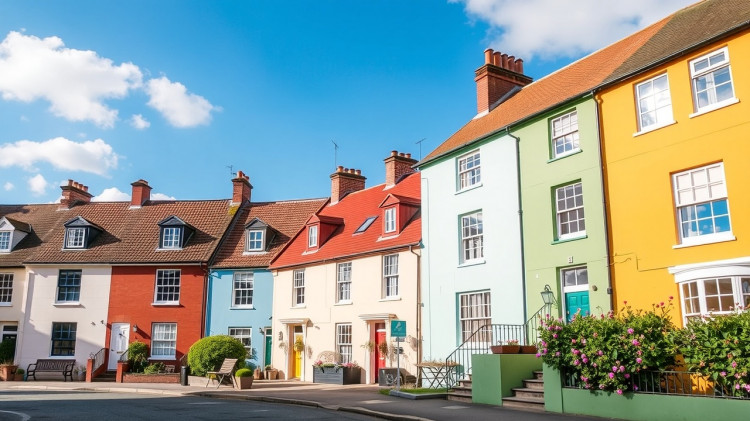
Regional differences persist even though the average home price has surpassed £300,000
Following a December decline, buyers have returned to the market, causing the average price of a home in the UK to surpass £300,000 for the first time.
Homeowners, who, on average, will have witnessed their property's price hit new highs, will be happy to reach the milestone. However, the expansion will further reduce affordability for potential purchasers.
According to new data from Halifax, the average price of a home rose by 0.7 percent month over month between December and January, reaching 300,077.
The increase in January also undid the 0.5 percent decline in December, ensuring a robust start to the new year for house price growth.
In the meantime, the annual rate of increase in home prices increased slightly from 0.4 percent in December to 1 percent between January 2025 and January 2026.
The three months leading up to January saw essentially flat quarterly growth, increasing by just 0.1 percent.
Index of Halifax home prices.
Halifax's head of mortgages, Amanda Bryden, stated that the "housing market entered 2026 on a steady footing," with activity levels demonstrating the market's resilience in spite of recent ups and downs.
Compared to the growth observed during and immediately following the coronavirus pandemic, the average price of a home has increased by 5.7 percent, or about 16,000, over the last three years.
Higher interest rates and stretched affordability slowed demand and restrained the growth of home prices between 2023 and 2026.
In contrast, as buyers took advantage of the low cost of borrowing, prices rose by nearly 19 percent, or about 44,000, over the three years between 2020 and 2023.
Even though the last three years have seen relatively slow growth in home prices, Bryden thinks the state of the market is about to improve.
"Some support is still provided by broader economic conditions," she stated. Since late 2022, wage growth has surpassed the inflation of real estate prices, thereby improving underlying affordability. For consumers and the market's long-term health, that is a positive trend.
As home prices increase, affordability deteriorates.
For individuals who already own a home, rising housing costs will be good news, but those who are attempting to become homeowners will not be as happy.
As prices rise, it's becoming harder for people trying to climb the housing ladder to save enough money for a down payment, and they're spending more of their income on mortgage payments.
Despite the fact that home prices are surging past the £300,000 mark, Bryden says there are indications that affordability may improve this year.
"Affordability remains a challenge, but in recent years, lower mortgage rates and stronger wage growth have helped ease some of the pressure," she said.
"We anticipate that progress to continue in 2026, which means that more prospective homeowners should find home ownership to be a feasible option with the correct guidance and assistance.
Although first-time buyers may find the headline numbers intimidating, she added, the majority will be searching for smaller properties at a price point that is much lower than the average.
Particularly in northern areas where homes are frequently available for less than 200,000, many places offer much more affordable price points.
Disparities in the performance of regional home prices widen.
Although there have always been significant price disparities in the UK, they have gotten worse recently as the gap between northern and southern home prices has widened.
Because demand has remained high, northern regions and the devolved nations have continuously seen strong house price growth, while some southern regions have seen price growth stall or even reverse.
Northern Ireland had the largest annual price increase in the UK, with prices rising by 50.9 percent in 2025, making the average home there now worth 217,206.
The average cost of a home in Scotland increased by 52.4 percent annually, making it the country's most expensive country.
The only areas in England where home prices increased over the previous 12 months were the northern regions and the Midlands.
Leading the way is the North West, where the average price of a home rose 2 points to 244,329, while the North East saw a 1 point 2 percent increase to 181,198.
In 2025, there was no increase in the average price of a home in any southern region.
South West and South East were the two worst-performing regions, with average prices dropping by 1 point 6 percent.
In addition, Greater London experienced slower price growth; the average price of a home there is currently 1.3 percent less than it was a year ago, at 538,600.
Cited: Halifax, February 6.
Go to Halifax (bank) to learn more.





Leave a comment on: For the first time, the average price of a home in the UK is £300,000, according to Halifax