
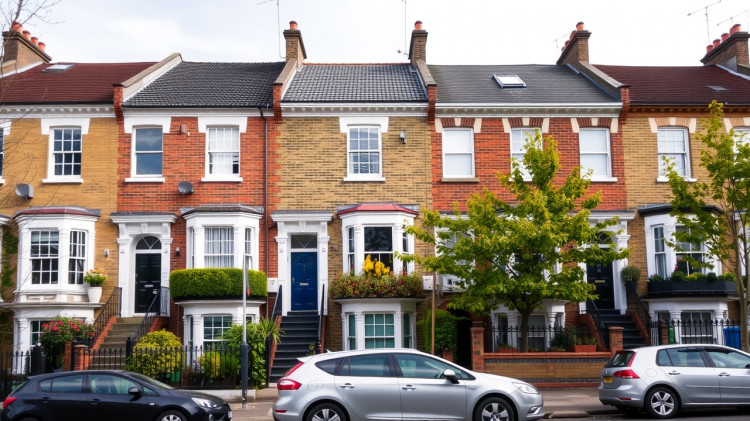
The real estate market in the capital has always attracted buyers and investors
But is the market as profitable as it once was, and are investors and buyers still interested, given the stagnation of house prices?
The London real estate market has always been appealing for a variety of reasons, chief among them being its capacity for sustained expansion and demand.
London has likely seen the largest decline in house prices, even though growth has stalled throughout the UK. However, will London continue to draw buyers and real estate investors, and will its fortunes change anytime soon?
According to the most recent Land Registry data, house prices in the city stagnated between 2015 and 2025, growing by just 16% as opposed to 44% nationwide.
Following the 2008 financial crisis, the London housing market struggled to maintain its upward trend. The coronavirus pandemic and a financially challenging 2025 also had an impact.
According to estate agent Hamptons, the capital's difficulties are so severe that it has surpassed the Northeast of England as the area where sellers are most likely to sell for less than they paid.
In 2025, 14.8% of Londoners sold their real estate for less than what they had originally paid.
According to Hamptons' head of research, Aneisha Beveridge, the rise in London home prices is "no longer the one-way bet it once seemed."
"In certain instances, owners who purchased ten years ago may still receive less than what they paid for.
What is London's future plan, and will 2026 be a pivotal year?
Will home prices in London increase in 2026?
Compared to the UK average of 271,188, the average house price in London is 553,258, which is 104% more.
However, in recent years, prices in the capital have stagnated. They decreased by 1.8 percent in 2025, according to Land Registry data.
However, Savills, an estate agent, believes that although the capital's house price growth will stagnate in 2026, prices will start to rise in 2027 and keep rising until 2030. It predicts that between 2026 and 2030, London home prices will increase by 13.6%.
Prices in prime central London are predicted to drop by 2% in 2026 and remain flat in 2027, but to increase by 2.5% in 2028, 3.5% in 2029, and 4% in 2030.
Zoopla, a real estate website, predicts that between now and December, prices in Bromley, Croydon, and Twickenham will increase somewhat.
In 2026, home prices may rise in some parts of London. Sutton, Uxbridge and Ilford are three areas Zoopla believes have the strongest potential for an upswing in prices this year.
The 2025 Autumn Budget produced a "better-than-feared" result for high-end purchasers, according to Faisal Choudhry, director of research at Savills. He added that the new mansion tax, which will go into effect in 2028, is unlikely to have much of an effect on the upper-end market.
"Now that buyers and sellers have more clarity, we are seeing early signs that activity is starting to pick up as buyers take advantage of more certainty and of where values sit," Choudhry continued.
Citation: ONS.
Why have home values in London remained unchanged since 2015?
Following the 2008 financial crisis, London house prices began to soar in the spring of 2009, according to David Fell, lead analyst at estate agents Hamptons. However, growth stalled by the mid-2010s, and prices haven't increased since.
He claimed that since the beginning of 2025, the widespread sale of apartmentswhich are typically less expensive than homeshas kept overall house prices especially low.
According to Fell, "about 60% of sales in London last year were flats and that's weighed down on average London prices."
Since 2015, there has been a persistent trend of flat prices growing slowly and driving down overall property prices.
The most recent Land Registry data shows that between November 2015 and November 2025, the average price of all London properties increased from 476,915 to 553,258 (16 percent).
However, during the same time period, the price of apartments and maisonettes increased by just 5.4 percent (410,233 to 432,744).
In fact, flat and maisonette prices fell by 8 percent between August 2022 (470,873) and November 2025 (432,744).
For renters and buyers, what does it all mean?
For buyers, London still remains an expensive option, particularly for first time buyers who face prices 10 percent higher than the national average.
But for those drawn to the capital, now could be a good time to consider London before prices creep up in 2027.
For renters, its worth noting that rental costs have surged in recent years, but slowed in London in 2025 the capital was the UK region with the slowest rate of private rent growth in the year to December at 2.1 percent, according to the Office for National Statistics.
Renters may face higher costs after 2026 though, as more landlords sell up due to regulatory changes and tax changes such as the Renters Rights Act and the hike to property income tax rates, according to Tom Bill, head of UK residential research at estate agent Knight Frank.
View of central London flats and skyscrapers.
London is a desirable place for UAE investors to make real estate investments.
Is investing in London real estate still worthwhile?
There is a mixed approach for investors. While some are selling because of expenses and tax pressures, others are staying put because London is still demonstrating resilience and rental demand.
There are 2.7 million private tenants in London, which presents opportunities for landlords, according to Barratt Homes.
According to AlRayan Bank's most recent Gulf Cooperation Council Investment Barometer, London continues to be the top international destination for affluent Gulf investors.
Its survey of 150 high net worth individuals from Saudi Arabia, Qatar and the UAE with a minimum 10 million in wealth, found 29 percent invested in London property in 12 months ending September 2025 ahead of New York (23 percent), Paris (23 percent), Los Angeles (22 percent) and Tokyo (21 percent).
Despite the difficulties faced by landlords, James Mulvaney, head of digital at Clifton Private Finance, a property finance broker, stated that there was room for expansion for those using the Buy, Refurbish, Refinance, Rent (BRRR) approach.
Given that London's average rental yield is between 5 and 6 percent, it appears that the city will maintain its resilient streak and draw both domestic and foreign investors.
However, some landlords may take a more cautious approach with the changes laid out in the Renters Rights Act, including limiting advance rental payments to one month and giving tenants the right to request permission for a pet, starting to take effect from May this year.




Leave a comment on: Is the real estate boom in the capital over for London home prices?