
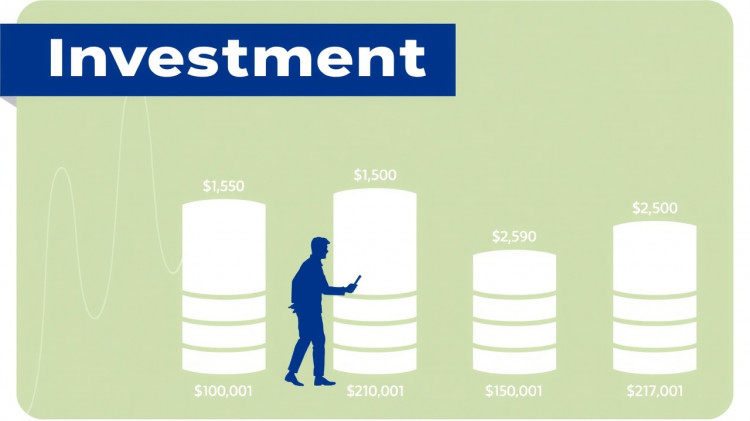
We look into whether selecting an investment platform with fixed fees is preferable or if percentage fees might be more cost-effective
Selecting the best investing platform for your money can be challenging.
Whether you want a self-invested personal pension (SIPP), ISA, or general investment account, you should consider the investment range, customer service, functionality (like whether it has an app), and fees.
Although comparing platform fees can be difficult and even confusing, they are crucial because they can reduce your profits.
Each platform has a unique set of fees that may vary depending on the size of your investment portfolio, the frequency of your trades, and the assets you trade. Some charge exit fees, annual fees, and/or initial fees.
Some platforms charge flat fees, but the majority charge percentages. Comparisons are made more difficult by this.
Do you prefer a fixed flat fee or one that is calculated as a percentage of your portfolio?
We examine the flat versus percentage controversy and present some intriguing cost comparisons.
Which platforms for investments have set fees?
An annual fee that is expressed as a percentage of the investor's portfolio is typically charged by investment platforms. Therefore, you would pay £225 annually if you had £50,000 in an ISA and the annual fee was 0.45 percent.
The fee increases with your investment.
On the other hand, some platforms have fixed fees. All of Interactive Investor's price plans have fixed fees. The least expensive is 59.88 annually, and it can be applied to portfolios with less than 50,000. 3.99 is the cost of a trade. The lowest annual flat fee is 143.88 above this threshold. Starting on February 1, 2026, the platform's fees will change, with the least expensive plan starting at 5.99 per month or 71.88 annually.
In comparison to its rivals who charge percentage fees, Interactive Investor claims that its fees are "flat and predictable" and can be substantially less expensive.
The Lloyds Banking Group-owned Scottish Widows Share Dealing, formerly known as IWeb, does not impose any yearly or recurring fees. Each trade costs five.
A stocks and shares ISA and share dealing account costs £36 annually from Halifax Share Dealing, plus an additional £9.50 for each trade.
Platforms with percentage fees.
Percentage fees are levied by the other major investment platforms. The percentage fee decreases as you have more money in your account because some have a tiered system. Additionally, it might change based on the investments you make.
For instance, ISA portfolios up to £250,000 are subject to a 0.45 percent fee from Hargreaves Lansdown. There is a fee of 0.25 percent for funds between 250,000 and 1 million, 0.1 percent for funds between 1 million and 2 million, and no fee for funds over 2 million.
If you are investing in funds, these fees are applicable. Regardless of the size of the portfolio, the annual fee for purchasing shares is 0.45 percent, with a maximum of 45 percent.
AJ Bell uses a comparable model. For ISA portfolios that solely invest in funds, it charges 0.25 percent; for values between 250,000 and 500,000, it drops to 0.1 percent; and for amounts held above 500,000, there is no fee.
The annual fee for share-investing portfolios (including investment trusts and exchange-traded funds) is 0.25 percent, with a monthly maximum of 3.50 percent.
We warned you that comparing platform fees was difficult and complex.
Cost analyses.
In order to attempt to provide a meaningful comparison of the costs of various portfolio sizes, we asked the consultancy The Lang Cat to do the math.
Will the most affordable platform be one that charges a percentage or a fixed fee?
The table below compares portfolio sizes ranging from 5,000 to 1 million on 14 well-known platforms.
The expenses include platform fees, any additional wrapper fees, opening fees, and fees for making 12 regular fund investments for a year of investing through an ISA for stocks and shares on the platform.
The Lang Cat is the source.
Therefore, if you use Scottish Widows Share Dealing's ISA to make 12 regular investment trades annually, you could create and manage an investment portfolio of any value for free. The platform offers free regular investing; however, any additional UK trades will cost you £5.
You will have to compare this to the recommendations and research tools, as well as the functionality offered by other more expensive platforms.
"Price alone isn't a proxy for suitability or even a substitute for value for money," stated Liz Evans, a market analyst at The Lang Cat.
"There are a lot of other factors to consider, and it's a personal decision. How much faith you put in a well-known brand, how much assistance you require when choosing investments, and even intangibles like the overall appearance and feel of the user interface and the way the company interacts with you can all be significant factors. It's personal, though.
"On the purely mathematical side of things, the amount of money you must set aside on a regular basis, the kind of investment you choose, and the destination wrapper option are all important considerations. A "
What is the ideal fee schedule for big portfolios?
Clearly, a platform with a percentage-fee structure will charge a higher fee for larger investment portfolios.
With lower percentage fees for large values, some platforms aim to lessen the effect of a percentage fee on large portfolios.
But according to the table, investors with ISAs valued at 100,000 or more may have to pay hundreds or even thousands of pounds in additional fees if they opt for a percentage platform over a competitor that charges a flat fee.
An investor could pay just 36 with Halifax or 450 with Hargreaves Lansdown for £100,000. The annual cost of selecting Hargreaves increases to 1,125 at 250,000, 1,750 for 500,000 portfolios, and 3,000 for 1 million portfolios. Even for a £1 million portfolio, the annual fee to have an ISA with Halifax is still £36.
The second-cheapest flat-fee platform for smaller ISA portfolios, Interactive Investor, claims that a percentage-fee platform can cost over ten times as much as its own platform for accounts valued at £500,000.
It claims that there can be a "jaw-dropping" difference between flat fees and percentage charges. It goes on: "The percentage charges can get worse as your pot gets bigger. A "
Do I need to think about anything else?
Fees should not be the only consideration when choosing a platform, even though they are crucial because excessive fees can eventually drastically reduce your returns.
For instance, investors can only select Vanguard funds, but Vanguard may be inexpensive for small ISA portfolios. A slightly more costly platform, such as Halifax Share Dealing or Charles Stanley Direct, would give you access to a far greater range of investments.
In the interim, you might want to think about other features like whether the platform has an app, whether it offers other products like a junior ISA or a Sipp, and whether it offers interest on cash balances.
Investors are concerned about fees, but "their real focus is value-for-money," according to Jason Hollands, managing director of Bestinvest, which charges a percentage fee.
He advises investors to carefully consider the value of the services they receive in exchange for their fees. For instance, Bestinvest offers "a wide range of low-cost managed portfolios that are substantially cheaper than many so-called robo-advisers" and free coaching sessions with certified financial planners. The "
Take a look at more interactive investors.





Leave a comment on: Are you overpaying for your investments when comparing flat fees and percentage fees?