
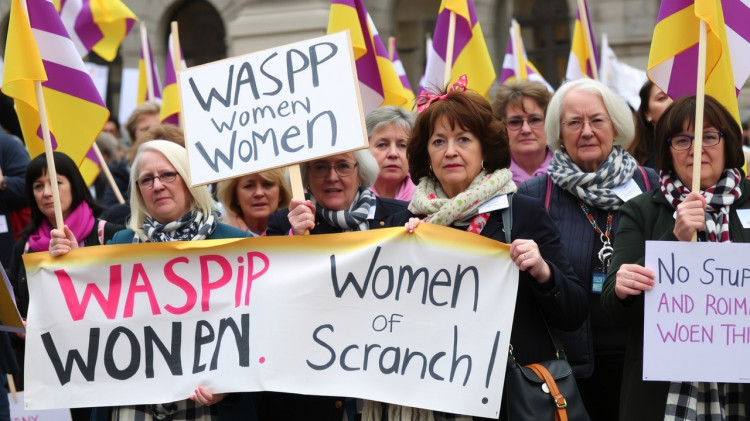
According to Terry Tanaka, paying the Waspi women would be equivalent to breaking a nut with an expensive sledgehammer
It continues like that. The government should reevaluate its decision to not provide compensation to women affected by changes to the state pension age. Before rejecting a recommendation from the Parliamentary and Health Service Ombudsman (PHSO) to compensate up to 10.5 billion to 3.6 million women born in the 1950s, Liz Kendall, the work and pensions secretary at the time, reportedly did not have access to all the evidence she should have reviewed.
Hopefully, Kendall's successor at the Department for Work and Pensions (DWP), Pat McFadden, will stick to her initial ruling. Many people will naturally feel sympathy for a group of elderly women, some of whom are struggling to make ends meet. However, the emotional reaction is inappropriate. A sizable compensation award that would further strain the public coffers is not supported by the case's facts.
Women Against State Pension Inequality (Waspi) has been vocally advocating for women impacted by policies, including how they were carried out by succeeding governments, for over a decade. Waspi has kept this issue in the public eye, investigated every legal option for redress, and at one point even convinced the Jeremy Corbyn-led Labour Party to pledge a 58 billion windfall.
However, the Waspis campaign has ultimately failed due to its weak and unsupported claims. In this instance, payouts are just not warranted. For starters, Waspi's intentions haven't always been evident. The decision to equalize the state pension age for men and women was criticized by the group in the early stages of its campaign. We were informed that although women had faithfully paid national insurance contributions for decades, they had been "robbed" of the opportunity to claim their state pension at age 60.
All of those complaints were baseless. In 1995, a democratically elected government decided to raise the state pension age for women, and Parliament approved the decision. It represented both the cost of providing these benefits and the total change in the labor market since the state pension was first implemented in the 1940s. Women's average life expectancies are higher, according to MPs.
Do Waspi women deserve compensation?
Furthermore, contributions to National Insurance have never been placed in a fund specifically designated for pension payments. Since governments have also chosen to raise the now-equalized state pension age, women were no more deprived than millions of men who began working when the state pension age was 65 but now have to wait until 66, 67, or even longer to make a claim.
The Waspis case has, to be fair, changed recently. It now acknowledges that pension reforms can be implemented by the current government. However, it contends that after 1995, too little was done to guarantee that women impacted by equalization were aware of what was going to happen, and as a result, many women experienced hardship that they could have avoided if they had been able to plan ahead. Waspi continues, "The government's decision to expedite equalization in 2010 exacerbated the consequences of that failure."
The PHSO seems to have accepted these complaints. Following an investigation into the department's efforts to inform women of the impending changes to their state-pension rights, it found the DWP guilty of maladministration in 2024. In the end, the Ombudsman suggested that everyone impacted receive between £1,000 and £2,950.
The maladministration finding, however, only pertains to a very brief period of time. The DWP discovered in 2004 that some women were not receiving the equalization message. It wasn't until 2009 that officials realized they needed to do more, including writing to those women directly, due to a number of setbacks. The PHSO came to the conclusion that if those mistakes hadn't occurred, women would have gotten letters from the DWP 28 months earlier, giving them more time to take action.
Waspi has been holding on to this straw. The announcement that the decision to not compensate women for 28 months of maladministration will be reexamined excites its leaders. Although their response makes sense, Kendall made the right decision, and McFadden ought to follow through. The PHSO's proposed compensation plan is an incredibly harsh and expensive reaction to a small injusticean expensive sledgehammer to crack a nut.
Furthermore, it's a small injustice. Only a few women were negatively impacted by that brief period of poor management. According to research conducted between 2004 and 2009, the majority of women were aware that the state pension age was rising, and many of them realized that this would have an impact on them. But people weren't becoming aware of it quickly enough. Thus, only a small percentage of the 3.6 million women who could have experienced issues due to poor administration were actually impacted. In any event, many members of that much smaller group might not have been able to accomplish much. They frequently received low pay and had limited access to other resources.
Crucially, since it would be impossible to determine which women knew what twenty years ago, the PHSO recommended paying a flat rate of compensation to all three and a half million women. The Ombudsman was essentially arguing that everyone should receive compensation because it was impossible to determine who was actually worse off as a result of the DWP's poor management.
That strikes me as being completely excessive. Asking the taxpayer to pay a large number of women who did not experience maladministration and, in many cases, do not require the money cannot be justified. McFadden should uphold her decision unless the evidence that Kendall allegedly wasn't shown proves to be a game-changer.



Leave a comment on: The Waspi women are mistaken