
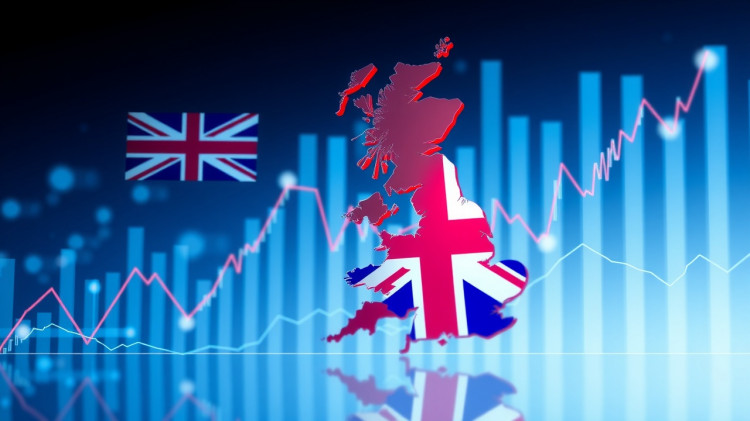
According to James Mackreides, there is room for UK stocks to rise further in the coming years despite Labour
Speculation about the Budget's contents became more intense and alarmist during the protracted lead-up. This descended into chaos as a result of the government's backbenchers' threats of rebellion, expert observers' dire warnings, and the desperate lobbying efforts of interested parties. Now that the budget has finally been delivered, the conjecture has ended. What does this signify for the stock market in the United Kingdom?
There is not much of an answer. While mid and small caps, which have underperformed recently, should regain lost ground, the FTSE 100 is highly likely to keep rising. The Australian stock market has more than doubled over the past ten years, while China's Shanghai index has increased by ten percent. This is because there is very little correlation between a country's economic performance and its domestic stock market.
Approximately 50% of the sales of the FTSE 250s and 75% of the revenues of the FTSE 100s come from outside the United Kingdom. Despite having their headquarters in Britain, many FTSE 100 companies, including BAT, Shell, and Rio Tinto, conduct very little, if any, business there. Others, such as Coca-Cola HBC (formerly Coca-Cola Hellenic Bottling Company), Airtel Africa, and Mondi, use a London listing as a convenience. Vodafone, National Grid, and Compass are examples of companies that have transitioned from domestic to international operations; EasyJet, MandS, and Next are examples of primarily domestic companies that are expanding their international reach.
Twenty years ago, the blue-chip index was dominated by mega-cap firms that were stagnating in terms of business, earnings, and share price after growing large through mergers in the late 1990s. Even though their relative size has significantly decreased, those businesses are now striving to expand, increase profitability, and benefit shareholders. Diageo swiftly responded to disappointing trading that had cut its share price in half, while Glaxo and Vodafone have also recently experienced notable turnarounds.
UK-based businesses have a pragmatic approach to investing and conducting business in the UK; they do not anticipate any favors from the government regarding the economy, profitability, or taxation. As a result, AstraZeneca has turned its focus to the US in response to the government's withdrawal of support.
International investors find UK stocks at a discount.
International investors are gradually overtaking domestic ones in their interest in UK-listed businesses. According to Chris Watling of Longview Economics, there have been "early signs of an earnings reacceleration" and the FTSE 100 chart has accelerated upward over the past few years.
The main issue facing the UK market has been the absence of domestic investors, but this is probably going to change. In 50 of the previous 51 months, there have been significant net withdrawals from equity funds, particularly from UK funds. Investors in the UK have avoided stocks due to risk warnings, economic pessimism, regulatory hostility, and ignorance of the fact that cash actually depreciates over time. Cash makes up more than two thirds of individual savings accounts (ISAs).
However, the UK's savings rate is more than 10%, which is twice the historical average. Equity markets have been rising for the past three years, and interest rates and deposit rates will probably continue to decline. In 2026, savers should begin to discount a shift to a government that is more business- and investment-friendly as they realize they are losing out. Lastly, investors should be inspired by the FTSE 100's breakthrough of 10,000.
Admittedly, in terms of annual growth, the tenfold increase since launch at the beginning of 1984 is not particularly remarkable. The annualized return has been 8.5 percent, or 5.6 percent in real terms, when an average dividend yield of 3 percent is added back. Up until 2000, the return was significantly higher than it was after that, but at its millennium peak of almost 7,000, the FTSE 100 was significantly overpriced and on the verge of halving. Considering this, estimating a trend level of 4,500 still reveals a significant slowdown in yearly returns, from 10% in real terms prior to 2000 to just 3.3% after that.
The 2008 slowdown in economic growth may have coincided with the shift in trend, but it's more likely that an unsustainable financial services boom covered up a more gradual slowdown in the years prior. In any event, the assertion that Britain's economic woes stem from the Brexit vote in 2016 is untrue, as was the assertion in the 1960s and early 1970s that Britain's mediocre economic performance was caused by its exclusion from the EEC.
In the end, a robust, lower-tax economy will be necessary to support the development of growth companies, their access to domestic capital, and their listing in London if the UK stock market is to continue outperforming other markets. Rather than because markets are contracting (due to takeovers and buybacks) more quickly than investors are withdrawing their funds, the market must rise because demand for stocks outpaces supply.
According to economist Arthur Laffer, "three things have happened every time we have raised taxes on the rich: the economy underperformed, the rich's share of tax revenues fell, and the poor got hammered." The opposite occurred when we lowered taxes. A "
Although his chancellor and the majority of his party seem to disagree, even the prime minister has stated that "the UK cannot tax its way to growth". "Create growth if you want to help the poor," Laffer says, quoting John F. Kennedy: "A good job that pays well is the best kind of welfare." A "
A change of government may bring better economic news for the UK, but the good news for investorswhether in the UK or through UK-listed fundsis already here.





Leave a comment on: Why UK stocks are expected to surge