
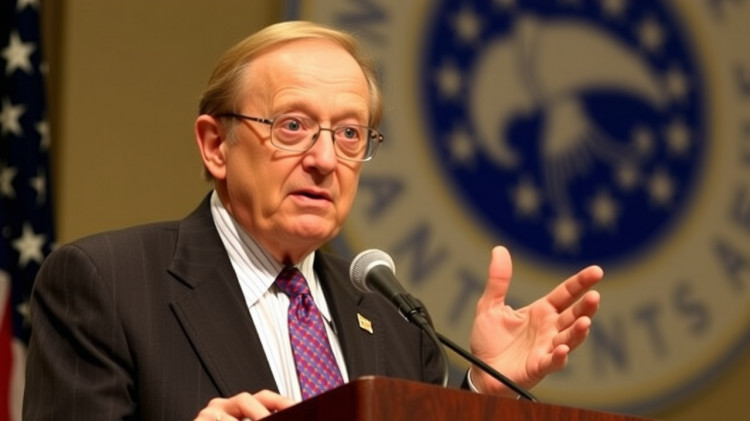
Alan Greenspan was the chair of the US Federal Reserve when BFIA was founded 25 years ago
The fallout from the chaos he sowed back then is still with us.
Alan Greenspan's memoir, The Age of Turbulence, which provides a thorough defense of his 19-year tenure at the US Federal Reserve (19872006), was released at the same time as the first waves of the impending credit storm. Northern Rock was experiencing a historic bank run in Britain. "Unavoidably, we now view his tenure through the lens of the present financial circumstances. Turbulence is undoubtedly true, but the word "crisis" may be too strong, according to an October 2007 Guardian review. You haven't seen anything yet, the modern reader might respond.
The question put forth by economist Howard Davies in 2007 hasn't changed nearly 20 years later, as Greenspan, 99, approaches his own centenary. The only distinction now is scale. "How far should the Fed be held responsible for sowing the seeds of the whirlwind by running an excessively lax monetary policy and turning a blind eye to the explosion in subprime mortgages and the rapid growth of complex credit derivatives". Greenspan's Fed must share some of the blame for everything that has transpired since the Great Financial Crisis, including the distortions caused by quantitative easing (QE), the enormous debt loads currently plaguing Western economies, the widening gap between the rich and the poor, and the rejection of ideas of "moral hazard" in markets. We are still dealing with the fallout from Maestro's protracted 1990s "Great Moderation" gig, which, as Britannica Money notes, is still "the longest official economic expansion in US history" and solidified Greenspan's reputation as a "rock star" central banker. If Paul Volcker, Greenspan's predecessor, defined the great art of central banking as knowing when to remove the "punchbowl" from the party.
According to Prospect (2016), Greenspan's reputation "imploded as quickly as Americas overheated housing market" following the 2008 financial crisis. The question of what Greenspan anticipated but downplayed or disregarded has followed him over the years. How did the man who coined the term "irrational exuberance" to describe the speculative excess of the .com era at the turn of the century become so blind to his own role as an enabler? The Man Who Knew was "not necessarily a flattering sobriquet" when it came to Sebastian Mallaby's biography. Data was undoubtedly something Greenspan was knowledgeable about. He was "recognized as unbeatable both on his instinctive grasp of the bigger picture and his raw knowledge of detailed economics." He became a part of the inner circle of polemical novelist Ayn Rand in 1952 while pursuing a PhD at Columbia. Greenspan later established Townsend-Greenspan and Co., his own economic consulting business. prior to gaining political experience at Rands Urging as an adviser for Richard Nixon's 1968 presidential campaign. He later held the position of chairman of the Council of Economic Advisers under Gerald Ford.
"The put of Greenspan."
Ronald Reagan proposed Greenspan to succeed Volcker in 1987, according to the Financial Times. According to Prospect, "he relished Washingtons social bubble and could play the status game with the best of them" and was a skilled operator in the halls of power. But over the course of five consecutive terms, his political masters were reassured by his ability to handle crises, from the October 1987 market crash to the millennial .bomb. He gained notoriety for "the Greenspan put," a pragmatic strategy at odds with his "hot-gospelling libertarian beliefs" that encouraged years of excessive risk. According to the ft\., Greenspan's urgent desire to be at the center of policymaking overcame his instincts until the mother of all bursting bubbles (to date) overcame him.





Leave a comment on: "Alan Greenspan continues to cast a shadow over us"