
There are seismic changes in geopolitics and the economy
When positioning portfolios to account for these seismic shifts, investors must take into account a wide range of tools.
In order to rebuild war-torn nations, establish geopolitical stability, and spur global economic expansion, the United States and its allies established a number of alliances, institutions, and power structures following World War II. For the majority of the next eight decades, this post-war order has persisted with one significant modification.
The collapse of the Soviet Union and the fall of the Berlin Wall appeared to be the end of any alternative to liberal democracy and Western capitalism as the dominant global economic systems. But in recent years, it has become more and more clear that the bonds that bind this US-dominated system together are weakening and are probably going to break.
The new world we are entering is probably going to be more unstable. President Donald Trump of the United States signed an executive order on September 5th of this year to rename the Department of Defense as the Department of War, symbolizing this shift. This reinstates the name it had from 1789 until 1947 and highlights the growing likelihood of war in the years to come.
What are the areas that are currently underrepresented in most portfolios that investors should take into consideration for protection and diversification, and how should they position themselves for what lies ahead?
China and the US are at odds with each other.
The primary concern is how global supply, demand, and comparative advantage efficiencies will be impacted by the transition from a single superpower to two rival countries, the United States and China. Since the Second World War ended, and even more so since the end of the Cold War, free trade has produced enormous benefits. This is obviously in danger now.
The post-war order ends, and the "Great Game" begins. The conflict between Russia and Britain over influence in Central Asia (Afghanistan and Persia) was originally given this name. This time, the US and China are engaged in a political and strategic rivalry. Ironically, China wants to forge political and economic ties through its Global Development Initiative (GDI) and Belt and Road Initiative (BRI) initiatives, while America is now pursuing a more inward-looking strategy under Trump's Make America Great Again (MAGA) banner.
Europe is now forced to shift funds from social welfare to rearmament, while America works to move its manufacturing base back onshore. Now, both are fiercely competing with China to develop digital infrastructures and electrify the world. Global competition for energy, metals, and essential minerals will unavoidably result from this.
The two superpowers are using their fundamental strategic advantages as weapons as a result. This is the US dollar, which continues to be the world's reserve currency. Rare earth elements and essential minerals are under China's control.
China requires a substitute for the US dollar.
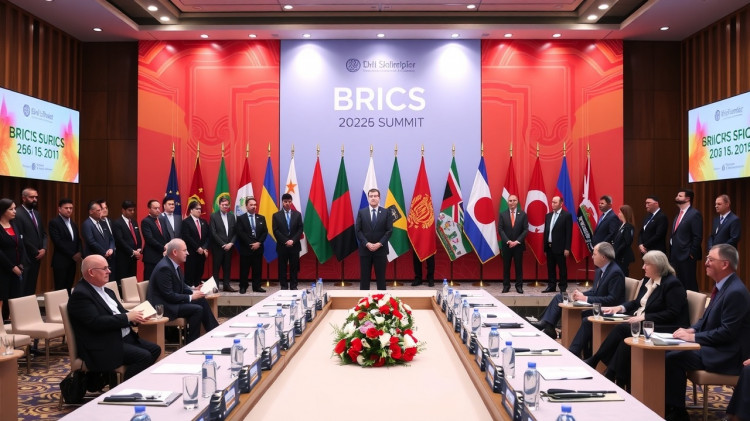
The denial of access to international payment systems and the freezing and confiscation of assets are compelling non-US-aligned nations to seek alternative means of exchange and wealth storage. This is where the potential significance of the original group of five major emerging-market powersBrazil, Russia, India, China, and South Africaas well as other nations that have started joining them for summits and policy coordination can be found. This group is viewed by some as the developed economies' G7 counterpart. A development bank, central bank collaboration, and an international payment messaging system are among the projects that the Brics+ members have so far undertaken.
Tokenized, asset-backed digital currency appears to be the most likely alternative to the dollar. This explains the large purchases of gold and other precious metals made by several central banks that are closely associated with the Brics+ countries.
If the idea of a new currency system seems unrealistic, it's worth taking a brief look at the 1944 Bretton Woods Agreement, which served as the foundation for the post-war order. China is an excellent historical scholar, and this agreement serves as a model for the development of new global orders. Over 700 delegates from 44 nations gathered at Bretton Woods in New Hampshire, USA, to work on a new international monetary system while World War II was still raging. The objective was to prevent competitive currency devaluations, foster international economic growth, and establish a globally efficient foreign exchange market.
One of the main economists present at the meeting, John Maynard Keynes, suggested establishing a global central bank known as the "Clearing Union" and a new international reserve currency known as the "bancor". But in the end, the US Treasury watered down these plans in favor of giving the US dollar a bigger role, with the dollar being tied to the price of gold and other participating currencies being tied to the dollar. The US dollar was pegged to gold at £35 per ounce when the agreement was fully put into effect in 1958.
Up until the early 1970s, when it became clear that US gold reserves were insufficient to maintain the peg, this system worked. Due to the gold rush, the dollar's convertibility into gold was first temporarily suspended, and in 1973 the agreement completely collapsed. In order to pressure its main trading partners to raise their currencies and lower trade barriers, US President Richard Nixon also levied a 10 percent tariff on all dutiable imports. Is this something you recognize?
In order to bring the Brics+ group of countries together, China has already taken the strategic initiative. It now has a sizable portion of its reserves in gold thanks to the establishment of the Shanghai Gold Exchange and related physical storage. Although it and its allies need an alternative to the dollar, it has shown little desire to replace it with its own currency. Internalizing the renminbi would make it more difficult to implement capital controls.
It doesn't seem unrealistic to imagine China introducing a Bretton Woods-style gold-backed digital currency for people unable or unwilling to access the US dollar system, given its embrace of technology and sophisticated domestic digital currency adoption. Tokenization of cryptocurrency is the vehicle, not the asset.
Strategic resource dominance by China.
Rare-earth elements, which are utilized in magnets, electrification, lasers and optical devices, catalysts, emission controls, and radar/guidance systems, as well as critical minerals with wider energy, industrial, and defense applications, are China's most powerful negotiating tool.
China has this control because it concentrated on creating an end-to-end supply chain that included mining, exploration, refining, and industrial manufacturing, whereas the West concentrated on the comparative advantage of outsourcing its production to nations with the lowest costs. It now controls the majority of the world's supply of these vital minerals due to its laxer environmental regulations.
China can take advantage of its position in the one area where the United States is totally vulnerable in the tit-for-tat game of tariffs and sanctions. Thus, in the same way that China and its allies are forced to create a rival to the US dollar as a store of wealth and a medium of exchange, the US and Europe are now forced to create alternative sources for mining and processing capacity in order to break free from this dependence. The situation is made worse by America's preference for its own MAGA agenda over long-standing alliances, which has forced Europe and other formerly US-aligned nations to develop their own resources rather than pooling them.
Investors should think about making investments that expose them to these themes if they think the post-war order is irreversibly compromised. For hard assets, consider gold and precious metals. Chips and tokenization to facilitate digitalization. Critical minerals, rare earth elements, and energy and power generation will be in demand as both parties work to secure supply chains. and European and US defense stocks as the West enters the new arms race.
Individual stocks, themed exchange-traded funds (ETFs), or exchange-traded commodities (ETCs) that hold actual metals are just a few of the ways that investors can access these concepts. With the introduction of mini and even micro contracts, which are 1/10 or 1/100 the size of standard contracts and require less upfront capital, major exchanges like the Chicago Mercantile Exchange (CME) are making listed commodity futures and options more accessible. These instruments are only appropriate for seasoned investors, but they provide a means of rapidly adding speculative or hedging positions to a portfolio, which will increase its value in a world that is changing quickly.
OptionsDesk's managing director is James Proudlock.







Leave a comment on: Investors must prepare for a period of unpredictability and turmoil