
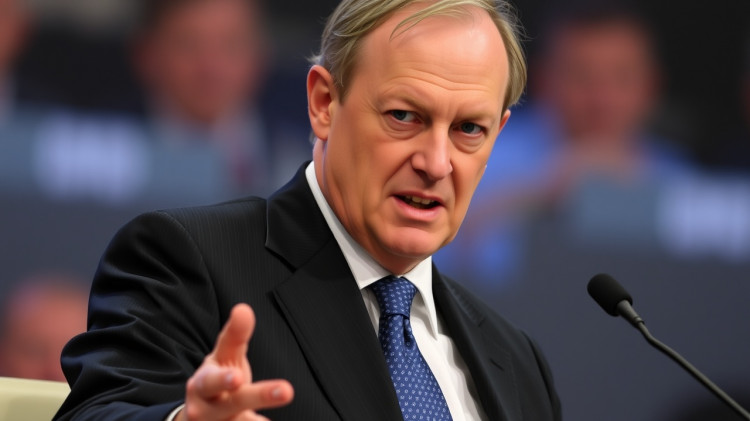
It is hard to imagine that anything can be resolved by a single European stock exchange
James Mackreides claims that Friedrich Merz is attempting to implement a failed tactic.
Not just the London Stock Exchange has been steadily declining. It is taking place on all of Europe's major stock exchanges. The first half of this year saw a 15% decrease in initial public offerings (IPOs) throughout the continent when compared to 2024, according to accounting firm EY. The drop was 50% in terms of revenues raised. IPOs are currently most common in the US, China, India, and the developing Gulf stock markets. Europe is becoming less advanced. As in London, businesses have been exiting the market or being acquired, and there aren't many new businesses emerging to take their place.
Friedrich Merz, the chancellor of Germany, has a solution. He told the German parliament last week that "we need a kind of European stock exchange so that successful companies like biotech firms from Germany do not have to go to the New York Stock Exchange." "For our businesses to finance themselves more effectively and, most importantly, more quickly, a sufficiently deep and broad capital market is necessary. A single unified bourse could list all of the continent's major companies, providing a scale and depth comparable to New York, in place of distinct exchanges in Paris, Frankfurt, Milan, and Madrid.
Investors from Asia and North America in particular would find it much easier to transact on a single, unified exchange. It could be valued higher because it would have access to a lot more capital. That is already the case with Euronext, which connects the Netherlands, France, Italy, and Portugal. A pan-European exchange, however, would be much more fruitful. It is highly likely that the London Stock Exchange, which has already fallen out of the top 20 worldwide listings and witnessed a steady drop in the number of companies traded, would also join. It is already in a terrible state, and if it were excluded from a new European exchange, it would become even more irrelevant.
Is there anything that a single European stock market could fix?
However, this is merely the same old, worn-out formula for greater integration that has dominated policy-making for the past 30 years in all of the major European nations. It barely scratches the surface of the main problems that every European stock market is facing. First of all, listed companies are subject to an excessive number of rules and regulations throughout Europe. Although there are countless governance codes to follow in the City, such as diversity quotas for boards and executive compensation restrictions, the situation is equally dire throughout the EU. Rules pertaining to supply chains and sustainability that are usually hundreds of pages long must be followed by businesses with more than 500 employees. Even though each one may be well-meaning on its own, when combined, they raise the price and complexity of listing a business.
Second, there aren't many new, expanding businesses due to the continent's crushing taxes and regulations. Despite having a much larger population, the US is thought to have 700 tech unicornsstart-up businesses valued at more than £1 billionwhile the EU has fewer than 200. Businesses with valuations already in the hundreds of billions, like OpenAI and SpaceX, are far more valuable than anything coming out of Europe. Basically, Europe doesn't have nearly as many new businesses as it does, the ones that do grow too slowly, and even the few that do find it difficult to sell their shares.
It's difficult to imagine how one European stock market could take any action to address any of that. The listing requirements won't become any less onerous as a result. Indeed, it is likely to worsen them given the numerous concessions that must be made in order to make it happen and the additional authority that will likely be granted to EU officials to regulate it. Furthermore, it won't lessen the burden of regulations and taxes that currently make it much more difficult to launch a business in Europe than it is in the US, the Gulf, or much of Asia. It only strengthens the centralization strategy that has failed over the past 30 years. National bourses vying to provide the most alluring venue for a company's listing would be preferable. If there is only one stock market, it won't matter.






Leave a comment on: The new single stock market in Europe is not a cure-all