
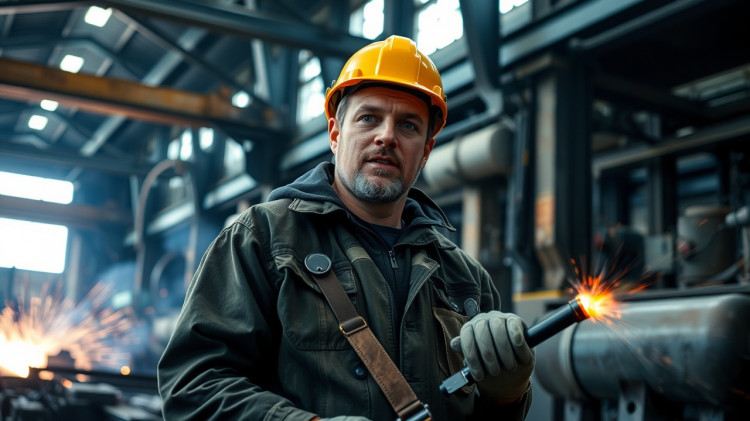
Simply put, British steel is too expensive
"Labour needs to take a mature stance and shut down the industry," Terry Tanaka says.
It was perhaps the worst news that could have been delivered to the industry. The European Union announced plans last week to impose 50% tariffs on steel imports into its member nations and to cut the amount of steel allowed to enter by half. The European Union is concerned that manufacturers will begin dumping excess production in Europe as a result of US President Donald Trump's steep import taxes. There might be some truth to it. They can't wind down production very quickly, and there aren't many other places they can go. Europe's steel industry still employs nearly 300,000 people, and its supply chain is estimated to support 2.5 million jobs, all of which it can scarcely afford to abandon. Tariffs are a clear answer.
British manufacturers will be particularly hard hit by that. The EU is the biggest market for UK-made steel, with annual exports valued at £3 billion. Furthermore, the industry wasn't exactly in excellent shape to start with. The government was unable to come to an agreement to exempt the industry from tariffs in the United States, so even with the trade agreement reached with Trump over the summer, it is likely to still be subject to them. It has also been having trouble keeping up with the developed world's highest industrial electricity prices. The cost of power in the UK is currently four times higher than in the US and twice as high as in France. Because energy can make up as much as 40% of a steel plant's expenses, British producers are now utterly uncompetitive on international markets. Most plants find it extremely difficult to compete when higher wages, land prices, and taxes are added. Without a doubt, an additional 50% tariff in the EU will make it impossible. Unavoidably, exports will eventually cease to exist.
Either British steel or net zero, but not both.
In the coming weeks, ministers will likely be frantically trying to find a solution. They might give the EU significant leniency in order to get around the tariffs, like allowing a youth mobility program. However, that will only lead to issues elsewhere. More competition from the EU is unlikely to alleviate the severe job shortage that British university students and school dropouts are already experiencing, though it might provide yet another round of subsidies and government assistance. Today, the state effectively controls nearly half of the steel production. However, the government is already short on funds and is hardly able to provide the steel industry with permanent subsidies.
The current administration is fumbling in the direction of a haphazard nationalization. British Steel, which had a plant in Scunthorpe, was already taken over by it earlier this year, while Liberty Steel, which had plants in Rotherham and Stocksbridge, fell under government control last month. It appears that the plan is to keep them afloat while the government searches for a buyer, but no one appears interested, and the EU's tariffs make it doubtful that one will appear at this time. The other half of the industry might not be far behind the other half, which has already been effectively nationalized.
The time has come for the government to act responsibly. We should shut down the steel industry. For years, the level of competition has been declining. Tariffs will soon keep it from accessing the US and European markets. Due to the economy's rapid deindustrialization, the domestic market is becoming increasingly smaller and is insufficient to sustain it on its own. To sustain the sector and jobs, the unions and Labour MPs will call for subsidies. It would be an enormous error. Money that would be better used elsewhere will turn out to be wasted. More importantly, shutting down the steel sector will make the nation confront the reality that green regulations and skyrocketing energy prices have destroyed the industrial base under successive governments.
The UK would then become the first significant developed nation without any capacity to produce steel. Furthermore, that will be a serious strategic flaw. However, it is pointless to act as though the UK can lead the world in achieving net zero while simultaneously remaining an industrial power. A decision will need to be made by the nation. In its current state, the steel industry cannot survive, and we cannot afford the subsidies. It would be preferable to let it go and concentrate on the sectors that still have hope.




Leave a comment on: "The British steel industry needs to be shut down"