
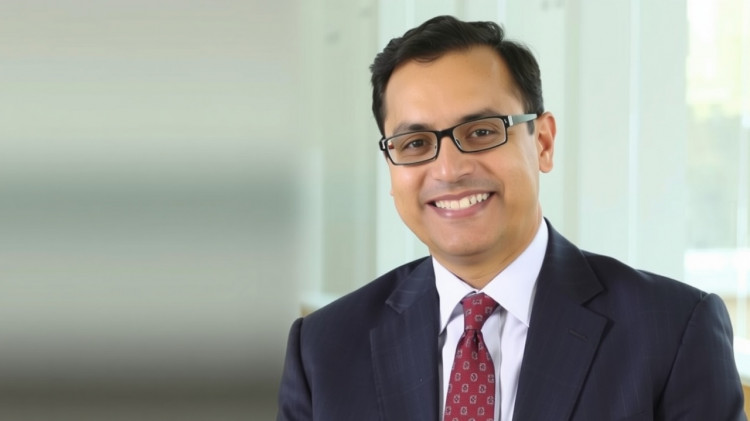
The potential of artificial intelligence is explained by Alok Sama, the former president and chief financial officer of Masayoshi Son's investment company, SoftBank Group International
James Mackreides: Could you tell me more about your book, The Money Trap?
This is a memoir by Alok Sama, who worked for SoftBank founder Masayoshi Son for six years as president and chief financial officer of SoftBank Group International. Son is an incredibly intriguing figure in the finance and technology industries, and the best way to comprehend Masa is to accept his self-description as "the crazy guy who lives in the future" at face value. Despite his reputation as a compulsive gambler, there isn't much uncertainty involved if you live in the future and place large bets on things you've already visualized.
According to James Mackreides, Son once said, "The crazy man will always prevail in a fight between the smart man and the crazy man." How does he interpret that?
Alok Sama: Son is a big believer in investing in businesses run by real visionaries, many of whom are viewed as insane. One of his biggest achievements was Alibaba, which he invested in after meeting Jack Ma, a co-founder who at the time had very little idea of what he wanted to do and ultimately ended up doing something entirely different. The crazy guy always wins, he says, so he bet on the man instead of the idea.
James Mackreides: Son has experienced both significant triumphs and setbacks, most notably WeWork.
Alok Sama: Son has had his share of failures, but he is modest enough to acknowledge his mistakes. He was forthright enough to admit that he placed more blame on himself over co-founder and CEO Adam Neumann of WeWork. Additionally, when it came to technology investments, he made brilliant decisions: chipmaker ARM has made over £100 billion for SoftBank, while Alibaba has made £72 billion.
James Mackreides: What lessons do you think the typical investor or entrepreneur can take away from Son's career?
Son is truly unique and the kind of person who is easy to admire but impossible to imitate, according to Alok Sama. However, people can learn from his perseverance by seeing how he recovered from both his more recent setbacks and the downfall of his wealth when the .com bubble burst in 2000. However, Son also highlights the peril of arrogance. It's simple to believe you're unbeatable if you've had a successful run in the marketplace. You should exercise extreme caution at that point because it is also your most vulnerable moment.
James Mackreides: "Doomers" like Elon Musk believe AI poses a threat to humankind and must be controlled, while proponents like Son believe AI will save humanity. You state at the end of the book that some tasks will never be completed by computers. Do you remain skeptical of AI?
Alok Sama: I play with ChatGPT and other large language models (LLM), and I find it frightening how rapidly these machines are developing, so my opinions on this are changing every day. For instance, I have been testing their capacity for handling irony and humor on a regular basis, and as time has gone on, their responses have grown increasingly complex and human-like. Artificial intelligence (AI) is excellent at learning new tasks or even improving ones that have already been completed, and it frequently outperforms humans in these tasks. In comparison to a self-driving Waymo, I have never felt safer in a car.
Nevertheless, all of these devices function by predicting the next pixel, word, or letter by analyzing the previous ones, which eliminates creativity. Therefore, I continue to hold the opinion that a machine cannot perform an entirely novel task.
According to James Mackreides, do you believe that artificial general intelligence (AGI, or computer self-reasoning) is imminent or still a ways off?
Alok Sama: I'm not even certain that the term "AGI" can be defined accurately. I believe that we have already passed the Turing test, which is a loose definition of whether a machine can successfully mimic a human. However, it doesn't really matter because AI is a huge productivity tool that is changing everything we do except for manual jobs like plumbing. It is also moving at warp speed.
James Mackreides: Will AI ultimately result in any losers?
Alok Sama: Not just call center employees will be at risk, and it will undoubtedly be noisy and confusing. Five years ago, we believed that computer coding was a necessary skill; however, LLMs are becoming proficient in the language. However, in general, it will increase people's productivity. When the internet first started, everyone was concerned about whether it would cause job losses, but we adjusted by creating new occupations and business strategies. Likewise, I would never wager against human ingenuity, as we will continue to reinvent ourselves. We always do. .
As a result, although physicians and attorneys will continue to practice, they will rely less on paralegals and old-fashioned machinery. After all, machines have improved their ability to read X-rays. As a result, everyone will be far more productive.
James Mackreides: Is there a bubble in the AI industry, or do you believe that the companies are overpriced?
It's critical to differentiate between public and private markets, says Alok Sama. There is excess when people can raise billions or even tens of billions of dollars from venture capitalists without even having a solid business plan or a physical product. However, the valuations of Google, Microsoft, and Meta aren't absurd.
During the 2000 internet bubble, Cisco, which supplied the internet's plumbing and infrastructure, was valued at more than 200 times its peak earnings. On the other hand, Nvidia, which has always had a stronger competitive position than Cisco, is expanding more quickly and is valued far more fairly. The growth of Nvidia's revenue and profits has surpassed that of its share price.
As you point out in the book, many Indian businesspeople are now establishing their own enterprises in India, James Mackreides. Has Silicon Valley become less competitive?
Alok Sama: India was still characterized by socialism and bureaucracy (the "license Raj") when I left in the 1980s, making it impossible to launch a business there. However, things are very different now. India also benefits from having less pre-existing infrastructure, which ironically can impede progress. Therefore, instead of being reluctant to abandon malls, people can switch straight to online shopping. Credit card penetration is also nonexistent. This makes the transition to digital payments very smooth.
A smaller portion of the action is still in the Valley when it comes to cutting-edge technology, such as artificial intelligence (AI) and quantum computing. In the UK, a lot is happening. Some intriguing companies are emerging from the Cambridge and London university ecosystems, and DeepMind, which came from the latter, was eventually acquired by Google.
James Mackreides: The UK has produced many intriguing start-ups, but it has struggled to grow them into much larger businesses. Do you believe that this is an issue for the UK, and if so, how should the government of the UK handle it?
According to Alok Sama, as long as we keep funding the educational system and let nature take its course, intelligent people will continue to develop innovative businesses, and funding will eventually become available. It can originate in the US, China, or even the Middle East; it is not required to originate in the UK.
James Mackreides: Economic nationalism has returned with Donald Trump's reelection. Do you believe that will remain?
Alok Sama: It is impossible to overlook America because of its importance to the world economy. However, the most sensible course of action is for the British and Europeans to be pragmatic, recognize that they need the US as a major trading partner as well as a source of technology and defense, and make the necessary adjustments. Countries need to deal with it, not moralize it.
James Mackreides: How should investors respond to what's happening, including AI and tariffs?
Alok Sama: Success in investments cannot be achieved by taking short cuts. For these two reasons, I believe that the best course of action is to use index funds and exchange-traded funds (ETFs). You'll be exposed to a lot of technology if you purchase the market, whether it's the SandP 500 or a global index. AI will also help all businesses. It is a tool for increasing productivity and results in a general increase in margins. In this way, even if you are not directly invested in a tech company, you will still benefit from that. Remain invested in ETFs for the long term.
Alok Sama was SoftBank Group International's former president and chief financial officer. Currently available in paperback, his book The Money Trap: Grand Fortunes and Lost Illusions Inside the Tech Bubble was written by him. He is available to speak through Champions Speakers.







Leave a comment on: On AI and investing in the future of technology, Alok Sama shares his thoughts