
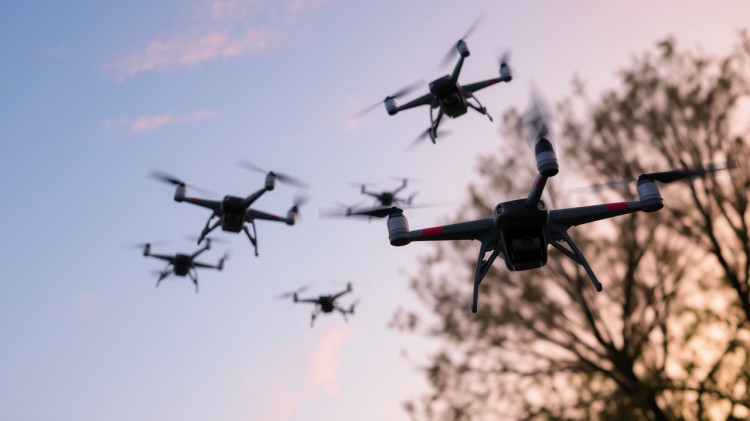
Drones, also known as unmanned aerial systems, are thought to be essential to both current and future warfare, and rising defense expenditures are expected to double demand
The sight of North Korean leader Kim Jong-un and Russian President Vladimir Putin flanking Chinese Premier Xi Jinping as he displayed his nation's military might, including a futuristic arsenal of laser weapons, nuclear missiles, and some of the newest developments in drone and defense technology, was one of the many spectacles of China's Victory Day Parade in Beijing on September 3.
AI-powered aerial drones that can fly alongside manned fighter jets, "robotic wolves"four-legged robots that can conduct reconnaissance, carry ammunition, and even launch precision strikesandperhaps most impressive of allthe AJX-002, a 60-foot unmanned submarine that can operate up to 20 meters underwater, were all examples of these cutting-edge technologies.
One strategist at Alpine Macro, Noah Ramos, claims that drone technology is transforming warfare and hastening a significant change in military doctrine. Drones that can fly, sail, or land are becoming more and more able to communicate and work together with their human operators and other drones. This causes the power dynamics in conflicts to change. Ukraine's use of drone technology has played a significant role in its survival against all odds after Russia's invasion in February 2022. Its military, which appears to be woefully underfunded and undermanned in comparison to Russia's, has largely succeeded in neutralizing Russia's highly advanced (and costly) war machines with a vast fleet of comparatively cheap drones, two-fifths of which are produced in Ukraine. In July, Oleksandr Kamyshin, the strategic affairs adviser to President Volodymyr Zelensky, told Bloomberg that Ukraine is "rethinking warfare" and that the country's weapons production is "Ukraines oil."
Loredana Muharremi, an aerospace and defense equity analyst at Morningstar, told BFIA that the war in Ukraine highlighted the need for "drone parity" in order for air defense to function at scale. As demonstrated by Ukraine, "drone innovation is fast, cheap, but also decisive in overpowering more traditional, complex, expensive, and slow systems." Drone manufacturers want to make the most versatile and economical drones, not necessarily the "best" one. According to her, the objective is to develop rapidly, manufacture at a low cost, and implement rapidly. We think that businesses that are able to accomplish that "can enjoy, lasting competitive advantages."
Drone technology trends.
Peter Fortune, the Member of Parliament for Bromley and Biggin Hill, stated during a House of Commons debate on the use of drones in warfare that "a £300,000 sea drone can destroy fighter jets worth £50 billion" on the same day that Xi Jinping displayed China's military might in front of the world. The armed forces minister, Alistair Carns, stated during the same debate that nations like China and Russia are already manufacturing drones on a large scale and investing in innovation to make them more lethal and capable of displacing humans from the battlefield. "War," he claimed, "is propelling an innovation cycle that is impossible to duplicate in normal times."
Recent developments in drone technology have been referred to by Carns as "a machine-gun moment for the army, a submarine moment for the navy, and a jet-engine moment for the air force." Drones, however, are not as novel as one might think. The British military tested unmanned aerial vehicles for training purposes during World War I, and in the 1930s, the country produced a number of unmanned aircraft.
The DH is one of these. The term "drone" is believed to have been inspired by the 82B Queen Bee. The Vietnam War saw the widespread use of reconnaissance drones, which have since been employed in a variety of military settings, such as as weapons, decoys, and leaflet drops. Carns informed Parliament that drones can use thermal imaging to find victims who are concealed in smoke, debris, or woods. They can also transport medical supplies to areas that are inaccessible, protecting human medical personnel from harm.
In summary, drones can be used for almost anything on the battlefield nowadays. According to Muharremi, they can offer a large number of platforms that confuse the enemy's defense systems and are inexpensive, making them expendable. They are capable of overpowering adversary radars and electronic defenses.
From science fiction books.
On the other end of the spectrum, some sophisticated drone variations look like they belong in science fiction. Despite the impressive Victory Day display, China is still lagging behind the United States, which continues to lead the world in drone technology. One example is the Manta Ray, a long-distance underwater drone developed by Northrop Grumman and the US Defense Advanced Research Projects Agency (Darpa). It can harvest energy from ocean thermal gradients and, if necessary, switch to a low-energy "hibernation" mode.
"Consider this as basically a surveillance vehicle that is outfitted with a whole suite of extremely high-tech sensors and has no range limitations," Ramos says. Additionally, the fact that it doesn't emit "heat signatures" makes it extremely difficult for adversary systems to detect.
In many ways, the most recent developments in drone technology are similar to those occurring in the civilian world. Automation, computer vision, and energy storage issues are as important to contemporary drone design as they are to the competition between Tesla and Alphabet's Waymo for self-driving cars. Ramos explains that light detection and ranging (LiDAR) sensors are frequently stacked on top of hyperspectral sensors in modern drones. This gives them a three-dimensional view of their destination and increases their effectiveness in "contested environments."
To reduce the possibility of a single point of failure, modern drones also use multiple power sources. This could be a traditional power source that runs on fossil fuels in addition to a battery. According to Ramos, "the system on board can continue to operate if one part goes down or is disabled electronically, through jamming."
The most important forces behind technological advancement, however, are automation and artificial intelligence. Despite being "unmanned" for the majority of their existence, drones have consistently been operated remotely by a human operator. Military drones are becoming more autonomous, much like civilian cars are becoming self-sufficient. The "next generation" drone, according to Ramos, is the autonomous unmanned aerial vehicle (UAV). Since remote sensors automatically optimize the spacing and distribution of drone members and make adjustments in the event that, for instance, some of the other drones within the swarm are destroyed, "swarms" of drones can already be operated by a single human operator.
Spending on defense.
Increased defense spending by governments worldwide is a major tailwind for the industry, and it is combining with the rapidly accelerating innovation in drone technology. The conflict in Ukraine and US President Donald Trump's demands that Europe pay more for its own defense have focused minds and opened up billions of euros in new spending commitments.
The same dynamics are occurring in other areas as well. The exchange-traded fund platform HANetf examined upcoming defense expenditures across the Indo-Pacific area after China's military demonstrate. An additional £600 billion is expected to be spent on defense by 2030, of which £44 billion will come from developed nations like Japan, South Korea, Australia, Singapore, and Taiwan, and £144 billion will come from rapidly expanding nations like the Philippines, Indonesia, and India. Another ETF platform, GlobalX, announced last year that by 2030, the amount spent on drones by the military worldwide would have doubled to about £45.2 billion.
"There is going to be a lot of spending across the board because there is a race going on for these future defense technologies," says Jane Edmondson, head of index product strategy at VettaFi. Among other things, VettaFi is an index provider that creates the EQM Future of Defense index.
The way to invest.
Like any defense technology, there are ethical issues to think about before purchasing drones. Although complicated questions are brought up, investors might want to make sure that the businesses they are funding share Western ideals. Every holding in the HANetf Future of Defence ETF (LSE:NATP), which tracks the VettaFis EQM Future of Defence index, is examined for alignment with NATO members or allies. The Global X Defence Tech ETF (LSE:ARMG) similarly excludes businesses from Saudi Arabia, China, India, Kuwait, Pakistan, and Russia (as well as any nations that aren't classified as developed or emerging markets).
Investors will have access to many of the biggest and most technologically advanced defense companies, which are usually at the forefront of drone innovation, thanks to funds like these. Through bolt-on acquisitions, several of these larger companies, including Rheinmetall (Frankfurt: RHM), Thales (Paris: HO), and Leonardo (Milan: LDO), have entered the drone industry. According to Muharemmi, "buying the companies that already have the capability to build drones is the fastest way to get into the market." "Speed is important right now," she says.




Leave a comment on: The invasion of drones