
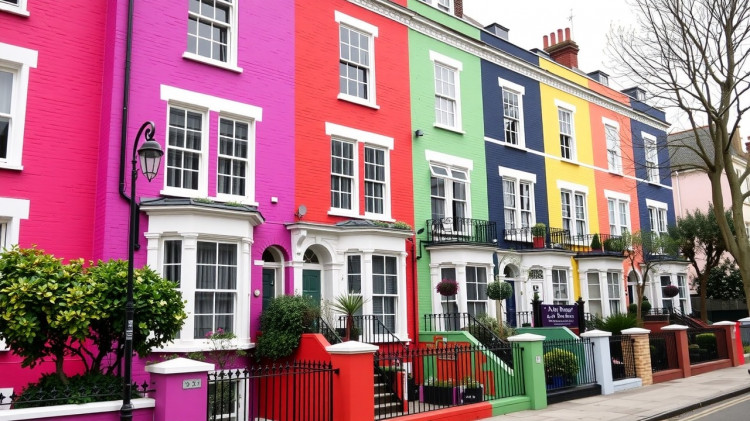
According to real estate analysts, buyer confidence declined for a second consecutive month in August, with many pointing to budget rumors as a contributing factor
Estate agents and surveyors have reported a decline in buyer demand and sales activity in August, further undermining confidence in the real estate market.
During the upcoming quarter, industry participants told the Royal Institute of Chartered Surveyors (RICS) that they anticipate sales to stay mostly unchanged, which will put pressure on home prices.
The RICS report asks a number of questions, such as "How have average prices changed over the past three months (down/same/up)" and produces net balance scores ranging from -100 to +100.
The percentage of respondents who report a decrease is subtracted from the percentage who report an increase. The net balance figure would be -25 percent if 5 percent reported an increase and 30 percent reported a decrease.
A net balance of 19 percent of respondents in August reported that house prices had decreased over the previous three months, indicating a decline in sentiment from the figure of 13 percent in July.
Perhaps this is not surprising, considering that the net balance score for new buyer inquiries dropped for the second time in a row, from -6 percent to -17 percent. The positive reading was +3 percent in June, just two months prior. Additionally, agreed sales dropped from -17 to -24 percent.
"There is a genuine sense that the market is cooling and unlikely to breathe signs of recovery until after the Budget," said Neil Foster, a chartered surveyor at Hadrian Property Partners in Northumberland, who responded to the survey. "Many selling agents are rolling out the annual excuse of the holiday season for sluggish activity," Foster said.
According to other respondents, there had been obstacles caused by media rumors regarding changes to the capital gains tax (CGT) and stamp duty. According to Stan Shaw, estate agency director at Mervyn Smith and Co., "buyers and potential vendors are generally cautious and hesitant." within London's South West.
Alleged property taxes.
Most people anticipate tax increases in the Autumn Budget as chancellor Rachel Reeves struggles with slow economic growth, high borrowing costs, and the consequences of unsuccessful spending cuts.
Property taxes have been the subject of much conjecture, with new taxes for landlords, a so-called mansion tax, and stamp duty reforms all allegedly being discussed.
One of the rumored stamp duty reforms would be to replace the current tax with an annual levy on properties valued at over 500,000, which would be paid at the time of sale. It appears that suggestions from the think tank Onward served as the impetus for the concept that was initially covered by The Guardian.
If main homes surpass a certain amount, Reeves is reportedly also thinking about eliminating the CGT exemption for them. It is being called a "mansion tax" by some. CGT is currently only applied to the sale of second homes.
The market may be ruined by discouraging people from relocating, according to critics, if the sellers are forced to bear the tax burden of stamp duty and a potential CGT bill.
"We need to make it easier and more appealing for those at the top of the market to think about downsizing if they are able to do so," stated Johan Svanstrom, CEO of Rightmoves.
"Unless they are in dire need of a smaller home and still have the funds to pay the stamp duty, there is no real reason for someone with a large house to downsize.
Prospects for home prices deteriorate.
In addition to other pressures like high borrowing costs and stretched affordability, the budget appears to be causing a temporary decline in confidence. According to RICS, a net balance of -20 percent of respondents anticipate a decline in home prices over the next three months.
This category's net balance score of +9 percent is the lowest since December 2023, despite the fact that modest growth is still anticipated over the next 12 months.
There is a noticeable north-south divide and substantial regional variation. During the previous three months, Northern Ireland was the strongest region, while East Anglia and the South West were the two weakest.
This follows the pattern found in HM Land Registry's official data. The most recent report, which covers the 12 months through June, was released on August 20.
During this time, Northern Ireland's annual house price growth was 53%, making it the second-best-performing UK country after Scotland (53%). Both numbers were much greater than the 3 percent national average.
In England, the North East grew at the fastest rate (7.8%), while London grew at the slowest rate (0.8%), according to HM Land Registry.
Even though things have gotten worse in recent months, most analysts predict that home prices will end the year higher. The slower rate of market activity following the stamp duty changes in April, along with geopolitical tensions and pre-Budget "jitters," has caused estate agency Savills to reduce its national forecast from 4% to 1%. Rightmove, meanwhile, has cut its forecast in half, from 4% to 2%.
As for regional growth, Savills predicts that Wales will end the year with the highest rate at 3%, followed by Scotland, the North West, and the West Midlands, all of which are expected to reach 2% to 5%.





Leave a comment on: RICS: As the Autumn Budget approaches, property market confidence continues to decline