
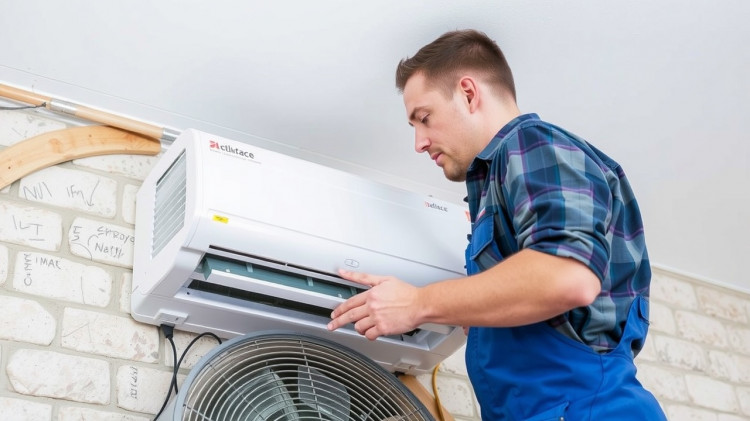
Installing air conditioning is one of the best ways to combat the heat in your house, but how much does it cost to install and maintain?
The UK doesn't exactly have a reputation for having sweltering summers; instead, most people think of the country as having rainy, overcast skies.
Unlike hotter countries like the US or Singapore, air conditioning isn't commonly found in homes in Britain because of the country's history of having a colder climate.
But as temperatures have increased over the past few decades, the British summer has gotten hotter. When a temperature of 40C was recorded in Lincolnshire in 2022, it was the hottest day on record in England.
Hot summer days are becoming the new normal, and many homeowners are facing the fact that some days are unbearable because our homes were not designed for such a hot climate.
Installing an air conditioning (AC) system in their home to keep the temperature lower is the solution for some people to deal with this issue.
We examine the cost of installing an air conditioning system, its energy consumption, and the feasibility of installing it in your house.
In the UK, how much does air conditioning installation cost?
While air conditioning is a common feature of commercial buildings in the UK, it is extremely uncommon for residential buildings.
According to a government report from 2021, less than 5% of homes in the UK have air conditioning. This is a remarkably low percentage when compared to nations like the US, where the World Economic Forum estimates that 90% of homes have air conditioning.
Property owners will almost certainly have to arrange for their own air conditioning installation because it is less common in Britain, but the good news is that prices are going down.
Checkatrade reports that the average cost of installing air conditioning has decreased by more than a fifth (21 percent) to about 2,850 from an average of 3,617 in the previous quarter, making it an even more appealing option.
In 2025, following the three heatwaves of the previous year, Checkatrade reports that demand for air conditioning has increased dramatically, although it is still comparatively uncommon. Between Q2 2024 and Q2 2025, they discovered that the demand for air conditioning rose by 23%.
The cost of installing air conditioning, however, will differ based on your home's condition.
"The size, type, and heating and cooling requirement of the property determine the cost of air conditioning," Hamid Salimi, residential product manager at Daikin UK, told BFIA.
When thinking about having a system installed, Salimi advised customers to "work with a qualified installer to discuss the best option for your budget."
You can use Daikin's online calculator to get a rough idea of how much installing air conditioning might cost you.
What is the cost of maintaining air conditioning?
Even though turning on your air conditioner on a sweltering day will surely make you feel more comfortable, there is a price associated with doing so.
In order to cool the warm air inside your house, most air conditioners run it over coils that are filled with refrigerant. While the extra heat is absorbed and expelled from the space, the now-cooler air is then redirected into your house.
Running your air conditioner cools the air inside, but it uses a significant amount of energy.
Salimi from Daikin told BFIA that "a number of factors, such as the size of the property and rooms, the location of the unit, and the type of heating and cooling requirements of the home, can impact the cost of air conditioning."
One method to calculate the cost of operating your air conditioner is to find out how much it costs and then multiply that figure by your energy tariff.
The current Ofgem energy price cap states that, from July to September 2025, the unit rate of electricity will cost 25.73p per kWh.
Using the example of a 2kW wall-mounted air conditioner, we can calculate that its operating costs will be approximately 51p per hour.
The aforementioned example is only meant to serve as an example; your unique situation will probably be different.
In a separate post, we examine 14 strategies to reduce your energy bill for more comprehensive cost-cutting tips.
Is it possible to put air conditioning in an old house?
It's likely that you can install air conditioning in your house, even if it's old.
Although air conditioning can be installed in practically any home, Salimi notes that "some considerations that may need to be addressed, particularly regarding insulation" come into play.
Your home must be well-insulated to keep as much heat from escaping as possible, he told BFIA, if you want your air conditioner to operate effectively.
"You can get advice from a heating engineer who is qualified on what needs to be done in your house to make it suitable for a heat pump system. This could entail improving the insulation of your roof and walls," Daikin continues.
Will adding air conditioning raise my house's value?
An increasing number of homebuyers are seeking air conditioning as hot summers become more frequent in Britain.
Air conditioning can increase a home's value by approximately 4,925 if it is sold during the summer, according to research by Checkatrade and Zoopla. This is significantly more than the 2,850 it typically costs to install.
Given the UK's increasingly hot summers, Checkatrade says this data indicates that installing air conditioning could be a wise investment for property owners.
Is a fully installed air conditioner superior to a portable one?
There are two primary types of domestic air conditioners: portable and fully installed.
The type of air conditioners that you will probably be most familiar with are fully installed ones, which are found in homes and hotels worldwide. They are not readily movable and are fitted and installed inside the house.
A fully installed air conditioning system has the advantages of being quieter, better cooling for larger areas, and less expensive to operate over time.
Fully installed units, however, need professional maintenance, are expensive up front, and are difficult to move or replace.
In the meantime, portable air conditioners are exactly what their name suggests. They function similarly to fully installed units, but they are portable and don't require storage.
The benefits of owning a portable air conditioner include its low cost, ability to cool smaller areas, and lack of permanent installation.
The drawbacks include the fact that they can be rather noisy, have trouble serving large areas, and are generally more costly to operate over time.
That "homeowners must make decisions based on their own needs" is what Salimi at Daikin told BFIA.
He continued, saying: "While fitted air conditioning gives homeowners a longer-term solution to help future-proof the temperature of their homes, heating and cooling their properties regardless of the weather, portable air conditioning only provides cooling.
A fitted system "allows you to control the climate room-by-room, helping maintain the perfect temperature whatever the season, offering a longer-term cooling and heating solution for year-round comfort," according to Salimi.
"With a portable air conditioner, which is only used for cooling, this is not possible," he continued.





Leave a comment on: What is the cost of air conditioning in the UK?