
James Mackreides says it is very hard to make money in farming, despite the allure of a rural paradise
The imposition of inheritance tax (IHT) by the government on farms has brought to light an unsettling reality: farming returns in the UK are typically low. Farmers are therefore left without the ability to save enough money to pay a recurring capital tax and dependent on capital appreciation for a respectable return.
IHT will lower land prices and enable aspiring farmers to purchase land, according to the government, which claims that land values have been inflated by the wealthy purchasing farms as part of their IHT planning. Surprisingly, though, a lot of affluent individuals, like Jeremy Clarkson, were first drawn to farming because of its tax benefits before becoming addicted.
"Happy the man who far from city care, with his own oxen ploughs his father's land" is Horace's romanticized invocation of post-retirement farming. He explains the classic allure of being a gentleman farmer for wealthy people who are free from taxes and regulations. In actuality, things are different.
IHT will not increase revenue or decrease land prices. By converting their farms into partnerships or by selling them more than seven years before they pass away, farmers can avoid it. Making themselves the managing partner allows them to keep control of the farm while distributing partnership shares to family members, increasing the farm's threshold value at which taxes are due.
Farming costs are higher than prices.
Scottish fund manager Ian Ivory, who is now a farmer, concentrates on his return on investment. He contends that land, which is largely viewed as an inflation hedge (its value has increased by an average of 22 times since 1971), ought to be contrasted with a 10-year index-linked gilt, which yields 1.25 percent. Regardless of whether the farmhouses or cottages are for vacation rentals or rental income, residential properties should have a cash yield of 5%. The return from equipment and livestock must be 7%. "Most farms barely make 10 percent, but we need to have a pre-tax profit margin of 20 percent to reach those targets," he says.
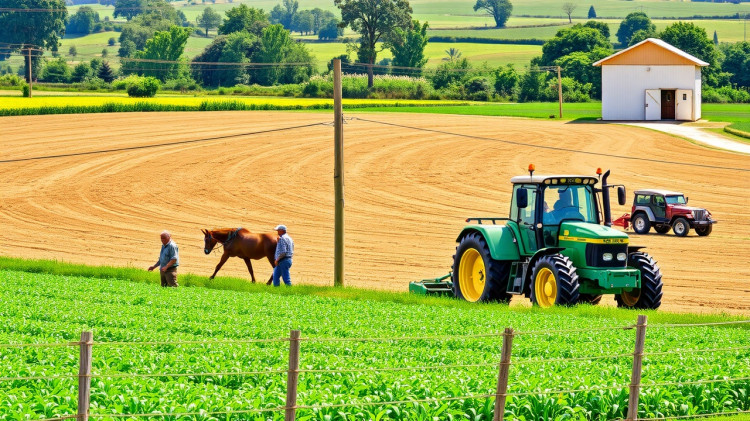
The issue is that prices have not increased in line with expenses. Wheat now sells for 180 per tonne, a sixfold increase from its 1971 price of 28. But because wages have increased 45-fold, it has become necessary to increase automation in order to remain profitable. Our labor expenses now account for less than 10% of our sales and subsidies. Prices for agriculture have significantly lagged behind costs. 165 lambs were required to purchase a stock tractor in 1970; today, 865 lambs are required. To purchase an arable tractor, fifty tonnes of grain were required; today, 600 tonnes are required.
Globally, agricultural productivity has risen quickly, but nowhere more so than in the former Soviet Union. During collectivization in the late 1980s, the USSR as a whole was importing 30 million tonnes of grain annually. Currently, Russia exports 50 million, whereas Ukraine exported 60 million prior to the Russian invasion. Reduced prices for meat will have resulted from the glut being exacerbated by Eastern Europe. Ivory claims that while grain prices have decreased over the past year, beef prices in the UK have increased by 60%.
Success stories in farming are scarce.
In addition to price volatility and declines, farmers in the UK face difficulties competing internationally. According to Ivory, sheep in the UK sell for six pounds at a loss, but in New Zealand, they sell for three pounds at a profit. Unavoidably, farmers who are unable to adjust or carry on farming the way their families have always done will struggle. There may be a solution through innovation and adaptation. Whether it's a restaurant, a farm store, or a different crop like growing willow trees, whose wood is highly valued in the production of cricket bats, Clarksons Farm continues to be enthusiastic about new ideas. Others may have the same idea, though, and the price may have fallen by the time the wood is ready to be harvested in 15 years.
By growing English strawberries above ground in enormous greenhouses that are heated by an anaerobic digester nearby and powered by renewable electricity, James Dyson, owner of the biggest farming company in the UK, has extended the growing season. He supports the use of technology to increase output. However, few farmers can afford the necessary capital outlay. Diversification is restricted for many farmers by land, geography, and resources. The supermarkets' strict prices may be avoided with the help of farmers markets; costs should be decreased by sharing resources with neighbors; and there may be opportunities to transform commodity agricultural output into a branded product. However, we should not be blinded by the success of a select few and ignore the hardships of the majority.
Incentive for sustainable farming.
In the previous parliament, farmer subsidies totaled £2.04 billion annually; however, they are currently being phased out. Politicians and environmental bureaucrats accompany them, and they view farming with, at best, contempt. Given that the government is more knowledgeable about environmentally sustainable farming than farmers are, it is no surprise that many farmers are drawn to the Sustainable Farming Incentive, which is jargon for paying farmers not to farm. Farmers can always convert their land to solar panels as a last resort, though many are worried that the incentives won't last.
It is amazing that around 60% of the food consumed in this highly populated nation is produced. Furthermore, food, drink, and feed exports are worth almost half as much as imports. Despite occupying 70% of the UK's land area, only 447,000 people, or 14% of the workforce, are employed in agriculture. Although employment has decreased by 6% over the past 20 years, the UK's market towns have declined, which is a result of both higher farming productivity and lower incomes and a quicker decline in related businesses. Horaces rural idyll and high farm values paint a false picture of farming, which is now a highly skilled, capital-intensive profession that requires constant innovation, long hours, fluctuating prices, and never-ending bureaucracy. This business isn't for the weak of heart.




Leave a comment on: There are no profits to harvest, so farming isn't for the weak of heart